
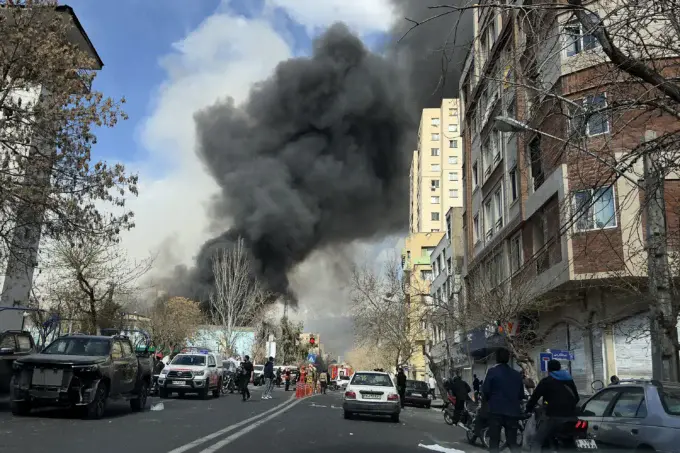
Residents in Tehran on the third day of US-Israeli airstrikes, March 3, 2026. Photo: Avash Media. CC BY 4.0.
The February 2026 Iran war cannot be understood as an isolated event; but rather the outcome of over four decades of coordinated American and Israeli efforts to contain and topple the Islamic Republic. Similarly, Iran’s ability to withstand the military onslaught and emerge victorious must also be situated within that historical context.
After weeks of U.S-Israeli bombardment, Iran has shown not only that it has been able to withstand an assault by the world’s strongest militaries, but that it could successfully exact substantial military, geopolitical and economic costs on its adversaries. Despite suffering significant damage, and the martyrdom of senior military commanders, including Supreme Leader Ayatollah Ali Khamenei, the state survived.
Tehran’s ability to maintain institutional continuity and operational resilience despite intense pressures could ultimately reshape the geopolitical landscape of West Asia.
Using asymmetric tactics and threatening global energy chokepoints, Iran forced a diplomatic standoff with Washington, which led to the signing on 17 June of the Islamabad memorandum of understanding, establishing an immediate cessation of hostilities across all fronts, including Lebanon. The document also launched the first round of negotiations on 21 June towards securing a final agreement.
It is reasonable to conclude that a secular government or monarchy, like that of the former Shah, would likely have yielded to military duress. Ending the conflict on Iran’s terms, however, required a defiant government driven by an ideological mandate of resistance to oppressors and oppression. Even fierce government critics concede that the Islamic Republic successfully preserved the country’s sovereignty and territorial integrity, and handed the U.S. and Israel an unprecedented defeat.
By recognizing the centrality of the ancient, deeply-rooted cultural concept of Iranzamin (the Land of Iran), that views defense of the physical and sovereign integrity of the historical homeland a sacred trust and government duty, we can better understand the Islamic Republic and the people’s response to the U.S.-Israeli unprovoked wars.
How well, over its 5,000-year history, Iranian monarchs fulfilled this sacred trust is the epic story of military triumphs and devastating territorial amputations. The 19th and 20th centuries, among the lowest points in Iran’s dynastic history, can be described as “centuries of amputation.”
For example, during the 19th century Qajar dynasty, Iran lost vast territories to Russia and Britain; in what came to be known as the “Great Game”—the competition for power between two competing empires.
Through war and subsequent treaties, Iran was permanently stripped of its South Caucasus territories (Georgia, Dagestan and Azerbaijan) in the Treaty of Golestan (1813). Today in Iran, the Treaty of Turkmenchay (1828) which required Iran to give up modern-day Armenia, remains a cultural wound, synonymous with national humiliation.
In addition, in 1857, under Qajar Shah Naser al-Din, Iran was forced by the British to give up its historical claims to the strategic Afghan city of Herat, permanently severing Western Afghanistan from Iran. And in the Treaty of Akhai (1881), Russia dictated that Iran relinquish all historic claims to Turkmenistan and parts of Uzbekistan. Due to the heedlessness of another Shah, Iran was compromised once again when Anglo-Soviet forces invaded and occupied the country during World War II.
The Pahlavi dynasty (1925-1979), founded by Reza Shah, was the last monarchy to rule Iran. His son, Mohammad Reza Pahlavi, like his predecessors, proved incapable of defending the country from Western encroachment. That, as well as his fealty to a foreign power, led to his downfall in 1979.
To gain insight into present-day Iran, it is important to recognize that the 1979 Islamic Revolution and radicalization that followed is also rooted in the legacy of Prime Minister Mohammad Mossadegh, and in the memory of the American CIA-backed coup that overthrew his democratic government in 1953. It can also be traced to the oppressive 26-year reign of Shah Mohammad Reza Pahlavi (1941-1979), who subcontracted Iranian interests to the United States.
Understanding Mossadegh’s actions, ideals and meaning to generations of Iranians is essential in apprehending how the 1953 coup set Iran on a path that culminated in the 1979 Revolution and the creation of the staunch anti-imperialism of the Islamic Republic.
Mossadegh, an ardent constitutionalist and democratic reformer, viewed oil nationalization as an economic necessity, but also as the ultimate declaration of independence to free Iran from decades of foreign colonial exploitation. His policy resonated deeply with a public eager for self-determination.
Decades of British monopolization of Iran’s oil wealth was shattered in 1951, when Mosaddegh nationalized the oil industry. His fierce defense of Iran’s right to its own resources made him a target of Washington and London.
Conversely, the Shah, yielding to American and British pressure, lent his support to their covert conspiracy. When the initial coup attempt failed, the fearful Shah fled the country, returning to reclaim the throne only after a second, successful putsch—code name “Operation Ajax”—toppled Mossadegh.
The resurrected Shah, aligned once again with the West, oversaw the surrender of Iran’s oil autonomy, signing an agreement in 1954 that transferred significant extraction and development rights to a consortium of Western multinational corporations.
Following in the footsteps of his disgraced father, the eldest son of the fallen Shah, Reza Pahlavi—who recently proclaimed himself “Reza Shah II”—made a pilgrimage to Israel in 2023 to appease his Zionist backers—a visit arranged by the Israeli regime. Once there, he shamelessly prostrated himself before the Western Wall in Jerusalem and sipped tea with genocider, Benjamin Netanyahu; the war criminal who would later bomb the land of his birth and kill 3,468 of the people Pahlavi claims to speak for.
By bowing before the Western Wall, the wannabe king performed an act of submission to Israel and the United States. This gesture echoed the deeply internalized colonized mindset and belief in Western superiority that defined his father’s rule and era.
Under monarchical rule, Iran’s autonomy was routinely compromised by foreign powers. Claiming true independence required a radical decisive severance to purge the nation from external control; but also to free it from its deeply entrenched pro-Western subservient mindset.
Although kings and dynasties have risen and fallen throughout history, the ancient concept of Iranzamin has consistently prevailed, ultimately serving as an ideological foundation for the modern Islamic government of Iran.
The political-religious framework of the Islamic Republic has institutionalized a distinct ideology of resistance. Iran’s defensive strength relies on this foundational ideology, that has framed enmity toward global arrogance and national survival into an existential religious imperative.
This strategic theo-political integration has provided the resilience needed to survive foreign hostilities, maintain self-reliance, and repel the combined aggression of the U.S. and its Zionist proxy.
For Iran, the coordinated U.S.-Israel bombing campaign (Operation Epic Fury), is a national trauma that will never be forgotten. Its sheer magnitude—measured in thousands of casualties, widespread infrastructural damage, and the assassination of a sovereign head of state—surpassed the tragedy of 9-11 many times over in destruction and lasting political fallout.
For the Islamic Republic, the war was a watershed moment, testing its ability to fulfill the Iranzaminmandate to safeguard national security, repel external threats and preserve territorial integrity. Despite severe degradation to its conventional military and leadership, Tehran achieved major diplomatic concessions through its strategic use of the Strait of Hormuz blockade.
The U.S. military intervention against Iran, initiated to achieve “regime” change and break apart the Iranian nation, on behalf of Israel, backfired. Rather than collapsing the government, Washington has been forced to capitulate and make significant concessions to Tehran, including an end to the U.S. naval blockade of the strait, sanctions relief, release of billions of dollars of frozen Iranian assets, and pledges for economic reconstruction.
In addition, while struggling for the past 47 years to protect its own sovereignty, the Islamic Republic has not faltered in its commitment to the Palestinian cause, continuously championing their right to self-determination and statehood.
For them, the liberation of Palestine and their own resistance against Western domination are inseparable.
Tehran and its allies understand that Palestine symbolizes liberation and autonomy for the entire region. Breaking the spirit of Palestine—the long-standing aim of Israel and the U.S.—would remove the major obstacle to their ambitions to establish hegemony across West Asia.
Having faced brutal military offensives, Iran has an existential obligation and absolute right to maintain a robust modernized defense to deter further destruction and to protect its citizens against U.S and Israeli aggression.
The war has demonstrated the Islamic Republic’s capacity to adapt strategy to confront and resist overwhelming military force and reassert its position as a regional power. Iran has sent a forceful message to the bullies: the era of strong-arming, coercion and intimidation is over.
The post The Defiant Republic: The Ideological Imperative of a Strong Iran appeared first on CounterPunch.org.
This content originally appeared on CounterPunch.org and was authored by M. Reza Behnam.