
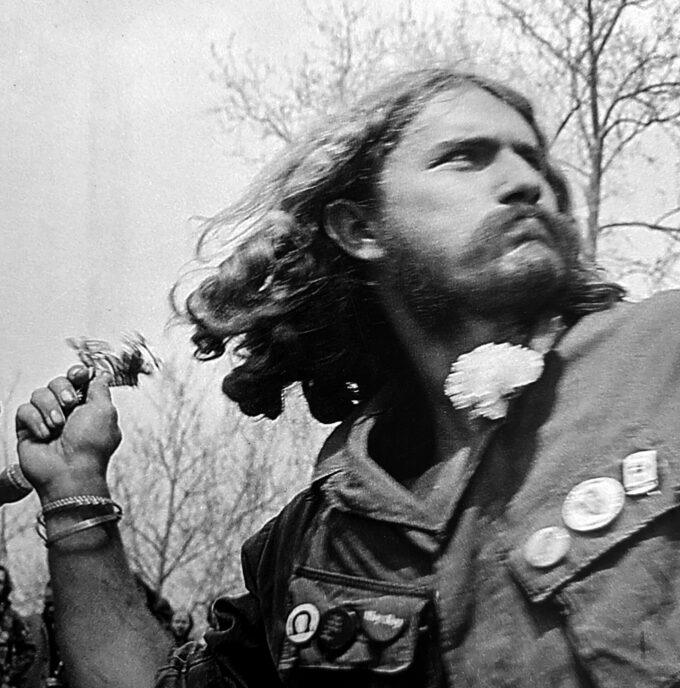
A Vietnam War veteran throwing his medal at the US Capitol. Source: Vietnam Veterans Against the War. Public Domain.
“Reading Dangerous, Dirty, Violent, and Young, what struck me most was what utter pussies we all were.”
– Emmett Rensin in the LA Review of Books
Around the start of the millennium, I visited Mark Rudd, who was living in New Mexico with his wife, Marla, and organizing workers into a union. He was also finishing his autobiography, which he was calling “Che and Me,” a cheeky title for sure that would be changed to Underground: My Life with SDS and the Weathermen. For most of the 1970s, Mark was a fugitive, though not a member of the Weather Underground. Racked by a sense of guilt when three of his comrades – Teddy Gold, Diana Oughton and Terry Robbins— blew themselves up, he distanced himself from the Weather Underground’s “central committee” that included Bernardine Dohrn, Jeff Jones and Bill Ayers.
He survived mostly as a solitary operative, though he had his own support network that helped to keep him safe. In much of the world, his fans and followers thought of him as a principal figure in the annals of the Weather Underground. Mark showed me dozens of emails on his computer that lauded him for his work with Bill Ayers and Bernardine Dohn, who he insisted would soon be forgotten figures on the left. That’s what he wanted. That didn’t happen.
As it turns out, Dohrn and Ayers are almost as well known now as they were in 1969 when they went on a rampage in the streets of Chicago, trashing windows and cars in an action that Yippie Abbie Hoffman dubbed “the Days of Rage.”Abbie wasn’t a Weatherman, but he definitely liked the idea of rage in the streets and wanted to be inducted into the organization. He never was. Didn’t have the necessary skills to be a successful fugitive.
Bernardine and Bill are well known now because they’re still alive, still loyal to their comrades and still endorsing revolutionary anti-imperialism, as good a cause as any for white kids at war with racist cops. They are also well-known because of the movie, One Battle After Another, and because of a new book by their elder son Zayd – named after a member of the Black Panther Party – which has been widely reviewed in the New York Times, the LA Review of Books and elsewhere including CounterPunch.
Zayd is a nimble writer who has “negative capability,” which the poet John Keats defined as the ability to hold contradictory ideas in one’s head without seeking a resolution. Zayd approves and disapproves of the actions of his parents. He loves them and at the same time thinks that they were insane to do what they did – plant bombs in buildings like the US Capitol and the Headquarters of ITT. Zayd’s book is an important document necessary for an analysis and an understanding of the long 1960s, the era that began in 1955, with the Montgomery, Alabama bus boycott, and that ended twenty years later in 1975 when the  Vietnam War came to a conclusion.
In most of the reviews I’ve read, the reviewers state their credentials as former members of the New Left, the antiwar movement and SDS. For the most part, they still have resentments and carry grudges against Weatherman and the Weather Underground and blame Bill and Bernardine and their comrades for destroying SDS.
I prefer Hunter S. Thompson’s view that internal contradictions were what destroyed SDS. Radicals dedicated to organizing the white working class could not coexist with those who idealized the Black Liberation movement and the hippie/ freaks in Yippie and the Youth International Party – and vice-versa.
The review to which I most strongly object was published in the LA Review of Books. The author Emmett Rensin writes that “what utter pussies we all were.” I took that comment personally. Excuse me, but I don’t care for the word “pussies “which can mean “vagina,” the female sexual organ, or a man who is cowardly and thus by inference like a woman. Didn’t words like pussy and pussies go out of style along with cunt and bitch?
I thought so. Looking back at the Sixties and Seventies, I don’t think that I was a “pussy” or that my comrades were somehow or other cowardly. We marched, protested, burned draft cards, sat in and sat down, stood up for human rights and civil liberties, firebombed ROTC offices, battled cops and went to jail, refused military service, fled to Canada and elsewhere, made bombs with sticks of dynamite and blew shit up, created chaos where chaos was necessary, confronted patriarchy and patriarchal institutions, wrote for and published underground newspaper, joined and endorsed gay liberation, and defied violence from Klans men and their kin.
I regret not doing more, but I did all I thought I could do. I was arrested, beaten and tortured, lost my job and was blacklisted. I don’t feel guilty about what I did or didn’t do, but I regret having harbored resentments toward former and current comrades for something they did and said decades ago.
When Zayd read from Dangerous, Dirty, Violent, and Young: A Fugitive Family in the Revolutionary Underground at Booksmith in San Francisco, I told him I wanted to let go of my resentments. If readers take anything away from his book, it ought to be that they not continue to fight ancient ideological battles and rather make peace with themselves and forgive themselves and those who once offended them or crossed them.
When I was with the Weather Underground in the 1970s, I wasn’t sure if what I was doing was the right thing or if I was making a grievous error. I shared my doubts with Doris Lessing and Clancy Sigal, both of them former Communist Party members and neither of them especially sympathetic to the New Left or the counterculture and both of them foes of terrorism. But they both admired the members of the Weather Underground and argued that they had written a new and singularly important chapter in the history of the American left. Keep their comments in mind please and remember, too, that in 1970 when I asked Jean Genet about Weatherman he said in French, “The US has very big bombs. The Weathermen have very small ones.” After all these years, a sense of proportion still matters.
The post I Am Not a “Pussy” and Never Was appeared first on CounterPunch.org.
This content originally appeared on CounterPunch.org and was authored by Jonah Raskin.