
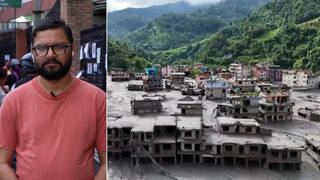
We get a report from Nepal, where at least 547 people are confirmed to have died and over 1,500 are still missing after a glacial collapse on Wednesday sent a wall of ice, mud and rock into a Himalayan river, triggering catastrophic flooding in the Nepal-Tibet border region that swept away entire communities. Nepali authorities say they have rescued more than 3,700 people so far. Geologists say the flash floods were set off by a landslide and glacial avalanche so powerful it set off its own seismic signal. Climate scientists warn the region is warming much faster than the global average, leading to the rapid retreat of glaciers.
“Scientists and civil society have been warning about the very fact that these kind of events might happen in the Himalayas,” says Sunil Acharya, a climate and public policy specialist reporting from Kathmandu, Nepal. “This is the result of the delayed global action to deal with climate change.”
“The number of people being killed, the number of properties being damaged has been way beyond what we can adapt to,” says Acharya. The floods have “[washed] away hundreds of villages, a huge number of bridges and road infrastructure and also hydropower stations.”
This content originally appeared on Democracy Now! and was authored by Democracy Now!.