
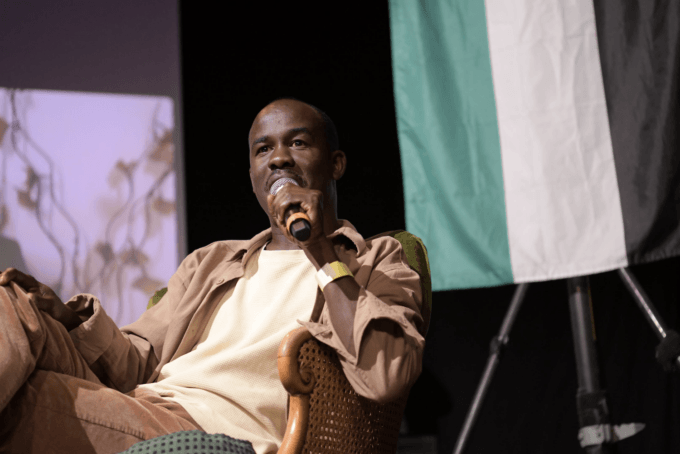
Hamad Ganale, photo by Nelson Pereira.
As the UN warns of the imminent threat of another large-scale massacre in Sudan, activists from the Sudanese democratic movement in exile denounce a war launched to end the popular revolution that began in December 2018. They argue that the war is supported by foreign powers eager to control the country’s resources and not interested in enabling a democratic transition in Sudan.
“War was the last resort chosen to crush the revolution, after several attempts to manipulate the revolutionary movement failed,” says Hamad Gamal, a Sudanese activist exiled in France.
The popular protests succeeded in overthrowing dictator Omar al-Bashir in April 2019. The army, however, remained in power, initially forming alliances with civilian parties, but ultimately regaining total control through a military coup on October 25, 2021.
“By choosing to sign an agreement with the counter-revolutionary military forces rather than pursuing the revolution to its conclusion, the Forces of Freedom and Change bear direct political responsibility,” Hamad emphasizes. “The military coup and the current war are the culmination of this flawed trajectory.”
For the Sudanese activist, the agreement reached by the military with the Forces of Freedom and Change was nothing more than a strategy to hijack the revolution. “It was at this point that we saw the first attempt to confiscate the revolutionary mobilization.”
However, the democratic forces understood that this was a move against the revolution and against the revolutionaries and did not abandon their demand for a democratic transition. A sit-in was organized in front of the army headquarters in Khartoum. But on June 3, 2019, soldiers and militiamen violently dispersed the protesters, killing more than 130 people.
“At that point, the revolutionary force agreed to sign an agreement with the army. But while the activists saw this agreement as a transition to a phase of stability, the army saw it as a new opportunity to hijack the revolutionary movement,” explains Hamad.
Determined to thwart the objectives of the democratic front and thus undermine the credibility of a civilian solution, the army realized that, despite the obstacles, civilians were achieving more or less significant results on the ground. The military then decided to stage a coup on October 25, 2021, seizing total power. “This coup triggered a second phase of mobilization. People once again took to the streets en masse to protest the coup, but also to continue the revolutionary work. This time, however, with much more radicalism, with much more determination,” underlines the Sudanese activist.
“After the failure of all attempts to discourage popular mobilization, from hijacking to obstruction and even the coup itself, the military understood that the people remained determined to resist, despite the repression, and decided to subject Sudanese civil society to the horror, to the extreme experience of war,” details Hamad Gamal. “Putting a country to fire and blood is the most effective way to stop a revolutionary mobilization.”
On April 15, 2023, war broke out between the Sudanese Armed Forces and the Rapid Support Forces (RSF), one of the militias created in the 2000s by Omar al-Bashir to suppress local rebellions, even though an agreement to integrate this paramilitary group into the army was expected. The war shattered the hopes of a civil and democratic revolution and forced many activists involved in the revolution into exile.
For Hamad Gamal, this is primarily a counter-revolutionary war, waged by two armed structures created by the dictator al-Bashir: the army and the RSF paramilitaries. It is also a proxy war, since each side in this conflict is supported by foreign powers eager to control the country’s natural resources and strategic position.
While the Sudanese army receives both military and diplomatic assistance from Turkey, the United Arab Emirates (UAE) is accused of providing military support to the RFS paramilitary militias, notably through mercenary forces. This support is linked to the UAE’s interest in controlling the Sudanese gold trade, as Dubai is a hub for gold illegally mined by the Rapid Support Forces.
Since the beginning of the conflict, the Sudanese Armed Forces and the RSF have committed numerous human rights violations, including deliberate attacks against civilians. According to the United Nations, the war has killed tens of thousands of people and displaced more than 12 million, including nearly one million in Chad. More than 30 million people are in need of humanitarian aid, and extreme famine is affecting the Darfur and Kordofan regions.
As the city of El-Obeid, the capital of North Kordofan state, has been besieged by the RSF paramilitaries for several months and violence continues to escalate, the UN High Commissioner for Human Rights, Volker Türk, issued a “red alert” on July 3, describing it as “a new human rights catastrophe” in Sudan.
El-Obeid, a city of half a million inhabitants, hosts approximately 100,000 refugees displaced by violence elsewhere in the country.
Mukesh Kapila, former UN Humanitarian Coordinator for Sudan, warned that the dramatic situation in El-Obeid could have an even more serious outcome than what unfolded in El-Fasher in 2024-2025.
El-Fasher was besieged for over a year and a half by the Rapid Support Forces before falling under their control. Civil society organizations had been warning for months about the famine gripping the city and the mortal danger faced by its inhabitants, but their pleas went unheeded by the international media. In December 2025, a whistleblower revealed that warnings about a possible “genocide” in El-Fasher had been removed from a risk assessment conducted by the British Foreign Office to protect the UAE.
The RSF militia’s capture of the city in October 2025 was accompanied by mass killings of the inhabitants, among the worst atrocities committed since the start of the war. It is estimated that over 60,000 people were killed in just a few days.
“The Sudanese people fought for universal values and suffered violent repression and a war ignored by the international community due to commercial interests involving many countries,” Hamad emphasizes. “The companies whose governments participate in this neocolonial system now have a duty of solidarity towards Sudan,” the Sudanese activist concludes.
Hamad Gamal is a Sudanese activist exiled in France, Hamad Gamal is the co-founder of Sudfa Media, a Franco-Sudanese media platform created in the context of the revolutionary mobilization in Sudan. He co-directed, with Sarah Bachellerie, the documentary film “Jusqu’au bout!” which shows the efforts of Sudanese exiles to keep the revolution alive from exile.
The post Hamad Gamal: The War Was Started to Crush the Sudanese Revolution appeared first on CounterPunch.org.
This content originally appeared on CounterPunch.org and was authored by Nelson Pereira.