
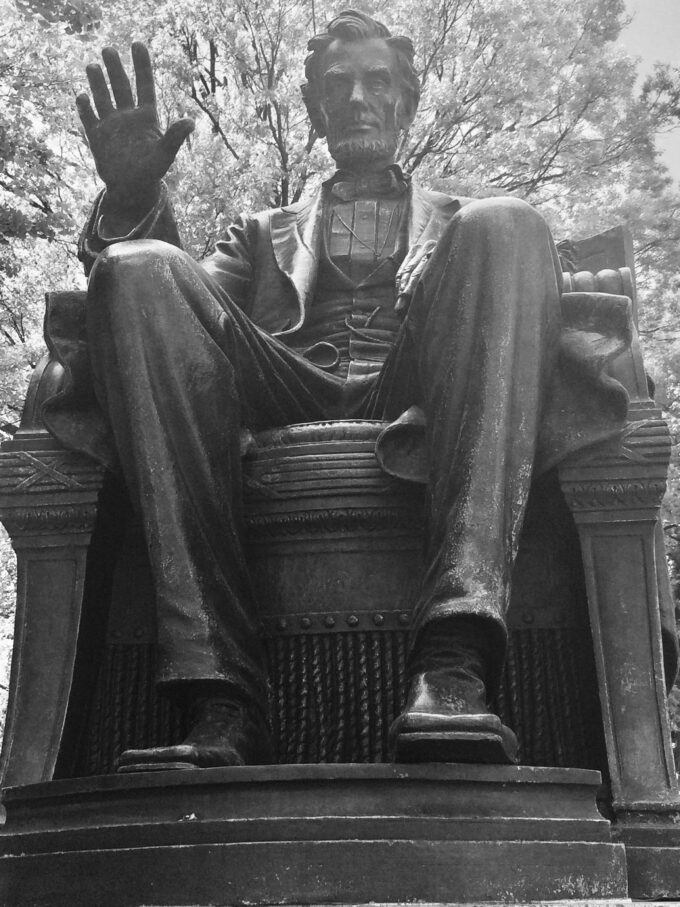
Statue of Lincoln, Indianapolis. Photo: Jeffrey St. Clair.
A half score and one year ago, the white marble eyes of Abraham Lincoln gazed eastward across the Lincoln Memorial Reflecting Pool, overlooking the collateral damage caused to the pool by the heavy construction of the World War II Memorial.
Skies roiled over Washington, DC, during June 2015, one of the wettest Junes on record to date, with thunderstorms, street flooding, hail, tornadoes, and winds that toppled trees. Weathermen forecast which way the wind would blow from the remnants of Tropical Storm Bill, now moving up from Guatemala.
Meanwhile, a six-day heat wave was cresting on the afternoon of the 16th, the hottest day of the year to date, during the sixth consecutive year that June temperatures trended above normal. Even the Washington Post reported blazing sun at high noon.
Abe’s eyes looked straight through the curved thickness of the WWII Memorial’s Freedom Wall to the side where 4,048 gold-plated stars commemorated American casualties. His eyes then traced with studied regard the elliptical path of the bronze Rope of Unity that bound together 56 pillars representing each of the states and territories that had joined the fight, together.
Sunlight splashed colors from the twin fountains of the Rainbow Pool. Lincoln recalled how the rainbows looked before the waterworks were split apart and surrounded by pillars with their glints of grey that glanced back at him from Kershaw granite, hewn and hauled in from the South Carolina underground. He kept his mind on the math. Add 400,000 American casualties of World War II to 600,000 casualties of the Civil War, and you get a cost of one million American souls.
Lincoln’s republican soul uplifted itself to the memory of Cato’s final hour as dramatized on stage by Addison’s famous play. The ancient senator, with book and sword in hand, drew inspiration from Plato’s reasoning as he turned the sword on himself rather than surrender to Caesar’s dictatorship. A soul could reach for immortality in courageous service to republican ideals such as these.
Lincoln, in his 1859 “Second Lecture on Discoveries and Inventions” quoted Cato’s soliloquy, yanking the meaning of it straight down to the ground floor. Just as Cato’s soul could express “a pleasing hope—a fond desire—a longing after” immortality, so could the soul of Young America yearn for “territory,” the better to “extend the area of freedom.”
Honest Abe satirized Young America who, he explained, “is anxious to fight for the liberation of enslaved nations and colonies, provided, always, they have land, and have not any liking for his interference. As to those who have no land, and would be glad of help from any quarter, he considers they can afford to wait a few hundred years longer.” Truly, the soul of Young America thrilled to the manifest destiny of real estate, landing the meaning of things a full stop down from what Plato had taught Addison’s Cato.
The lecture of 1859 confessed to other propositions, namely that Johannes Gutenberg’s 1436 invention of moveable-type printing was preceded by Antonio Gonzales’s 1434 “invention of negroes, or, of the present mode of using them.”
Lincoln’s lecture doesn’t consider Socrates’s warning to Phaedrus that writing, of itself, cannot recall truth–a lesson that he could have applied exponentially to printing. Books propagandizing African slavery still get shuffled next to Plato’s dialogues, necessitating one bloody rectification after another.
Meanwhile, Abe maintained his stoic pose for a FaceTime selfie now being shared with an iPhone 6 Plus from the steps of his memorial, at about the spot where Martin Luther King Jr. demanded sufficient funds to fulfill the Emancipation Proclamation. Abe glanced through his Georgia-marble eyes toward the Tidal Basin of West Potomac Park, checking to see that King’s memorial of Hope still kept watch in the heat.
Returning to the sight of splashing light at the Rainbow Pool, Lincoln tried to recall how Phaedrus learned from Socrates the infinite worth of love. The soul’s “longing after” immortality that Plato taught was the yearning that flows from the divine madness of love, a topic also well treated in Addison’s play. Those goosebumps that overcome you when you catch sight of your lover is but your soul’s yearning to grow feathers and fly back to heaven where the soul-stars move together in divine bliss.
Socrates was a skilled stone cutter–a master mason–who knew very well how to cut a granite pillar or a marble block to precise dimensions of sacred geometry. And he could inspire sacred geometries to rise up from within the souls of his students, whether from Phaedrus, Plato himself, or from the most unschooled slave child, as he demonstrated one day to the incredulous slave master Meno.
Some of the lessons that Socrates taught stuck with his students over time. It was Phaedrus who steered a weary drinking party toward a discussion of love’s glories, transforming forever the meaning of the word Symposium. Nor was that party scandalized by the whimsical speech of Aristophanes (which would get the Symposium banned from a Texas university syllabus in 2026).
Other lessons that Socrates taught boomeranged. He tried to get Alcibiades to take seriously the study of justice to no effect whatsoever and was likely held personally responsible for not having effectuated less disastrous learning outcomes. In the end, it was the Persians who dispatched Alcibiades, just as Socrates had tried to warn him would happen if Alcibiades did not take better care of himself.
With the sun blazing over the Lincoln Memorial Reflecting Pool, Abe overheard someone’s iPhone playing the Orson Welles reading of The Allegory of the Cave from The Republic, Book VII, a timeless invitation to inquiry within: Am I living in the cave or out of it? If I’m living in the cave, is it because I have returned, or because I never left? When I lift mine eyes from the reflection of the blazing sun to squint at the sun itself, what part of the allegory am I inviting myself to take in?
After a while, Abraham Lincoln’s eyes begin to drink in the cooling reflections of sunset, dusk, and night. With the moon gone new and dark, the starlight of stately souls resumes its divine and brilliant pageant. Here and there, Old Abe catches the reflection of a falling star. But he keeps his mind on the math. On a clear night, he never shirks his duty to count each soul reflected in the Lincoln Memorial Reflecting Pool until he reaches at least to a million and one.
The post Abe Lincoln’s Reflecting Pool: A Republican Allegory appeared first on CounterPunch.org.
This content originally appeared on CounterPunch.org and was authored by Greg Moses.