
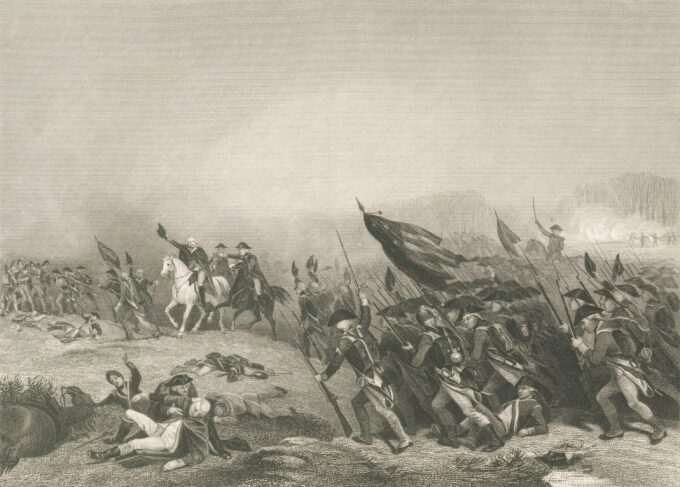
Image by New York Public Library.
The renowned political theorist Danielle Allen once wrote, “The Declaration of Independence matters because it helps us to see that we cannot have freedom without equality.” As the United States commemorates the 250th anniversary of its independence on July 4, 2026, the Declaration of Independence (1776), the U.S. Constitution (1787) and Northwest Ordinance (1787) link early concepts of imperial power, sovereignty, legitimacy, and interdependence. Combining these three documents is a departure from the historiography that sometimes places American imperialism starting in the nineteenth century and in the context of Westward expansion or U.S. pursuit of places like Alaska (1867) and Hawaii (1898); the latter two in accordance with the “blue water thesis” of imperialism.[1] I argue that the founding principles of the country were rooted in colonization and imperialism more so than freedom and liberation. In other words, the process of colonization started much earlier than the 1800s.
The U.S. started out as both a republic and an empire in the 1700s. As scholar Greg Grandin recently pointed out, “American freedom was built on endless conquest.” This was evident in its territorial expansion and indigenous dispossession that were built into its early stages. “We have it in our power to begin the world over again,” wrote Thomas Paine in 1776. Paine was a rarity, as the lone progressive Founding Father in that he envisioned domestic liberty and not an empire. His contemporaries, at best, however, saw native people as obstacles and children to be disciplined when they were not steered for diplomatic purposes. At worst, they were to be removed or slaughtered outright. In 1776, the First Report on Canada stated its purpose as a territorial strategy.[2] Even with the Articles of Confederation (1777) there was acknowledgement of indigenous sovereignty, but at the same time, speculation over the future of “Indian affairs.”[3]
Historians such as Fr. Francis Paul Prucha, Colin G. Calloway, and Robert J. Williams, Jr., documented the shift in the colonial perspective from strategic ally and brothers in liberty, to children and domestically dependent nations. Native Americans went from equals to those in need of guardianship.[4] The Treaty of Paris (1783) further undermined Indian sovereignty and legitimacy and allowed indigenous ancestral lands to be transferred without native peoples’ consent. Recent scholarship pays more attention to the Northwest Ordinance, drafted mainly by Manasseh Cutler, Rufus King and Nathan Dane, over the Constitution, and points to the direct expansionist policies it structured culturally through America’s founding documents and strategies.[5]
The U.S. was also intended to be both a republic and an empire. The Ordinance was used to organize and pacify white settlers and protect their interests from the big planter class. Further, since James Madison favored orderly expansion and feared direct democracy he “used [the Ordinance] as a tool of settler colonial expropriation and violence against indigenous peoples and their homelands. That it served the ends of white supremacy, however, can obscure the fact that much of its essential work was directed at, not on behalf of, white men, specifically to harness and direct the polities they created,” stated historian Jessica Choppin Roney.[6]
Years prior to the U.S. reach toward Alaska or Hawaii, and writing from Mount Vernon on August 29, 1788, George Washington stated, “The natural, political, and moral circumstances of our nascent empire justify the anticipation. We have an almost unbounded territory whose natural advantages for agriculture & commerce [are] equal [to] those of any on the globe.”[7] Further, Thomas Jefferson in writing to James Madison from Monticello on April 27, 1809, expressed “I [am] persuaded no constitution was ever before so well calculated as ours for extensive empire & self-government…”[8]
In 1787, Alexander Hamilton wrote in The Federalist Papers No. 1, “To the People of the State of New York: The subject speaks its own importance; comprehending in its consequences nothing less than the existence of the Union, the safety and welfare of the parts of which it is composed, the fate of an empire in many respects the most interesting in the world…”[9] In other words, it was clear to Washington, Jefferson and Hamilton in these exchanges that “empire” was an inevitable and desired component of an American grand strategy. These outweighed notions of democracy and republicanism.
In yet another sequence, and writing from Paris on January 25, 1786, Thomas Jefferson wrote to Virginia attorney Archibald Stuart and stated:
Our confederacy must be viewed as the nest from which all America, North and South is to be peopled. We should take care too not to think [about] it for the interest of that great continent to press too soon on the Spaniards. Those countries cannot be in better hands. My fear is that they are too feeble to hold them till our population can be sufficiently advanced to gain it from them [piece] by [piece]. The navigation of the Mississippi we must have.[10]
Here, Jefferson’s writing explained the careful maintenance and intent that he was prepared to undertake in structurally extending colonial violence in all directions in coordination with the Northwest Ordinance.
George Washington addressed New York lawyer James Duane on September 7, 1783, from Rocky Hill near Princeton, New Jersey, and said:
At first view, it may seem a little extraneous, when I am called upon to give an opinion upon the terms of a Peace proper to be made with the Indians, that I should go into the formation of New States; but the [Settlement] — of the Western Country and making a Peace with the Indians are so analogous that there can be no definition of the one without involving considerations of the other.
Washington continued:
For I repeat it, again, and I am clear in my opinion, that policy and [economy] point very strongly to the expediency of being upon good terms with the Indians, and the propriety of purchasing their Lands in preference to attempting to drive them by force of arms out of their Country; which as we have already experienced is like driving the Wild Beasts of the Forest which will return to us soon as the pursuit is at an end and fall perhaps on those that are left there; — when the gradual extension of our Settlements will as certainly cause the Savage as the Wolf to retire; both being beasts of prey [though] they differ in shape.[11]
Washington’s poetics are horrific in its essential unambiguous language driving at paternalism and ownership. Apologists for the First President and Father of the Nation might perceive the letter to be more about diplomacy, peacemaking and peacekeeping when it is mostly written in a way that Aimé Césaire might call decivilizing, dehumanizing, and with attempts in “thingifying” indigenous people.[12]
In writing from Washington D.C. on November 24, 1801, Thomas Jefferson addressed James Monroe stating:
It is hard to believe that either Great Britain or the Indian proprietors have so disinterested or regard for us as to be willing to relieve us by receiving such a colony themselves; and as much to be doubted whether that race of men could long exist in so rigorous a climate. On our western and southern frontiers, Spain holds an immense country; the occupancy of which however is in the Indian nations; except a few insulated spots possessed by Spanish subjects — It is very questionable indeed whether the Indians would sell? W[hether] Spain would be willing to receive these people?
Jefferson continued:
And it was nearly certain that she would not alienate sovereignty. The same question to ourselves would recur here also, as did in the first case: should we be willing to have such a colony in contact with us? However our present interest may rest drain us within our own limits, it is possible not to look forward to distant times, when are rapid multiplication will expand itself beyond those limits, and cover the whole northern, if not southern continent with a people speaking the same language, governed in similar forms, and by similar laws: nor can we contemplate, with satisfaction, either blot or mixture on that surface.
Jefferson used even more stark and uncompromising language, in his letter to John Adams on June 11, 1812, from Monticello:
The backward will yield and be thrown further back. These will relapse into barbarism & misery, lose numbers by war and want, and we shall be obliged to drive them, with the beasts of the forest, into the stony mountains. They will be conquered however in Canada. the possession of that country secures our women and children for ever from the tomahawk & scalping knife, by removing those who excite them. [13]
Jefferson signifies his imperialist perspective and frames the removal and subjugation of Indigenous peoples as necessary for territorial control and the security of settlers. He makes it clear that he believes in racial superiority, the separation of people, and the overall grand imperial project that was based on a structurally and culturally violent law system. He wanted a state that favored an English-speaking Anglo world and prioritized the use of the American liberty project as an expansionary mechanism to set forth a class based ethnic democracy.
Later on in 1823, Secretary of State John Quincy Adams observed that there are “laws of political gravitation” as well as physical gravitation: “just as an apple, severed from its native tree, must fall to the ground, so too would Cuba, forcibly separated from its ‘unnatural’ connection with Spain and incapable of self-support, gravitate inevitably toward the North American union.”[14] Later that year, President James Monroe, in his annual message to Congress on December 2, articulated the principle of freedom for the American continents from future European colonization. This policy became known as the Monroe Doctrine.[15]
By 1824, supporters of Andrew Jackson celebrated him as embodying the spirit of the American Revolution; he was running for the presidency as a Democrat, and his campaign slogan was “the glorious principles of ’76.[16] This was perhaps the beginning of early American populist attempts to undermine elite imperial policies from the right.
Howard Zinn, author of the People’s History of the United States, wrote about American exceptionalism and explained how in 1846, Democrats ardently pushed expansion. The common phrase came from John O’Sullivan, editor of the Democratic Review who in 1845 wrote, “our manifest destiny to overspread the continent allotted by Providence for the free development of our yearly multiplying millions.”[17] The idea of America guided by divine providence dates back to its separation from Great Britain, when John Adams articulated, “It was the will of Heaven that the two countries should be sundered.”[18]
.jpg)
Leading up to the expansionary policies associated with the Panama Canal’s construction and twentieth and twenty-first century warfare, there were additional annexation projects. This long list of strategic territories included: Louisiana (1803), Florida (1819), Republic of Texas (1845), Mexican Cession (1848), Gadsden Purchase (1853), Alaska (1867), Hawaii (1898), Puerto Rico (1898), and just after Panama, the Virgin Islands (1917). Prior to these all, however, were the early American visions of continental empire, which helps to explain Trump’s “Donroe Doctrine” and “America First” philosophy that entails “maximum pressure,” or what Razi Canikligil called Trump’s pursuit of “a neo-imperialist agenda.”[19] Further, on February 10, 2025, the Financial Times called Trump, Xi, and Putin committed expansionists in a “new age of empire.”
Early American visions of continental empire gave us the imperial politics of the current moment. Along with New World “discovery,” the colonial period, and prolonged chattel slavery, early America led campaigns of Manifest Destiny and an intervention in Mexico. In 1832, the Democratic Party and a wing of the Jacksonians supported expansion of U.S. territory through the annexation of Texas.[20] Further calls for expansion could be seen in slogans such as “Fifty-Four Forty or Fight,” the 1844 annexationist policy of James K. Polk who wanted the boundary line for Oregon to be drawn at the latitude 54° 40’.[21] Well before Trump articulated a vision for projecting American renewed regional hard power in the Panama Canal, Venezuela, Cuba, Greenland, and stretching to Gaza, were elites of the aristocracy – enslavers and leaders such as George Washington, Thomas Jefferson, Alexander Hamilton, and John Quincy Adams. [22] Their private letters help to explain empire and the brutal mindset found in the twenty-first century as we approach America’s 250th birthday.
Historian Sophia Rosenfeld recently wrote:
What a time to try to commemorate this nation’s founding! Imperialism is back. Militarized federal agents have been massing in cities to root out people deemed unwelcome or disloyal. The president styles himself more as a monarch than a civil servant, from the plans for his new golden ballroom to the parade of courtiers and oligarchs paying him homage. Given this situation, what are the options for narrating the story of the Declaration of Independence 250 years after the fact? Are we left with anything other than irony or tragedy?
The history of the United States from its founding through the early nineteenth century exposes its imperial ambitions.[23] This was not incidental, but central to the nation’s formation. Ranging from Washington and Jefferson’s letters to the structuring of the Northwest Ordinance, the dispossession and subjugation of indigenous peoples were outlined as necessary for the growth of a continental republic. Early American leaders consistently employed the rhetoric of liberty and the strategies of territorial expansion. They set precedents for later policies of Manifest Destiny and eventual intervention abroad. The Founders set racial hierarchies and shaped the U.S. as inseparable from empire. Therefore, America’s “New Imperialism” in the global south was not new at all. As America reaches its 250th year, it becomes clear that empire was not a departure from the aspirational democratic ideals of 1776-1787; it was a parallel and continues in the present.
NOTES
1. United Nations General Assembly, Resolution 637 (VII) of 16 December 1952, “Maintenance of the Right of Self-Determination,” U.N. Doc. A/Res/637(VII) (1952). (This resolution countered the notion that imperialism was only conducted overseas). ↑
2. Continental Congress, First Report on the Committee to Digest the Resolutions Respecting Canada and Indian Allies (1776). ↑
3. Articles of Confederation and Perpetual Union (1777), National Archives. ↑
4. Francis Paul Prucha, American Indian Policy in the Formative Years: The Indian Trade and Intercourse Acts, 1790–1834 (Cambridge, MA: Harvard University Press, 1962). ↑
5. William Frederick Poole, The Ordinance of 1787 and Dr. Manasseh Cutler as an Agent of its Information (Cambridge, MA: University Press, 1876). ↑
6. Jessica Choppin Roney, “An Expansion of the Same Society: Republican Government and Empire in the Early Republic,” Journal of American History III, no. 1 (June 2024): 15–38. ↑
7. George Washington to Sir Edward Newenham, August 29, 1788, in The Papers of George Washington, Presidential Series. ↑
8. Thomas Jefferson to James Madison, April 27, 1809, The Papers of Thomas Jefferson. ↑
9. Alexander Hamilton, The Federalist Papers, no. 1, in The Federalist, ed. Clinton Rossiter (New York: Penguin Books, 1961). ↑
10. Thomas Jefferson to Archibald Stuart, January 25, 1786, Paris, in The Papers of Thomas Jefferson. ↑
11. George Washington to James Duane, September 7, 1783, Rocky Hill near Princeton, New Jersey, in The Papers of George Washington. ↑
12. Aimé Césaire, Discourse on Colonialism, trans. Joan Pinkham (New York: Monthly Review Press, 2000). ↑
13. Thomas Jefferson to John Adams, June 11, 1812, Monticello, in The Papers of Thomas Jefferson. ↑
14. John Quincy Adams, as quoted in Morrison Samuel Elliott, The Oxford History of the American People, 3 vols., vol. 2 (New York: New American Library, 1972). Adams, a northerner and eventual 6th president of the United States was the first to ever serve in the post-founding-father-era (after Washington through Monroe). He continued, however, with the mindset of a Virginia planter elite and forged ahead with imperial institutional governance. ↑
15. James Monroe, “Annual Message to Congress,” December 2, 1823. ↑
16. Arthur M. Schlesinger Jr., History of American Presidential Elections, 1789–1968, 4 vols. (New York: Chelsea House McGraw-Hill, 1971). ↑
17. Howard Zinn, A People’s History of the United States (New York: Harper & Row, 1980). ↑
18. Familiar Letters of John Adams and His Wife Abigail Adams During the American Revolution. ↑
19. Razi Canikligil, “New American Expansionism: Trump’s Manifest Destiny,” Envoy, Spring 2025. ↑
20. Dictionary of American Politics, ed. Edward Conrad Smith and Arnold John Zurcher (New York: Barnes & Noble, 1955). ↑
21. Dictionary of American Politics, ed., 1955). ↑
22. Trump’s Board of Peace Is Dividing Countries in Europe and the Middle East,” Associated Press, January 21, 2026. ↑
23. David Barsamian, Imperial Ambitions: Conversations with Noam Chomsky on the Post-9/11 World (New York: Metropolitan Books, 2005). ↑
The post America 250 and the Imperial Nation appeared first on CounterPunch.org.
This content originally appeared on CounterPunch.org and was authored by Daniel Falcone.