
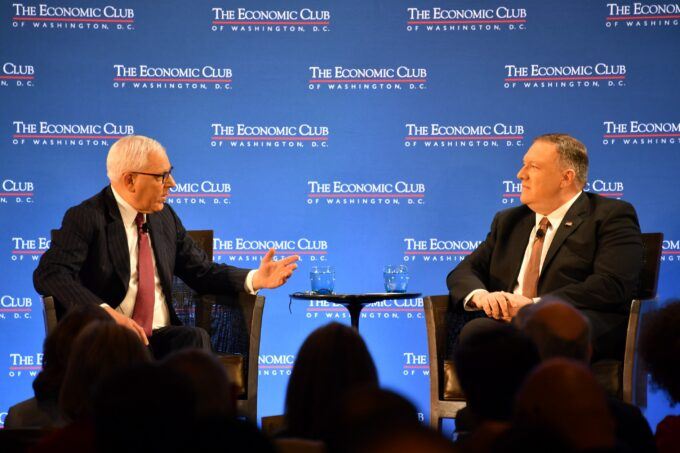
David Rubenstaine (L) in conversation with former US Secretary of State Mike Pompeo at the Economic Club. Photo: US State Department.
His name is all over Duke, Johns Hopkins, and the University of Chicago. It’s on the National Archives, the National Zoo, and the Library of Congress. It’s on the Lincoln Center and a handful of TV shows. It’s even featured at the Smithsonian’s National Museum of African American History and Culture. It’s the name of private equity billionaire and Carlyle Group co-founder David M. Rubenstein, who for years has undertaken one of the country’s most successful reputation laundering projects. Through his “patriotic philanthropy” ruse, Rubenstein has invested hundreds of millions in convincing Americans that he is a public-spirited and altruistic “civic leader.” And if you’re just tuning in now, you might be forgiven for being fooled by the TV character hosting America’s Book Club on C-SPAN. But for those who have followed Rubenstein and the Carlyle Group closely, his special attention to education, history, and the arts looks like a cheap (for him) and easy path to reputation rehab for one of our recent history’s most ruthless, exploitative executives.
If you’ve ever watched one of his shows, you might have wondered, “Why is this awkward, tactless billionaire interviewing historians and Supreme Court justices?” Notwithstanding his interest in putting his name on universities and museums, literary and academic concerns clearly can’t hold Rubenstein’s attention for long. His interviews bear a conspicuous lack of reading or intellectual curiosity. To be sure, this is not at all unusual within the Washington elite. What is more novel is the willingness of respected outlets like PBS and C-SPAN to indulge this kind of cringeworthy performance. Rubenstein proves that one can be a billionaire and yet unable to shed personal insecurities about wealth and social standing. He is quite like Donald Trump, and the billionaire class more generally, in this way and many others.
He is attempting to buy a new reputation. As a piece in The Atlantic noted last year, “His name is stamped all over the Washington region.” This rather Trump-like, implacable need to self-promote reflects the fact that Rubenstein’s career is built fundamentally on proximity to political power and special privilege, not legitimate, independent achievement or service. Without clear talents or intellectual gifts by his own admission, Rubenstein sought out politics not out of any interest in ideas or justice, but because he wanted to sidle up next to the political elite.
Access Capitalism and the War Racket
Rubenstein’s pompousness and relentless self-promotion might not be of concern if it were not for the malignant activities of the Carlyle Group. It’s no longer enough to be a billionaire. Adding insult to injury, they want us to see them as thoughtful and responsible “civic leaders.” Rubenstein and the Carlyle Group embody much of what is wrong with contemporary American society and culture, and this goes a long way toward explaining the embarrassing, self-conscious need to show up on PBS, Bloomberg, and C-SPAN.
The criticism of the Carlyle Group isn’t about resentment toward wealth, much less toward the freedom of economic exchange through markets. The success of the Carlyle Group has nothing to do with commonsense definitions of fair economic competition. Their practice of “access capitalism” is much closer to organized crime than legitimate entrepreneurship on their best day. It is difficult for ordinary Americans, who must play by the rules, to understand how openly unethical firms like this can be right out in the open. They are in effect above the law, embedded with the formal state at the highest levels.
For decades, the Carlyle Group has been among the most politically connected private equity firms in the world, counting George H.W. Bush and James Baker, for example, as advisers. Working in the White House taught a younger Rubenstein that big business in our country is about who you know. Shortly after starting the firm, Rubenstein brought in Frank Carlucci, “among the most powerful men in Washington for decades.” A former Secretary of Defense, Deputy Director of the CIA, and National Security Advisor, Carlucci made his reputation by helping the U.S. government knock off Patrice Lamumba in 1961. His exploits earned him endearing nicknames like Spooky Frank, Creepy Carlucci, and Mr. Clean.
With Carlucci, Rubenstein had his connection to “the right people: the generals, the defense undersecretaries, and staffers who made the gears of the trillion-dollar defense world move.” Rubenstein and the Carlyle Group understood that war is a racket, and they wanted in. The firm looks to profit from this structure by promoting war as they invest in the arms industry. Just last month, the Carlyle Group’s current CEO gushed about the “unlimited” opportunities available in the war-making racket, “because everywhere you go everybody’s increasing their defense budgets by 1%, 2%, 5%.”
Rubenstein and the Carlyle gang continue to employ high-ranking former government officials to launder their crimes. Currently a partner in the firm, James Stavridis is a retired Navy admiral and the former NATO Supreme Allied Commander Europe. This year, Stavridis has been among the most visible and high-profile proponents of the United States’ aggressive and illegal war against Iran, even pushing for an American ground invasion of the country. Over the past several months, Stavridis has appeared regularly on cable news to beat the drums of war and mislead Americans about the threat posed by Iran, all as his firm very actively expands its war industry investments.
The Carlyle Group has “announced an expansion of its Aerospace, Defense & Government and Industrial teams through a dedicated middle-market platform focused on opportunities across the United States and Europe.” Of this new platform, Stavridis said: “The geopolitical environment and sustained increases in defense spending are creating a multi-decade investment opportunity across defense and industrial infrastructure. Governments are prioritizing military modernization, force preparedness, and resilient industrial capacity at a scale that we believe will drive long-term demand for advanced technologies and strategic capabilities.” War is a game and a business for Rubenstein, Stavridis, and the Carlyle global crime ring. The very same people engaged in shaping “defense” policy are turning around and privately profiting from increases in military spending.
At the very least, there is the appearance of a serious conflict of interest. A senior executive of a firm profiting from the expansion of spending on weapons and war while he is constantly speaking and writing to promote an illegal war. There is perhaps nothing more dishonorable than what Stavridis is doing. He is using his position as an admiral to profit from the military-industrial complex. He might instead consider taking a lesson from President Eisenhower. If he were a judge, government regulator, or even an academic, these are the kinds of conflicts that would require formal disclosure.
The Quincy Institute for Responsible Statecraft has flagged similar ethical issues for years, noting that Stavridis had “published multiple columns over the past year urging greater U.S. investments in cybersecurity and cyber-defenses while failing to disclose to readers potential conflicts of interest due to work in the defense industry.” The Quincy Institute describes a pattern, going back at least ten years, of Stavridis failing to disclose financial interests in defense firms; they report that Bloomberg, where he writes, “altered Stavridis’s bio following an email from Responsible Statecraft inquiring about his undisclosed ties to various defense contractors.” In 2016, when Stavridis made the short list of potential Hillary Clinton running mates, a review of his articles for Foreign Policy revealed that he had not disclosed his position on the advisory board of Northrop Grumman. Foreign Policy’s executive editor at the time said, “I was not aware of James Stavridis’s role as chair of the international advisory board of Northrup [sic] Grumman.”
The Politics We Never See
Even The Economist said, “The secretive Carlyle Group gives capitalism a bad name.” Rubenstein himself has admitted that the goal was to make as much money as possible, as quickly as possible. The firm infamously bought a nursing home company only to strip away its most valuable assets, including its facilities and real property, saddling it with massive financial obligations before the Carlyle crooks made off with a big bag. The vulnerable senior citizens caught in the wake? Who knows and who cares was the Carlyle Group’s M.O. In the decades since the Carlyle racket was founded, the American mainstream has only become more comfortable with (perhaps ignorant of) private equity’s leveraged looting. In the toxic, greed-is-good culture of the present moment, the response to the Carlyle Group’s brand of callousness and cruelty is “let ‘em cook!”
This helps to explain Rubenstein’s TV shows and “patriotic philanthropy” campaign. If thirty years ago business writers saw the Carlyle boys as giving capitalism a bad name, today theirs is the model to emulate. Rubenstein gutted enough companies and put his name on enough buildings that he even managed to buy himself a Presidential Medal of Freedom, and from a president who then rather incredibly warned about oligarchy. You couldn’t script it better. Rubenstein and private equity freeloaders like him aren’t philanthropists in any honest or rational sense. To judge from their life’s work, they loathe humanity. And in case the foregoing isn’t enough, Rubenstein met with Jeffrey Epstein after Epstein had pleaded guilty to procuring a child for prostitution.
This is the American politics we never see or discuss. It is the real structure of the political-economic system. When our elite political and media classes launder and celebrate the reputations of billionaire corporate raiders and their uniformed war-mongers, they show their cards and their contempt for the country and its stated values. We need not admire such openly corrupt and unscrupulous misanthropes. Americans deserve better “philanthropists” and “civic leaders.” We are fixated and over-indexed on the comings and goings of politicians, too often unaware of the immense real-world power of organizations like the Carlyle Group crime family and its “access capitalism.” We can vote differently, we can march once per quarter, and we can donate to our favorite charities, but there is no path to real change until we stop heaping praise on marauders like Rubenstein and Stavridis. We should remember that the next time we hear Rubenstein congratulating himself for his “patriotic philanthropy.”
The post Buying a Reputation appeared first on CounterPunch.org.
This content originally appeared on CounterPunch.org and was authored by David S. D’Amato.