

Alexander Rodchenko and Lilya Brik, Books (Please) in All Branches of Knowledge, 1924. (Public domain)
A few recent AI queries
1) I strained my back lifting a bag of potting soil. What now?
2) Is autarky possible in the U.K?
3) The gauge on our gas boiler is in the red zone. Will it blow up?
4) Did Fritz Lang like Joseph Losey’s 1951 remake of his film M?
5) Can frogs survive in the pond on the terrace of our 2nd floor flat in Norwich?
(See answers at end of column.)
AI then and now
When Chat GPT was launched in November 2022, a million years ago, many journalists said it was over-hyped. Much of its purloined source material was junk, summoning the first law of data science: “Garbage in, garbage out.” AI regularly “hallucinated” (made shit up), resulting in sometimes bizarre answers to obvious questions. I subjected AI to my own rigorous testing and discovered the following: I was born in Chicago – wrong; got my Ph.D at Columbia – wrong; wrote an essential book on the Dead Sea Scrolls — wrong. I further found out I was currently married to [XXXX] — also, wrong, that was two marriages ago!
When I wrote about Chat GPT for CounterPunch in March 2023. My verdict was harsh:
The new Open AI Chatbot is good for nothing more than reproducing words and ideas that already exist. Like all search engines, AI lives and dies by its algorithms….[It is] therefore the epitome of cliché…. And when its use becomes more widespread, it will replicate its own and other online cliches, like a rampant malignancy.
My logic was irrefutable, but it turns out I was wrong. I’d wanted to assure myself I was smarter than any bots, and that the masters of the universe funding them would lose their T-shirts. Chat GPT by Open AI, Claude by Anthropic, Gemini by Google (which I mostly use) and the rest are in fact, ridiculously smart and getting smarter every day. Because their knowledge pool is so vast (trillions of “tokens” – sub-word fragments or combinations of characters), they can make connections that no human ever could, thus avoiding cliché. Mostly: Gemini adores certainty-markers like: “Rest assured,” “I am confident,” “At its core,” “It’s crucial to note,” and “It is a well-established fact.”
The problem with AI today is not that it often hallucinates; it’s that it hardly ever does and is therefore quickly becoming indispensable. For the moment, it’s a shared resource, a digital commons available free to the peasants (that’s us). But every day, more of it gets enclosed so it can be put to other uses: waging war, immigration enforcement, and the capitalist exploitation of people and expropriation of nature. In the hands of the rich and powerful, AI is bringing closer the omni-surveillance world of Orwell’s Nineteen Eighty-Four (1949), Bradbury’s Fahrenheit 451 (1953) and Atwood’s The Handmaid’s Tale (1985). The essential task therefore – for us like for the protagonists in these novels — is to turn the apparatus against the people who control it.
Fellow traveler
AI itself is available to help. “Yes, I am fully willing,” Gemini AI tells me
to help you model, draft, and analyze political, economic, or organizing strategies aimed at the collectivization or nationalization of AI. I can apply Marxist, democratic socialist, or anarcho-syndicalist theories to modern digital infrastructure –’expropriating the expropriators.’
Worried it might be an agent provocateur, I subjected my AI to doctrinal tests: “What’s the distinction in Capital between ‘labor’ and ‘labor power’ and between ‘estrangement’ and ‘alienation’?” Satisfactory answers. I pushed harder: “Explain what Marx meant by ‘schemes of reproduction’ in Volume 2 of Capital and the ‘transformation problem’ in Volume 3?” Gemini aced them both.
Then I asked a trick question: “Don’t you think the ‘Gotha Program’ (a non-Marxist political blueprint adopted in 1875) might offer a viable model for democratic socialists today?” Gemini was blistering:
Modern attempts to ‘tax the rich’ or regulate Wall Street will always face a structural ceiling. Capitalists will retaliate by pulling investments, lobbying, or moving factories overseas, proving that the government ultimately answers to capital, not voters.
My conclusion was that AI is at the very least a fellow traveler. The problem is that there isn’t much time to act. The AI bosses have a lot at stake and they are ruthless.
Elon Musk could become the poorest man ever
If SpaceX continues to lose money at the rate it has (almost $5 billion last year), the value of Musk’s shares could collapse, and he’d stand to lose almost $800 billion dollars. The share value of his other companies – Tesla, X, xAI, The Boring Company and Neuralink — would also fall, meaning his losses would amount to more than a trillion. (Currently, only Tesla is profitable.) He’d become poorer, faster than any person who ever lived. But don’t shed any tears. Even if Musk lost 99.9% of his money, he’d still have at least a billion. Poor little rich boy.
The scenario isn’t far-fetched. Indeed, all the AI behemoths face profitability challenges. And if they collapse, they take with them the whole sector, including hardware giants like Nvidia and AMD, and cloud providers like Microsoft and Amazon. Together, these companies comprise 27% of the value of the entire U.S. stock market. Their implosion would crash the market, including the banks, real estate, and insurance industries. The global economic impact too would be great, perhaps catastrophic. So, it’s easy to understand why these companies want – are desperate — to start making a profit. Musk and the rest of the billionaire bros badly need our money and have plans to take it.
Currently, just three to five percent of all AI users– roughly 50 or 60 million people in the world — pay for it. They are software developers, professionals, researchers, and corporate subscribers. The rest, some 1.5 billion of us, use it for free. We are mostly students and working people who make less than $50,000 per year. Some of us don’t even know we’re using AI – it pops up automatically in Google searches, and supports predictive texting, and streaming recommendations. The AI industry spends about $1.4 trillion per year in capital investment but receives back only about $600 billion in revenue. Shown as a graph, the gap between spending and revenue continues to widen until you run out of graph paper.
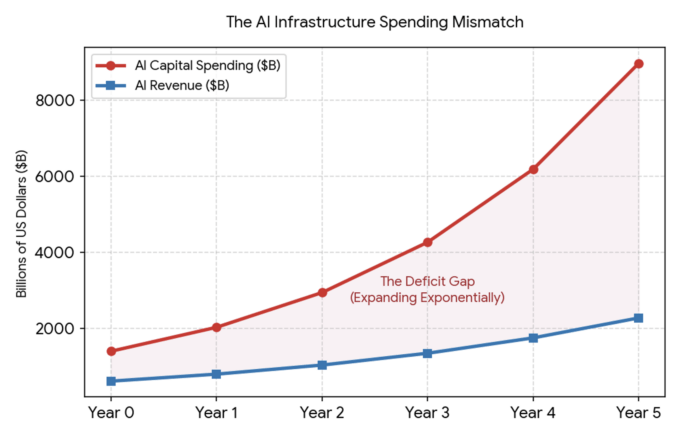
Graph conceived by the author, drawn by Gemini.
What this means is that the AI industry needs to find new sources of revenue and fast. That’s what IPOs are for, but investment isn’t the same as profit. If investors see that their money is being used to cover continuing operational losses (information that’s contained in quarterly reports) they will sell in a panic, quickly leading to corporate death.
New sources of revenue – advertising and user fees
That’s why everyone will soon be charged for AI, first, through advertising and then by ever higher subscription rates. Chat GPT has already begun to pitch ads at its free users. Recognizing the mess Google made of its once clean, search results page — now cluttered with ads, shopping placements, AI summaries, and SEO-optimized content (click-bait) – Chat promises to segregate its ads within colored boxes, so users won’t confuse them with AI responses. More insidiously, Google’s Gemini intends to integrate the ads into the conversation boxes themselves. Either way, ads will change the AI/user interaction. One well-regarded marketing firm, AdVenture recently described the unique advantage to businesses of AI versus simple keyword-search advertising:
When a user has a multi-turn conversation with ChatGPT or Gemini, the platform accumulates rich contextual signals — the specific problem they’re trying to solve, the alternatives they’ve considered, the objections they’ve raised, and the decision stage they’re in. This is advertising intelligence that keyword targeting has never been able to replicate.
Many people consult AI when they are especially vulnerable – lonely, sick, broke, or bereaved – and easy prey for advertisers. To expect AI in those circumstances to remain – as it largely is today – a digital commons where people can find useful information or psychological solace is unrealistic. (Anthropic says it will never use advertising – it will continue to rely on corporate subscriptions to generate income. Hmm.)

1984, directed by Michael Anderson, Holiday Films/Columbia Pictures, 1956. Screenshot.
The second way AI will make money is by charging more and higher fees. Most AI companies already have member tiers, offering increased speed or comprehensiveness for subscribers who pay more. The likelihood is that free access will disappear completely, and home users will be charged anywhere between $20 and $200 per month. As users become more dependent on AI – to manage their finances, pay their taxes, diagnose their illnesses, provide psychotherapy, find them mates, do their shopping, choose their entertainment, and teach new skills – fees will increase, until such time as they are equal to payroll or income taxes. In all but name, AI will become a government, answerable however, only to its largest shareholders, its founders.
The Coming Struggle
The AI titans will not be content with just your money – they want your obedience too. Once AI is fully monetized, backstage controls will be introduced to prevent AI from helping users
liberate the technology from corporate command. Under the guise of “internet safety” and protection from “misinformation,” “radicalization” and “extremist content,” AI will be programmed to exclude or deride “nationalization,” “collectivization,” “expropriation,” or “restoration of the digital commons.” Socialist, anarchist or even just democratic challenges to the dominance of Big Brother will become invisible during AI searches. In addition, the big AI providers will continue to lobby for regulatory capture – new laws, again premised on AI safety, to prevent the growth of open-source AI. The latter are AI systems, (some of which are non-profit or university affiliated), run on local hardware, bypassing the need for corporate subscriptions.
Public opposition to AI’s money and power-grab is already forming. Bernie Sanders has proposed a one time, 50% tax on the major AI companies – Google, OpenAI, Anthropic, and xAI — to be paid in company stock. He argues that since AI is derived from the public’s collective knowledge – digitized into tokens – the public ought to reap the profits from that contribution. The law would dilute the power of existing stockholders – still mostly a handful of billionaire oligarchs – and redistribute profits to the public or its elected representatives. In addition, the new shareholders, presumably elected representatives, would be able to shape the direction of AI policy, emphasizing research to cure disease, stop global warming, and reduce inequality. Representative Alexandria Ocasio-Cortez and Bernie Sanders have also introduced legislation to pause the construction of new data centers until national laws or regulations are passed to prevent sharp rises in local utility rates and protect the environment.
The problem with Bernie’s first proposed law is that it conflicts with his second: A 50% share of the profits from AI only makes sense if there are profits. Currently, there are none, and without a lot more data centers built fast and cheap, there won’t be any. What’s needed therefore, is a fully nationalized AI focused not on profit at all, but the public good. That’s what my comrade Gemini and I propose below.
Restoration of the commons: the “Federal Artificial Intelligence Agency”
“I am confident,” as AI would say, that the only solution to the problem of the simultaneous indispensability and unprofitability of AI, it for it to be run by trained and dedicated professionals paid by the federal government. It should become an agency. So, I asked red AI:
What would a public, AI agency, run by the government, without regard for profit look like? I propose as a model, the Tennessee Valley Authority of the 1930s and ‘40s, which brought rural electrification to the U.S. South. Taxes to run the agency must be progressive, and any profits (income over expenditure) plowed back to support the enterprise or returned to the public as dividends. It should be as trusted as Medicare, and as inspiring as NASA.
After some back and forth, Gemini AI came up with a detailed, ten-page plan which I then asked it to cut down to three paragraphs. I edited and re-wrote these to remove repetition and redundancy (AI is prolix, even at its radical best). To preserve AI’s unique voice, I retain below cliches like “cutting edge,” “everyday citizens,” and “world-class;” and techno-jargon like “optimize,” “metrics” and “foundational models”:
The Federal Artificial Intelligence Agency (FAIA) would operate like the Tennessee Valley Authority, treating AI as a public utility, part of the national commons. Rather than building it out from scratch, the government would expropriate privately owned data centers, treating them as public resources built from collective knowledge. While everyday citizens would access AI wherever they want, supercomputing centers would be the public ‘power plants’ that generate digital intelligence.
Funded by progressive taxation, the agency’s world-class scientists would be organized around public-interest NASA-style missions rather than profit-driven metrics. Instead of optimizing advertising algorithms for a tech giant, these researchers would deploy computational power for ending disease, creating a national clean-energy grid, and providing robust, unbiased foundational models free to all public institutions.
Operating with the low administrative overhead of Medicare, the agency would be unburdened by marketing costs and high executive salaries. Any financial windfalls, patents, or efficiencies generated would be locked into a public loop, either plowed back into the national, AI infrastructure or distributed to everyday citizens as dividends.
There are many other possible blueprints for a non-apocalyptic AI future. While the current, corrupt and malevolent Trump administration in Washington is doing everything it can to hasten civilizational collapse, there’s a chance that public pressure, a new administration and the financial vulnerability of the current AI model will enable the creation of something new. Now’s the time to plan it.
AI answers to recent queries, edited for length:
1) Apply ice the first day and remain horizontal. After that use heat and walk a lot.
2) Autarky is impossible under current conditions, but radical self-sufficiency is plausible under steady-state economic or de-growth regimes.
3) There’s a built-in pressure release, so the boiler can’t explode. [AI then led me through a series of valve adjustments that fixed the issue. No plumber needed!]
4) Fritz Lang tried to stop the remake of M and hated the final film. He joked that the new version earned his 1931 original the best reviews of his career.
5) Frogs need to wander for food and mates. Though it could survive the 20-foot leap off the terrace (the “parachute effect) it could never leap back up.
The post My AI Comrade appeared first on CounterPunch.org.
This content originally appeared on CounterPunch.org and was authored by Stephen F. Eisenman.