
Right-click here to download this episode (“Save link as…”).
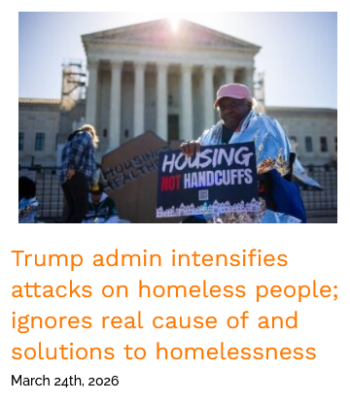
NHLC (3/24/26)
This week on CounterSpin: From the federal level on down, many laws and policies that claim to be about “ending homelessness” seem to be clearly more about hurting homeless people than changing their circumstance. Even if you, or anyone you know, has never been unhoused: How hard is it to understand the difference between charging poor people monetary fines they obviously can’t pay, and then throwing them in jail when they don’t—and addressing homelessness with, oh I don’t know, housing?
That would be a commonsense conversation, about what resources we have and how we deploy them; but instead we see power actors, with the support of the White House and the Supreme Court, telling us that “ending homelessness” means tearing up people’s tents, throwing away their belongings; a new law in Kentucky says officials can use “stand your ground” laws to shoot homeless people that don’t “cooperate” with their eviction from private or public land.
So: Is this really about addressing homelessness? Because we know how to do that. And if it’s not: What is it about? And can we have an honest conversation about that?
Jesse Rabinowitz is the campaign and communications director at the National Homelessness Law Center. We hear from him this week.
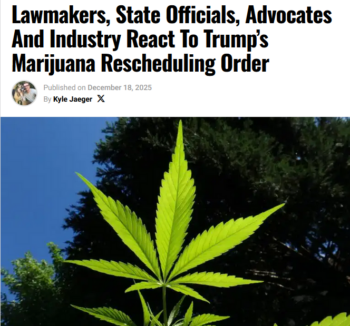
Marijuana Moment (12/18/25)
Also on the show: You may think weed is “legal” because you see so many people smoking it on the street. Including your grandma and your next-door neighbor who just a few years back would’ve called the cops. But just as the criminalization of marijuana affected different communities very differently, the current supposed de-criminalization continues to comfort the comfortable and afflict the afflicted. Though that is not at all the understanding you would get from a casual view, or for that matter from media coverage that makes it seem like the debate over weed is all over, and now we’re all just talking about which strain is the best.
Maritza Perez Medina is director of federal affairs at the Drug Policy Alliance. She joins us to talk about what the “rescheduling” of marijuana does and doesn’t do.
With both homelessness and drug policy, it’s useful to see how many current legislative measures, with a cultural backwind from corporate media, are fooling people that things have changed, while actually things are still harming the people who have always been harmed. So these moves are not something to “tweak”; we need conversation and action based on a different understanding of why things are as they are, and of how things can be.
This content originally appeared on FAIR and was authored by Fairness & Accuracy In Reporting.