
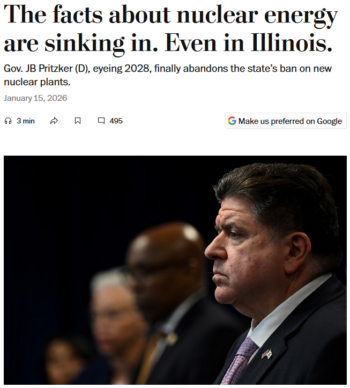
The Washington Post (1/15/26) describes as “the world’s largest source of clean energy” a technology that has, in Illinois alone, produced 11,000 tons of radioactive toxic waste.
The Washington Post has devoted four editorials to supporting the expansion of nuclear energy in the past three months, relying on factual errors and distortions to make the case for the Trump administration’s unprecedented cuts to nuclear safety regulation. The Post‘s owner, Jeff Bezos, is the chair of Amazon, a company dependent on electricity-guzzling data centers that invested more than $1 billion in nuclear energy last year.
The first of the editorials (1/15/26) was headlined “The Facts About Nuclear Energy Are Sinking In. Even in Illinois.” It lauded Illinois Gov. JB Pritzker’s decision to end the state’s moratorium on building new nuclear plants.
The piece contains no disclosure about Bezos’ financial ties to the nuclear energy sector, continuing a trend previously identified by FAIR (11/20/25). Bezos is the largest individual shareholder of Amazon, which has invested $500 million in small modular reactor nuclear (SMR) startup X-Energy. X-Energy recently signed a letter of intent to explore deployment in areas that include Illinois. Amazon is a member of the Nuclear Energy Institute, which advocated to end the state’s moratorium.
‘Clean energy’ (except the toxic waste)
The Washington Post editorial said of Pritzker:
The 2028 presidential hopeful personified the Democratic Party’s gradual realization that the country cannot meet its electricity needs—let alone combat climate change—without embracing the world’s largest source of clean energy.
As FAIR has previously noted, leading experts dispute the claim that nuclear energy is essential to address climate change. Describing it as “clean” obscures unresolved problems such as radioactive waste. More than 100,000 tons of spent nuclear fuel are stored in pools requiring active cooling and dry casks throughout the country—over 11,000 tons in Illinois alone, the largest stockpile of any state.
An expert report published the same day as the Post‘s Illinois editorial, co-authored by former NRC chair Allison Macfarlane, described the situation as a national imperative: The federal government has collected more than $50 billion from ratepayers for a waste repository it has never built, paid more than $12 billion to reactor owners in damages for failing to take the waste, and is projected to pay an additional $40 billion more.
Illinois’ 1987 moratorium was a bipartisan measure signed into law by a Republican governor that prohibited construction of new nuclear plants until the federal government identified and approved a means of disposing of radioactive waste. That condition has never been fulfilled. The Post omits the reason for the moratorium, instead characterizing nearly four decades of policy as a “perplexing attitude” driven by ideological environmental activists:
Illinois has suffered for decades from serious cognitive dissonance on nuclear energy. The state boasts the nation’s largest fleet of nuclear reactors, generating more than half its electricity from those plants. Yet lawmakers in Springfield followed the lead of environmental activists who regard the industry with open disdain…. That perplexing attitude is finally changing.
The Post also did not consider how the state’s years-long criminal nuclear scandal might affect its residents’ views. Since 2020, Illinois utility Exelon and its subsidiary Commonwealth Edison have agreed to more than $200 million in fines with federal authorities for bribing political figures to pass legislation that included roughly $2.35 billion in nuclear subsidies—the same subsidies Exelon has repeatedly stated it requires to keep its Illinois plants operating. The scandal is part of a broader pattern of corruption in the industry that the Post elided in other editorials.
Celebrating safety rollbacks
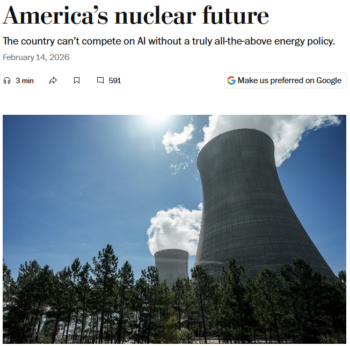
The Washington Post (2/14/26) mocks nuclear regulators who “mandate that plants minimize exposure to well below levels that people experience annually from the natural world, such as from the Sun”—ignoring the fact that radiation from the Sun causes thousands of cancer deaths in the US every year.
A month later, under the headline “America’s Nuclear Future,” the Washington Post editorial board (2/14/26) championed the Trump administration’s nuclear safety rollbacks:
Sometimes, regulators have even forced changes to designs mid-construction, as happened in 2009, when they required containment buildings for reactor developments in Georgia and South Carolina to be able to withstand direct aircraft strikes, driving up costs and delaying construction.
The editorial board invoked the Vogtle project in Georgia and the VC Summer project in South Carolina as cautionary tales about regulatory overreach. The Post did not mention that VC Summer’s failure in South Carolina was primarily caused by executive fraud and mismanagement (Power, 10/15/21).
Further, a senior representative of Southern Nuclear, the operator of Georgia’s Vogtle reactors, recently attributed reactor construction delays to macroeconomic events and lead contractor Westinghouse’s bankruptcy rather than over-regulation. The new reactors cost $35 billion, more than twice the original estimate, and were completed seven years late in 2024.
The Post claimed the Nuclear Regulatory Commission forced changes while reactors were “mid-construction” in 2009, but physical construction for both projects did not begin until 2013, as noted by Edwin Lyman, director of nuclear power safety for the Union of Concerned Scientists, and the pro-nuclear source they cited.
The Post made other misleading claims in the article regarding the science of radiation dangers. The editorial board expressed support for the Trump administration’s efforts to drastically weaken the NRC’s radiation guidelines, which are based on the Linear No-Threshold (LNT) model. LNT maintains cancer risk as proportional to radiation dose, with even tiny amounts causing small but real risks, particularly for infants and vulnerable populations. The Post wrote:
The science underpinning the radiation rule is mushy, at best. It’s based on a theory that because radiation poses a serious cancer risk at high doses, it must also pose a low risk at lower doses.
It is irresponsible for a reputable news outlet to describe the science supporting LNT as “mushy.” As the Bulletin of the Atomic Scientists (10/15/25) recently explained, the use of LNT model for radiation has been repeatedly affirmed by authoritative scientific bodies, including “the National Academies of Sciences, Engineering and Medicine, virtually all international scientific bodies, the Environmental Protection Agency (EPA) and the NRC itself.”
The Post did disclose Amazon’s nuclear energy investments in the February 14 piece, and in two following editorials. But those disclosures don’t convey the scope of their efforts to influence nuclear policy.
Amazon spent nearly $19 million on lobbying last year, including on nuclear energy–related issues. Amazon Data Services is a member of the Nuclear Energy Institute (NEI), the nation’s biggest trade group pushing to cut safety regulations—the same NEI that recently celebrated the Post’s inclusion of nuclear energy in its “25 Good Things That Happened in 2025.” In January, the Bezos Earth Fund donated $3.5 million to the Nuclear Scaling Initiative to help coordinate bulk purchases of standard reactor designs. Shannon Kellogg, vice president of public policy at Amazon, chairs the Data Center Coalition, another prominent lobby group that has pushed nuclear safety regulatory rollbacks.
Don’t mention the P-word
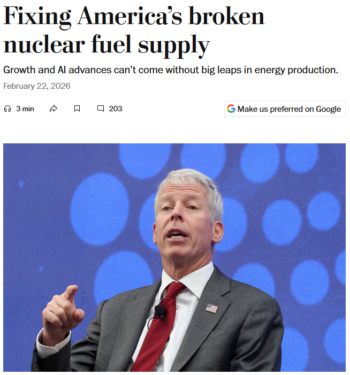
The Washington Post (2/22/26) wants the US to produce plutonium, though it doesn’t want to say the word.
The Washington Post’s next pro-nuclear editorial (2/22/26)—headlined “Fixing America’s Broken Nuclear Supply”—advocated the practice of nuclear reprocessing, which refers to the separation of uranium and plutonium from spent fuel. The extracted materials are then repurposed for use as reactor fuel, but also can be used to create nuclear weapons.
The Post editorial did not contain the word “plutonium.” It glossed over the proliferation risk, the foremost historical concern with reprocessing, only mentioning it once:
President Jimmy Carter banned the practice out of fears of weapons proliferation. President Ronald Reagan later reversed that decision, but reprocessing never rebounded, mostly because nuclear companies decided that sourcing new uranium was more cost-effective.
Reprocessing was originally invented to develop plutonium for nuclear weapons. India used it to create a nuclear bomb from its atomic energy program in 1974, which Carter explicitly cited as the impetus for the ban. Presidents George H.W. Bush and Bill Clinton also did not encourage reprocessing due to proliferation concerns.
‘Crucial to power AI’
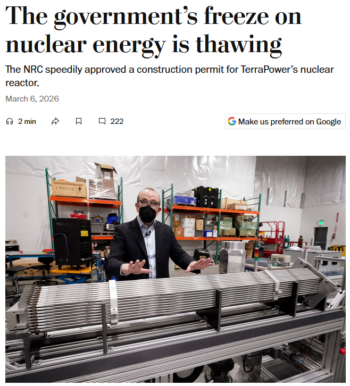
“Anyone who wants energy to cost less should be excited about the US producing more of it,” writes the Washington Post (3/6/26)—not mentioning that wind and solar can produces electricity at one-third the cost of nuclear power at its cheapest.
In its most recent nuclear editorial—“The Government’s Freeze on Nuclear Energy Is Thawing”—the Washington Post (3/6/26) celebrated the NRC’s March approval of a construction permit for Bill Gates’ SMR startup TerraPower:
Something shocking happened this week: Bureaucrats approved a project ahead of schedule. Even better, it was for a nuclear project that promises to make energy production safer and cleaner than traditional reactors. The government still holds back America’s nuclear industry too much, but it’s a victory worth celebrating.
The Trump administration has taken unprecedented measures to accelerate new nuclear reactors. It has secretly overhauled nuclear safety rules, proposed to severely cut inspections and radiation standards, and exempted new reactors from environmental reviews. Over 400 NRC employees have left the agency since Trump took office. These developments were not concerning to the Post, however, which wrote “the government still holds back America’s nuclear industry too much.”
The Union of Concerned Scientists’ Lyman warned that the NRC’s fast-tracked review for TerraPower failed to address serious safety concerns inherent to its design. The Post’s claim about TerraPower’s safety ignores unresolved issues admitted to by the NRC in the agency’s December safety evaluation:
The staff did not come to a final determination on the adequacy and acceptability of functional containment performance due to the preliminary nature of the design and analysis.
Unlike traditional reactors, TerraPower’s design does not include a physical containment dome to guard against the release of radioactive material in the event of a meltdown.
The Post wrote:
The speed with which the NRC has been able to review the TerraPower project is a testament to growing bipartisan support for climate-friendly nuclear energy. In June 2024, shortly after the company submitted its application, Congress overwhelmingly passed a bill called the Advance Act to cut red tape. Those reforms were crucial given the surging demand for new energy to power artificial intelligence.
The Post presented TerraPower’s rapid review as a “testament to growing bipartisan support for climate-friendly nuclear energy.” It does not mention that Trump fired the former Democratic NRC chair for the first time in its agency’s history, and its two remaining Democratic commissioners told lawmakers they believe they could be fired for refusing to approve reactors for safety reasons. Multiple Democratic lawmakers who voted in favor of the Advance Act have lambasted the Trump administration’s actions to expedite reactor approvals as dangerous and illegal.
The Post editorial did not mention the primary impetus for TerraPower’s rapid licensing process: a series of executive orders Trump signed last May. They directed the NRC to approve new reactors within 18 months, consult with DOGE on a wholesale revision of its regulations, and weaken radiation protections rooted in its “overly risk-averse culture.” A recent ProPublica investigation (3/20/26) revealed that nuclear firms were given the opportunity to offer edits for the EOs, many of which are financially connected to DOGE’s leadership.
‘Energy to cost less’
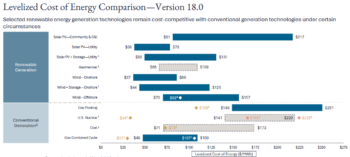
Lazard’s analysis consistently finds that electricity produced by nuclear power costs a lot more than power from most forms of renewable energy.
The Post went on to claim expanding nuclear energy will lower energy costs: “Anyone who wants energy to cost less should be excited about the US producing more of it.”
Yet as FAIR (4/21/16) explained in a 2016 analysis, Lazard investment bank’s widely cited, annual levelized cost of energy report has repeatedly found nuclear energy to be far more expensive than renewables, a finding that remains unchanged in its most recent report.
The Post claimed that the new generation of Silicon Valley–backed SMRs will be cheaper than traditional reactors, but the first expected commercial SMR project was canceled in 2023 due to repeated cost overruns that spent over $600 million in federal funds.
X-Energy, the SMR firm backed by Amazon, has also steeply increased its cost projections. In 2021, the Department of Energy awarded TerraPower around $2 billion, and gave $1.2 billion to X-Energy. X-Energy’s projected cost estimates have surged since then, from roughly $2.5 billion in 2021 to a range of $4.75–5.75 billion in 2023.
The Institute for Energy Economics and Financial Analysis warned these cost increases should serve as a “red flag” in a 2024 analysis. It concluded:
Investment in SMRs will take resources away from carbon-free and lower-cost renewable technologies that are available today and can push the transition from fossil fuels forward significantly in the coming 10 years.
As physicist MV Ramana argues in his book Nuclear Is Not the Solution (2024), tech billionaires like Bezos are backing nuclear energy rather than doubling down on renewables for reasons of of ideology, military and government alliances, and, crucially, profit opportunities. X-Energy filed for an IPO last month, giving Amazon the opportunity to leverage AI and nuclear hype into a higher opening valuation.
When the Post’s editorial board (10/15/25) hailed small reactors last year as a “worthy gamble” in an editorial headlined “The Military’s Big Gamble on Small Nuclear Reactors,” it did not mention its owner stood to profit from that wager.
This content originally appeared on FAIR and was authored by Peter Castagno.