
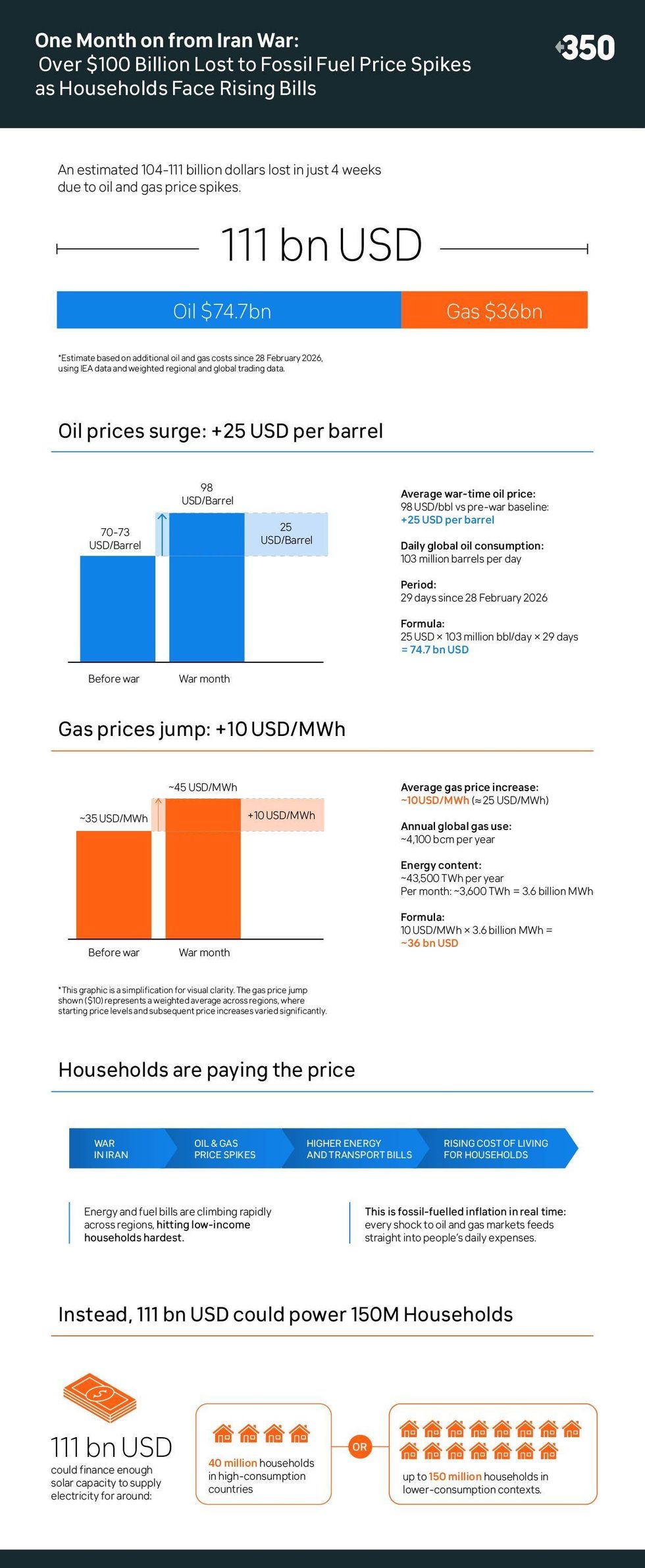
One month after the start of the Iran war, new analysis from 350.org shows that over $100 billion has been siphoned from ordinary people to oil and gas companies due to soaring energy prices.
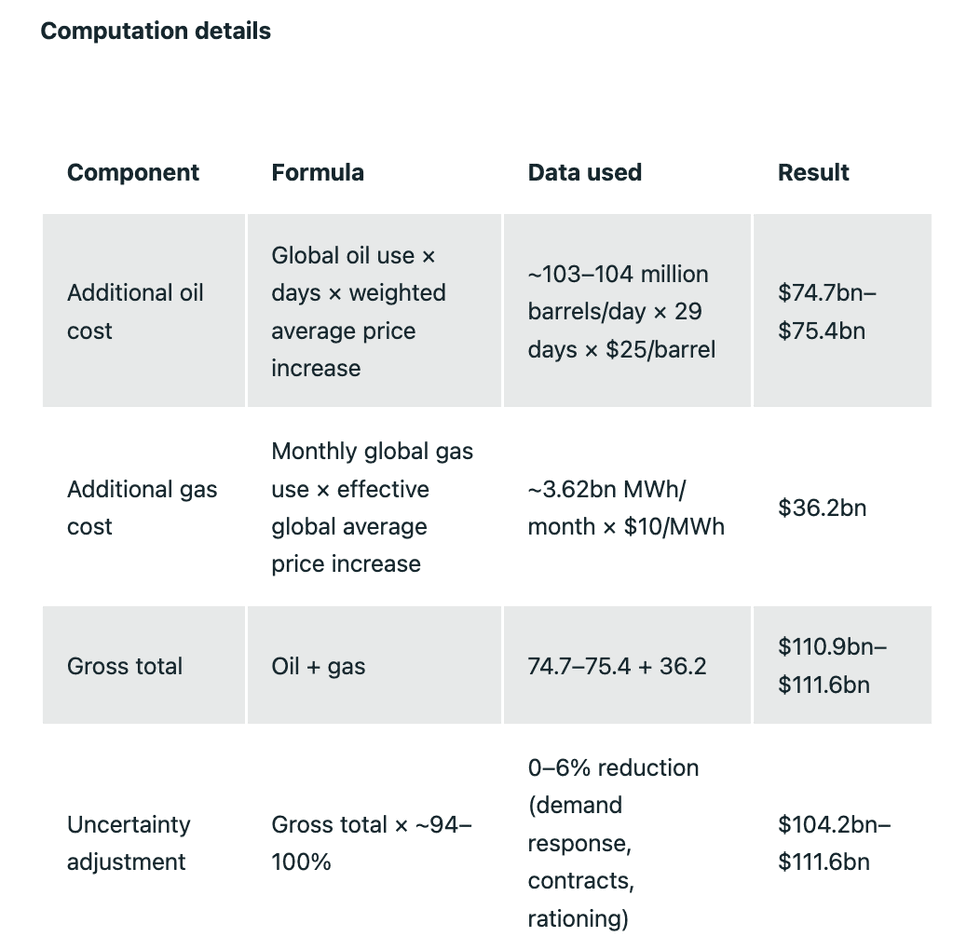
In addition to the horrific loss of human life, campaigners say the crisis highlights how dependence on fossil fuels enriches the few at the expense of the many. The analysis estimates that rising oil and gas prices have already cost consumers and businesses an additional $104.2–$111.6 billion. Impacts have been sharp and immediate, from textile factory layoffs in Bangladesh, to fuel rationing in Kenya, to a looming recession in the United States.
The 350.org analysis calculates losses from price spikes using weighted oil and gas price averages over the first month of the war, combined with global consumption levels and adjustments for uncertainty, such as reduced demand and rationing in response to rising prices.
It does not yet include wider knock-on effects, such as rising fertiliser and food costs, declines in economic output and employment, or broader inflation driven by fossil fuel price volatility. As a result, the true economic damage is likely significantly higher than the losses from oil and gas prices alone.
The $111 billion lost to higher oil and gas prices alone could instead build enough solar power to supply around 40 million households in high-consumption countries, or about 150 million households in lower-consumption contexts.
This figure is also roughly equivalent to current annual international climate finance—public and private funding provided by developed countries to developing countries under the UN Climate Convention and the Paris Agreement.
Anne Jellema, Chief Executive of 350.org, said:
“On top of the incalculable suffering of families and communities torn apart by the war, ordinary people around the world are paying an extraordinary price through fossil fuel-driven energy spikes. Over $100 billion has gone straight into the pockets of fossil fuel companies, while families struggle to afford energy and basic necessities. The case for windfall taxes has never been clearer.”
The organisation warns that, without urgent intervention, the impacts will deepen, particularly for lower-income households and countries already facing economic strain.
“Next month, governments will gather in Colombia to discuss how to end the era of oil, gas and coal. No more procrastination: our leaders must seize this moment to adopt binding targets to phase out fossil fuels and ramp up investment in a clean, safe energy future for all.”
350.org is calling on governments to tax the fossil fuel industry’s windfall profits in order to protect households from soaring prices. The group says that part of this revenue should be used to subsidise access to fast-deploying renewable solutions, such as rooftop and community solar and electric vehicles.
It emphasises that investing in renewables is the most effective way to stabilise prices, strengthen energy security, and shield economies from future crises. 350.org is also urging governments to agree on binding plans to replace oil, gas and coal with homegrown renewable energy, for example, through a Fossil Fuel Non-Proliferation Treaty.
Note to Editor:
To identify the oil and gas price delta, the analysis used various data sets, including data of the International Energy Agency, TradingEconomics and regional gas price benchmarks; the price in the week ahead of the outbreak of the war as the baseline for comparison, which likely slightly underestimates the price shock as trading prices had already modestly increased due to the anticipation of a possible conflict.
This content originally appeared on Common Dreams and was authored by Newswire Editor.