
Asia Pacific Report
Cuba’s Ambassador to New Zealand, Luis Morejón Rodríguez, last night made a passionate plea for his country’s sovereignty in defiance of the illegal US-led fuel blockade of the Caribbean nation.
Speaking at a packed Auckland Trades Hall, he warned that the three-month oil blockade and energy blackouts threatened the country’s public health system with dire consequences for many patients.
“In Cuba today, approximately 16,000 patients undergoing radiotherapy and more than 2800 patients receiving hemodialysis depend every day on a stable electricity supply in hospitals across the country,” he said.
- READ MORE: Cuban Ambassador denounces US aggression and violations of international law
- Two Cuba-bound aid ships missing after leaving Mexico
“These are life-sustaining treatments that cannot simply be postponed without risk.”
He said Cuba would continue to oppose Washington’s escalating military threats and economic pressure on his country.
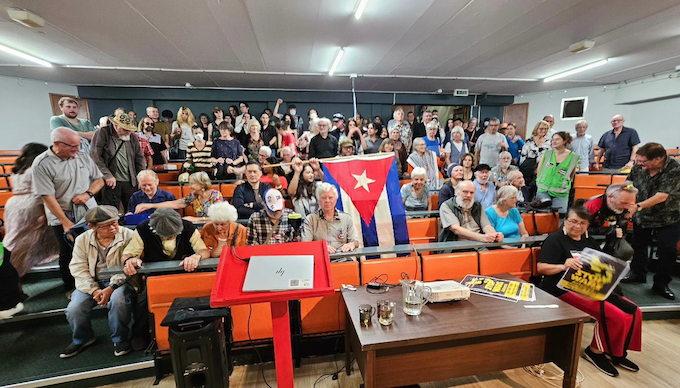
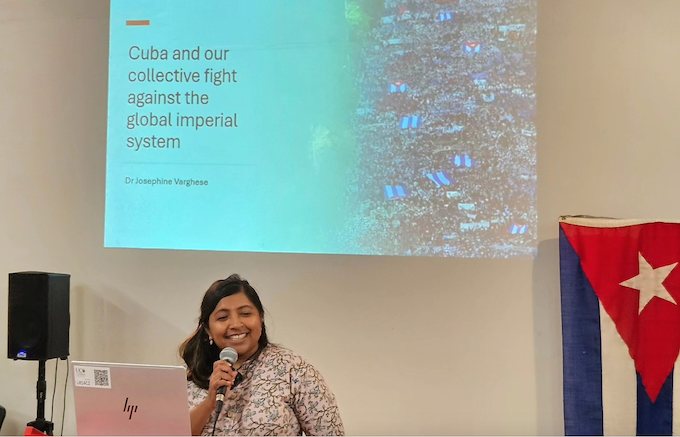
Speaking alongside Ambassador Rodríguez was Dr Josephine Varghese, a Canterbury University lecturer who shared an eyewitness account of her recent trip to Havana.
She praised Cuba and “our collective fight against the global imperialism system”.
Military assault openly discussed
A military assault on Cuba has been openly discussed by US President Donald Trump and other White House officials since the illegal January 2 strike against Venezuela and kidnapping of President Nicolás Maduro and his wife, Cilia Flores, and also during the current war on Iran.
Last week, Trump declared in an offhand manner that he could just “take” Cuba.
International humanitarian convoys are bringing aid to Cuba to protest against the US fuel blockade, as Cuba continues to fend off US threats of a takeover.
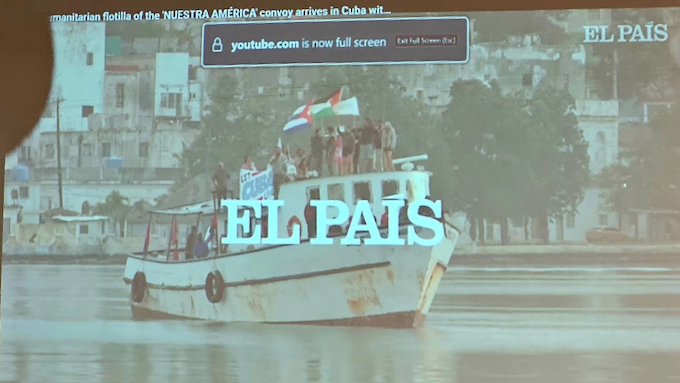
However, two Mexican sailboats on the Nuestra America Convoy that has just arrived in Cuba this week were reportedly missing at sea and coast guard authorities from Cuba and Mexico are looking for them.
Ambassador Rodríguez said solidarity aid flotillas were really important for Cubans as they demonstrated global support.
During his speech last night, Ambassador Rodríguez said that when energy availability became uncertain, hospitals needed to prioritise essential services, and non-urgent procedures often needed to be delayed, preserving electricity and fuel resources.
“In other words, restrictions on fuel do not only affect economic indicators. They directly affect operating rooms, diagnostic equipment, medical treatments, and ultimately the health and well-being of patients,” he said.
‘Coercion and collective punishment’
“That is why Cuba has described these measures as economic coercion and collective punishment.”
On January 29, the White House issued an executive order blocking oil exports to Cuba, which imports around 60 percent of its fuel.
Ambassador Rodríguez said the world was living in a moment when the international system was being tested.
“Increasingly, we see the logic of power challenging the logic of law.
“For countries like Cuba — small countries — international law is not an abstract concept. It is our main protection.”
He criticised President Trump’s claim in January that Cuba represented an “unusual and extraordinary threat” to US national security.
“Let us pause for a moment and reflect on that statement. Cuba is a Caribbean island of 10 million people,” he said.
‘We do not project power’
“We do not possess nuclear weapons. We do not have military bases abroad. We do not project military power internationally.
“And yet we are described as an extraordinary threat.
“But this declaration is not merely rhetorical. It has very concrete consequences.”
With Cubans continuing to live under prolonged blackouts and the government preparing for military confrontation, the audience last night celebrated Cuba’s courageous resistance, saying it was an inspiration to the world.
The fuel blockade, enforced by the US naval armada in the Caribbean, piles pressure on top of Washington’s economic embargo that has been in place since the early 1960s.
Discussing the impact of the blockade on Cubans that she witnessed on her travel to Cuba in January, Dr Varghese said the unjust US measures “denied working people access to the most basic necessities, from medicines to electricity and transportation”.
She linked the Cuban crisis to the Palestinian, Iranian and Venezuelan struggles for peace and justice.
The Cuba Friendship Society, which sponsoring last night’s meeting chaired by retired trade unionist Robert Reid, noted that the only crime of Cuba and its people was that of overthrowing a US-backed dictator in 1959, and then defending their sovereignty and other conquests of their revolution in the six decades since.
The ambassador is also due to speak at public meetings in Christchurch and Wellington.
This content originally appeared on Asia Pacific Report and was authored by APR editor.