
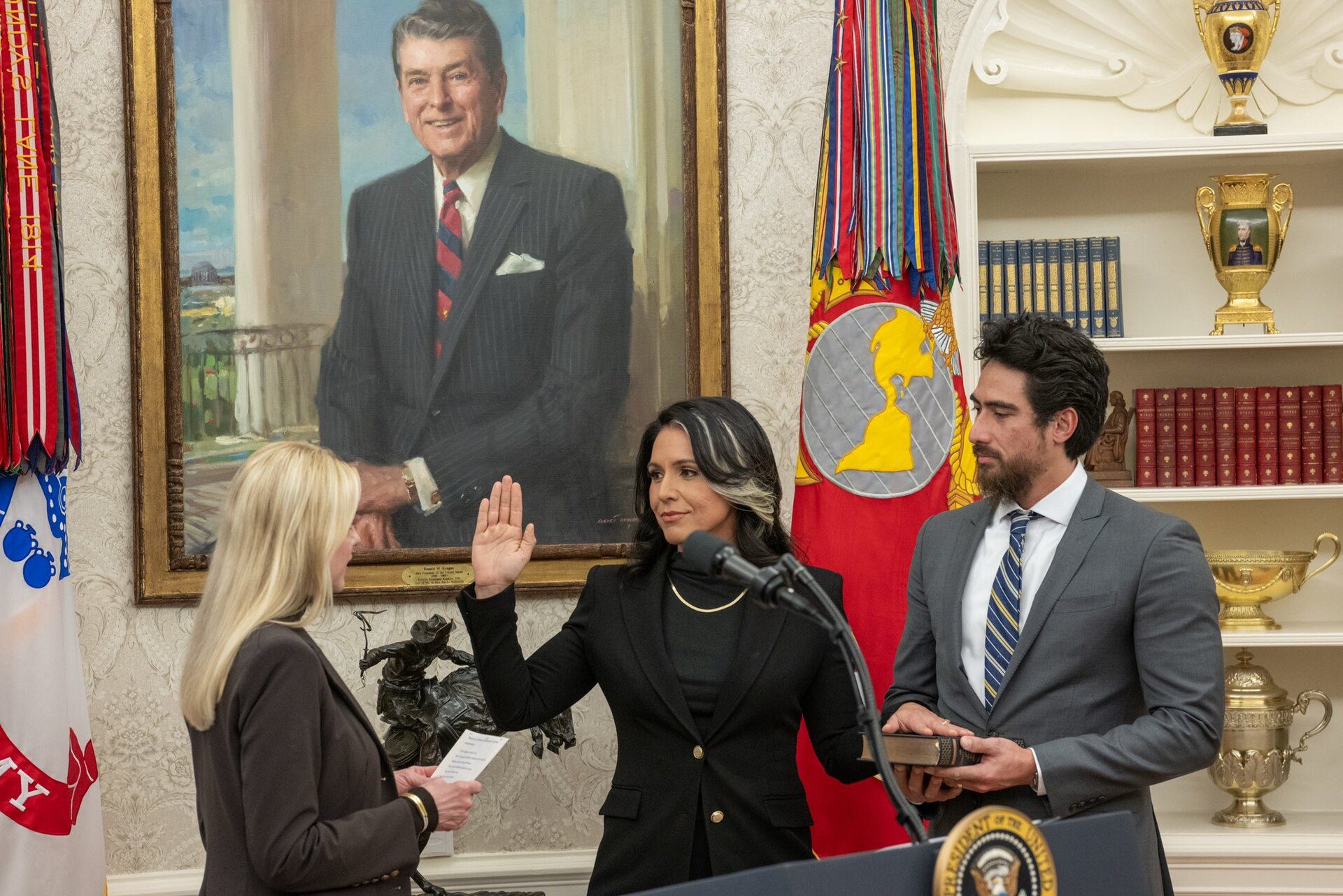
Photograph Source: Office of the Director of National Intelligence – Public Domain
“It is not a responsibility of the intelligence community to determine what is or is not an imminent threat.”
–Tulsi Gabbard, the director of national intelligence, March 18, 2026, testimony to the Senate Intelligence Committee.
“Anyone concerned with national policy must have a profound interest in making sure that intelligence guides and does not follow national policy.”
–Henry A. Kissinger, Secretary of State, October 1973.
When I joined the Central Intelligence Agency’s Directorate of Intelligence in the summer of 1966, the Soviet Division was in great turmoil because of the failure to predict the fall of Soviet leader Nikita Khrushchev two years earlier. Because of that analytic failure, the chief of the Soviet Domestic Branch had been replaced along with several of his veteran analysts. Most of the new and remaining analysts were without significant intelligence experience. My immediate reaction to this bureaucratic turmoil was “how would CIA analysts in McLean, Virginia, anticipate the coup against Khrushchev if it came as a surprise to Khrushchev?” Nevertheless, I learned from that experience that there were significant consequences for successes and failures in the intelligence community.
The fact that Tulsi Gabbard, a bizarre choice for the position of director of national intelligence, is not familiar with her most important duty regarding the warning of threat, let alone an “imminent” threat, is particularly stunning and dispositive regarding her continued role in that job. Her own National Intelligence University defines threat warnings as “one of the core responsibilities” of the intelligence community, and stresses that intelligence failure is “associated with a failure to warn.” Gabbard’s failure to understand her role is actually far worse because she was clearly unwilling to challenge Donald Trump’s false assessment of an “imminent threat” to justify his illegal and immoral attack against Iran.
One of the most influential scholars regarding warnings intelligence, Cynthia Grabo, wrote that “it is an axiom of warning that warning does not exist until it has been conveyed to the policymaker, and that he must know he has been warned.” Trump claims that he wasn’t warned about Iran’s threat to close the Strait of Hormuz or of possible threats to the energy infrastructure of the Gulf states. One of my former CIA colleagues, John Bird, who was the National Intelligence Officer for Warning in 2017, stated that “warning that comes too late is not warning, it is entertainment.” Tulsi Gabbard does not appear to understand any of this or—more likely—she has chosen her words in an awkward effort to avoid clashing with her president.
A week ago, a colleague of Gabbard’s, the director of Homeland Security, was fired for alleging that the president had approved the tens of millions of dollars in ads that prominently featured Kristi Noem in her role as director of homeland security. Trump, for his part, said that he knew nothing about the ad contract that skirted federal competitive bidding rules and went to a company that had personal business ties to Noem.
Gabbard tried to avoid Noem’s blunder by leaving sensitive intelligence out of her oral remarks to the Senate Intelligence Committee that challenged the views of the president. Her written statement echoed Trump’s claim to having “obliterated” Iran’s nuclear enrichment program in strikes last year, and stated that there have been “no efforts since then to try to rebuild their enrichment capability.” Her oral testimony falsely claimed that “Iran was trying to recover from the severe damage to its nuclear infrastructure.”
Gabbard’s deceitful and two-faced testimony to the Senate Intelligence Committee brings to mind the other failures of intelligence that were costly to U.S. national interests. Such failures involved inadequate or unexamined assumptions and failures to incorporate new information. Much worse are the failures associated with politicized intelligence, with political interference leading to corruption of the intelligence process. The politicized intelligence of CIA director Bill Casey and deputy director Bob Gates led to unnecessary spending on defense at a time when the Soviet Union was falling apart. The politicized intelligence of CIA director George Tenet and deputy director John McLaughlin was used to justify an unnecessary war against Iraq in 2003 regarding non-existent weapons of mass destruction.
The pathetic performances of Gabbard, CIA director John Ratcliffe, and FBI director Kash Patel in perverting threat assessments demonstrate that our current intelligence directors are failing to tell truth to power. As a result, U.S. national security is being jeopardized. The fact that the Pentagon is already requesting an additional $200 billion to fight the war in Iran, which exceeds the entire Russian defense budget and nearly equals the Chinese defense budget, suggests that many political and intelligence blunders were made in the run-up to Trump’s “excursion” in Iran.
The post The Intelligence Community and the Essential Role of Threat Assessment appeared first on CounterPunch.org.
This content originally appeared on CounterPunch.org and was authored by Melvin Goodman.