
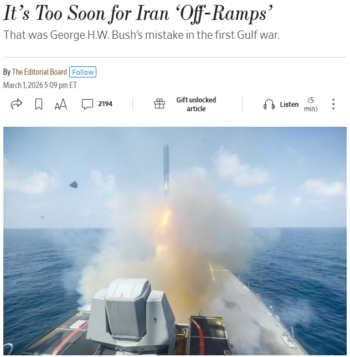
“The biggest mistake President Trump could make now would be to end the war too soon,” the Wall Street Journal (3/1/26) declared.
The United States and Israel are, for the second time in less than a year, committing “the supreme international crime” against Iran (FAIR.org, 7/3/25). Editorials in three of the United States’ most prominent newspapers, the New York Times, Wall Street Journal and Washington Post, offered varying degrees of support for the aggression.
The Times waffled about bombing Iran, the Journal enthusiastically supported it, and the Post had fewer concerns about the war than the Times but more than the Journal. Crucially, however, all three papers rationalized the US/Israeli assault.
The Journal provided full-fledged endorsements of the unprovoked attack, writing in its first editorial (3/1/26), headlined “It’s Too Soon for Iran ‘Off-Ramps,’” that “the first two days . . . have been a striking success.”
“The biggest mistake President Trump could make now would be to end the war too soon,” it said.
The Journal (3/2/26) took the same approach in its next editorial, “Trump Enforces His Red Line on Iran,” calling the aggression a “necessary act of deterrence.” “It carries risks as all wars do,” the piece read, “but it also has the potential to reshape the Middle East for the better and lead to a safer world.” The editors reiterated that their “main concern is that Mr. Trump may stop too soon.”
Killing upward of 175 Iranians at a girls’ elementary school (FAIR.org, 3/2/26) didn’t temper the degree to which the US/Israeli aggression was a “striking success,” nor was the possibility of similar massacres a “risk” or a “concern” of the editors.
‘Seeing this through’
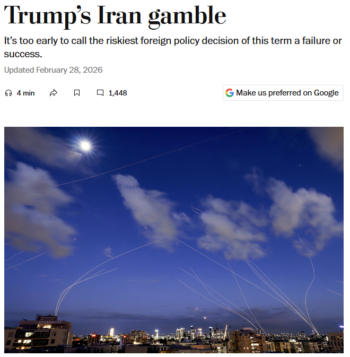
The Washington Post (2/28/26) warned of “the danger of lobbing some bombs without seeing this through.”
The Washington Post (2/28/26) expressed some reservations about the choice to go to war under the headline “Trump’s Iran Gamble,” but they seemed to be largely related to questions of success and procedure: whether the war would turn into a “quagmire,” “what happens to US troops throughout the region,” and that “it’s essential that the people’s elected representatives get to vote on whether these strikes are justified.”
The paper’s remaining concerns echoed the hawks at the Journal, worrying Trump might not go far enough. The editors fretted about “the danger of lobbing some bombs without seeing this through” and warned that “freedom for the people” might not be achieved “without some US boots on the ground…. Yet Trump appears to lack any appetite for doing so.”
While the Post appeared to have doubts about Trump’s leadership and strategy, at no point did the paper say that he shouldn’t have started the war, nor made mention of the prohibition under both US (The Hill, 6/23/25) and international law (Conversation, 3/20/22) on assassinating heads of state.
‘A successful outcome’
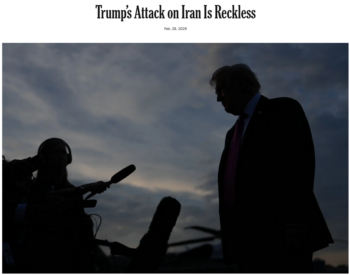
The New York Times (2/28/26) maintains that “Iran’s government presents a distinct threat because it combines…murderous ideology with nuclear ambitions”—but Trump didn’t announce he was attacking them the right way.
Meanwhile, the New York Times’ strongest criticism (2/28/26) of the US/Israeli attack was that
Mr. Trump’s approach to Iran is reckless. His goals are ill-defined. He has failed to line up the international and domestic support that would be necessary to maximize the chances of a successful outcome. He has disregarded both domestic and international law for warfare.
While the authors were correct to suggest that the war is illegal, they nevertheless implied that a “successful outcome” to this war of aggression is desirable. That ending the war as soon as possible would be a “successful outcome” was not part of the Times’ calculus.
Like the Post, the Times’ criticisms were mostly based on proceduralism. The Times (2/28/26) complained that Trump
started this war without explaining to the American people and the world why he was doing so. Nor has he involved Congress, to which the Constitution grants the sole power to declare war. He instead posted a video at 2:30 a.m. Eastern on Saturday, shortly after bombing began, in which he said that Iran presented ”imminent threats” and called for the overthrow of its government.
Thus, the Times was more concerned with how Trump explained his war aims to the American public than with those aims themselves. Indeed, as we’ll see, the paper dedicated considerable space to shoring up the rationale for the US/Israeli attack.
‘Positive consequences’
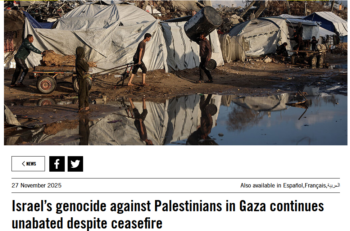
For the New York Times (2/28/26), Israel’s ability to continue its genocide in Gaza (Amnesty International, 11/27/25) without resistance from Hamas appears to be a “positive consequence” of bombing Iran.
One trait the propaganda in all three papers shared is the notion that Iranian foreign policy means that there are upsides to launching the all-out war with Iran. The New York Times‘ headline (2/28/26) called the attacks “reckless,” but the analysis bolstered the argument for the war about which they professed to be concerned:
Israel has reduced the threats from Hamas and Hezbollah (two of Iran’s terrorist proxies), attacked Iran directly and, with help from allies, mostly repelled its response. The new recognition of Iran’s limitations helped give rebels in Syria the confidence to march on Damascus and oust the horrific Assad regime, a longtime Iranian ally. Iran’s government did almost nothing to intervene. This recent history demonstrates that military action, for all its awful costs, can have positive consequences.
These “positive consequences” include a genocide in Gaza that, despite a so-called ceasefire, hasn’t ceased (Amnesty International, 11/27/25; Palestine Centre for Human Rights, 2/4/25). Sectarian massacres have followed the fall of Assad in Syria (FAIR.org, 6/2/25); similarly, in the first year of post-Assad Syria, Israel bombed the country even more than it had the previous year, and increased its theft of Syrian territory (Al Jazeera, 11/20/25). Nearly 4,000 Lebanese people were killed in the 2023–24 US-backed Israeli war on the country, Human Rights Watch noted, which included
apparently deliberate or indiscriminate attacks on journalists, civilians, medics, financial institutions and peacekeepers, in addition to the widespread and unlawful use of white phosphorus in populated areas, among other violations. More than 1.2 million people were displaced by the time of the November ceasefire, thousands of buildings and houses were destroyed, and entire border villages were reduced to rubble.
Subsequently, Israel has violated a sham ceasefire in Lebanon more than 10,000 times, during which “positive consequences” continue to accrue, such as the killing of 12 people in late February attacks (Democracy Now!, 2/23/26).
‘Biggest state sponsor of terrorism’
The Washington Post (2/28/26) wrote:
For a generation, Iran has been the world’s biggest state sponsor of terrorism, backing Hamas, Hezbollah, the Houthis and other proxies as they wreaked havoc and killed Americans.
Linguistic choices used to rationalize war and genocide need to be rigorously scrutinized, and nowhere is this more necessary than when the word “terrorism” is being deployed to rationalize the mass murder of Muslim-majority populations. As Edward Said (New Left Review, 9–10/88) wrote:
The most striking thing about “terrorism,” as a phenomenon of the public sphere of communication and representation in the West, is its isolation from any explanation or mitigating circumstances, and its isolation as well from representations of most other dysfunctions, symptoms and maladies of the contemporary world…. [Terrorism has been] stripped of any right to be considered as other historical and social phenomena are considered, as something created by human beings in the world of human history.
Hamas’s violence against Israelis on October 7, 2023, came in the context of Israel killing more than 7,000 Palestinians over the previous 23 years, including more than 2,000 children (B’Tselem). Israel has for decades occupied, besieged and ethnically cleansed Palestinians (Electronic Intifada, 7/26/18), and is now committing genocide against them (UN, 9/16/25).
Hezbollah came into existence as a result of the Israeli invasion and occupation of Lebanon in the 1980s (Electronic Intifada, 1/16/24), and went on to win wide popular support in the country, as demonstrated by its winning more seats than other party in elections (FAIR.org, 10/10/24).
Yemen’s Ansar Allah, known at the Houthis, arose as a rebellion against Ali Abdullah Saleh, the nation’s US-backed dictator (BBC, 12/4/17, 3/25/25). It gained power and prominence by continuing to struggle against his successor, Abd Rabbu Mansour Hadi, and then the “catastrophic” US/Saudi war on Yemen (In These Times, 4/13/23). Both Ansar Allah and Hezbollah are, it’s worth noting, guilty of helping the Palestinians resist the US/Israeli genocide (FAIR.org, 1/24/25).
If the Post wanted to help its readers make sense of the world, the paper would make some effort to explain who Hamas, Hezbollah and Ansar Allah are, and the contexts in which they have engaged in political violence, as well as the vastly more deadly and injurious violence initiated by the US and Israel they have faced. Instead, the paper offers a simplistic, ahistorical demonization of these groups as ideological scaffolding for “the supreme international crime” against Iran, as well as the slaughter of Palestinian, Lebanese and Yemeni people.
‘Main threat to the entire region’
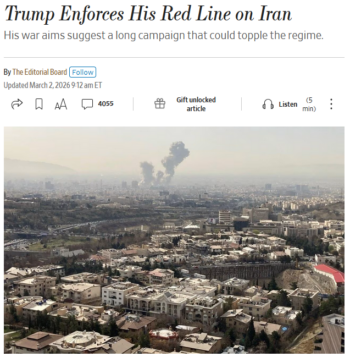
The Wall Street Journal (3/2/26) finds it “hard to imagine instability greater than what the [Iran’s] revolutionary regime has promoted for nearly five decades.”
The second (3/2/26) called the US/Israeli aggression “a necessary act of deterrence against a regime that is the world’s foremost promoter of terrorism.” The piece responded to the view that the war could lead to “new conflicts among other powers in the region” by saying, “Events are impossible to predict, but it’s hard to imagine instability greater than what the revolutionary regime has promoted for nearly five decades.”
It’s nonsensical to say that Iran is “the main threat to the entire region” and that “it’s hard to imagine instability greater” than that which Iran has “promoted in the region.” None of Iran’s alleged, unspecified crimes in the region come close to the actual bloodshed (not its mere “threat”) and “instability” the US and Israel have wrought in the “greater Middle East,” not only in Palestine, Lebanon, Syria and Yemen, but in Afghanistan (FAIR.org, 8/19/21), Iraq (BBC, 10/16/13; Guardian, 3/4/00) and Libya (Alternet, 12/5/17).
‘The danger of lobbing some bombs’
All three papers also lent credence to the idea that it would be legitimate to conduct a war on Iran to prevent it from developing nuclear weapons. The Washington Post (2/28/26) asserted:
Iran cannot be allowed to develop a nuclear weapon. Trump insisted that last summer’s bunker-buster bombs totally “obliterated” Iran’s enrichment program, but now he says it needs to be “totally, again, obliterated.” It’s always been clear he was exaggerating the success of Operation Midnight Hammer, and Iran has remained unwilling to give up its goal of proliferation. The danger of lobbing some bombs without seeing this through is that Iran’s leaders could become more determined than ever to get a bomb to deter future strikes.
Yet the day before the US/Israeli aggression commenced, it came to light that Iran had agreed to not stockpile enriched uranium (CBS, 2/27/26). Without such nuclear fuel, it’s impossible to make a nuclear bomb. Contrary to the Post’s suggestion, Iran apparently was not “unwilling to give up” its alleged “goal of proliferation.”
The Wall Street Journal (3/2/26) acted as if this Iranian offer had not taken place, saying that Trump “gave Iran’s Supreme Leader, Ayatollah Ali Khamenei, ample chance to strike a deal on nuclear weapons and its missile force, but the ayatollah refused.” The editorial praised the US/Israeli campaign, saying that even if the Iranian government survives, “the nuclear program will be difficult and expensive to rebuild.”
Yet on February 18, International Atomic Energy Agency (IAEA) Director-General Rafael Grossi said the organization had not seen any indication that Iran might currently be working to develop a nuclear weapon (CBS, 2/19/26). How Iran might “rebuild” a program that it may not have in the first place is anyone’s guess.
A ‘worthy goal’
“Preventive strikes…have no basis under international law,” noted the Australian Institute of International Affairs (7/3/25). “Strikes cannot be justified solely on the grounds that a future attack is believed inevitable—as it is impossible to determine whether such a condition will ever come about.”
Even though the New York Times (2/28/26) noted that “Iran does not appear close to having a nuclear weapon,” the paper described “the elimination of Iran’s nuclear program” as a “worthy goal.” The paper added:
American presidents of both parties have rightly made a commitment to prevent Tehran from getting a bomb.
We recognize that fulfilling this commitment could justify military action at some point…. The consequences of allowing Iran to follow the path of North Korea—and acquire nuclear weapons after years of exploiting international patience—are too great.
“Prevent[ing] from getting a [nuclear] bomb” could not, in fact, “justify military action.” Pre-emptive or preventative wars “clearly” violate international law (Australian Institute of International Affairs, 7/3/25), so even if Iran was on the cusp of having a nuclear bomb, that would not be grounds to attack them.
None of the editorials in the Times, Journal or Post mentioned that, in the run up to the US/Israeli aggression, the IAEA said it had no evidence that Iran was working on nuclear weapons development, or that Iran had agreed to an arrangement under which it couldn’t develop a nuclear bomb. Instead, the papers implied that a nuclear-armed Iran was a near-term possibility, and that such a prospect would warrant bombing the country.
When scholars and students look back on 2026 and study how some of the US’s most prominent papers responded to the war of aggression on Iran, the main takeaway won’t be that the Journal offered unhesitating applause while the Times and the Post equivocated. It will be that all three defended the indefensible.
This content originally appeared on FAIR and was authored by Gregory Shupak.