
Janine Jackson interviewed academic and writer Gregory Shupak about the US/Israeli aggression against Iran for the March 6, 2026, episode of CounterSpin. This is a lightly edited transcript.

USA Today (3/1/26)
Janine Jackson: Every day is a good day to recognize the substantive differences between the corporate news media, who firehose at us every day, and alternative outlets that you might need to seek out, whose journalism is shaped by a different bottom line. But when the country you live in launches an illegal, unprovoked assault against another sovereign country, that’s an excellent time to look at those differences.
Outlets like Drop Site News, Mondoweiss, In These Times, The Nation are bringing us critical assessments of the Trump White House’s shifting rationales for their attacks on Iran, along with voices from the people in the region, on the ground, who have a historical understanding that precedes the last presidential election.
Corporate media are reporting the assassination of Iran’s supreme leader, Ali Khamenei, as a “Cool Slick Techno-Operation,” in critic Adam Johnson’s phrase, while USA Today fearmongers with an explainer headed “US on High Alert for Homeland Attacks by Iran. What to Know.” Well, “what to know” starts with the brain teaser that the FBI and DHS are “on war footing due to Iran’s long history of plotting retaliatory attacks.”
If you can buy that premise, elite media assume you will buy the bit of yet another US war on a sovereign nation that no intelligence suggested posed an imminent threat, and that the majority of the US public oppose—but that will cause death and destruction, and be used as an excuse for why you can’t have healthcare.
Here to help us sift through news media that appear either vehemently or lazily uninterested in history or humanity is Gregory Shupak. He teaches media studies and English at the University of Guelph in Toronto. He joins us now by phone. Welcome back to CounterSpin, Gregory Shupak.
Gregory Shupak: It’s good to be back. Thanks for having me.
JJ: Listeners will understand: We are recording on March 5, and many things are happening as we speak, and certainly will have happened by the time that they hear this. That said, some things will still be true. At the risk of sounding naive or redundant—except that if you read the news, you know they still need saying: The US and Israeli strikes on Iran, the murdering of school girls, the assassination of Khamenei, are illegal, unprovoked and unpopular, yes?
PBS (3/6/26)
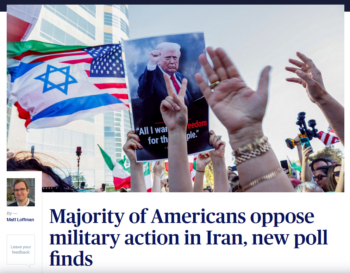
GS: Yeah, certainly. And I think that it’s interesting to observe the disjuncture between what’s been pretty thoroughly a media full-court press in support of the war, on the one hand, and on the other hand, the lack of public support for it.
And yet I think it’s also the case that, for war propaganda to be effective, it doesn’t necessarily have to result in the population being enthusiastic about it. The main thing it needs to accomplish is to plant enough doubt, sow enough confusion, that people aren’t organizing in large enough numbers to bring it to a halt. And so I don’t think the yardstick of the effectiveness of propaganda is solely “does the public support it,” to, for example, the very high degree that they did at the outset of the Iraq invasion.
JJ: Right. Which I always want to put an asterisk on because that high support was right before the invasion. And if you go back a couple weeks earlier, the US population was not even supportive of the Iraq invasion, yeah? I appreciate that talking point, and at the same time, I think if you move those polls back a couple of weeks, people were asking, “Why are we going to invade Iraq?”
You know, as a New Yorker, we were reeling from the attacks, but it wasn’t a cry for war. But I appreciate, still, the distinction—and it has to do, I guess, with maybe something that the people, if not the politicians, have learned.
Popular Information (3/9/26)
GS: Yeah, I absolutely think that a lot more of the population understands the costs of these types of adventures, and yet that is still not materializing in organized public opposition. And there are a lot of factors that explain that, not all of which has to do with corporate media propaganda, but I think that that is one noteworthy feature that is, of course, a throughline for so many of the US-led wars in the post-1945 era, that even, regardless of where public support is at, it takes quite a while—as it did in Vietnam, for example—for really large-scale, mass, effective opposition to materialize. And that’s if it ever does.
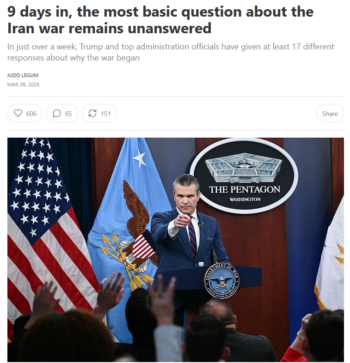
JJ: Let’s get into the media coverage that I know you’ve been, unfortunately, steeping yourself in. Some news media seem to feel that noting Trump’s shifting rationales for the aggression on Iran is the same as interrogating them, but it sort of feels like they’re just waiting for him to land on one that they can get behind. But certainly it’s meaningful that President Trump keeps saying something different about why we’re doing this.
GS: Yeah, absolutely. And I don’t know, it’s always hard to parse with him, and also his administration, how much of this, of the inconsistency in their talking points, has to do with a deliberate strategy versus incoherence. But certainly, in the initial 24 hours, Trump was pretty clear that the goal included regime change, where they seem to have backed off of that since then.
New York Times (2/28/26)
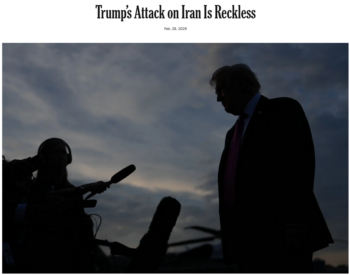
But it is, as you say, rather a weak criticism of the war to just say Trump is being unclear, or to emphasize, as the New York Times’ first editorial on the attack did, there was this focus on, well, the way that Trump communicated with the American population, which was dropping a video in the middle of the night.
And yes, that is an absurd way to, frankly, avoid democratic engagement. However, if Trump had some sort of town hall meeting, and this was still what was happening, it’s not as if his method of communication matters more or as much as the fact of carrying out this war in the first place.
And I would say the same thing about the criticisms that we saw in that Times editorial, and in the Washington Post editorial as well, about Trump’s failure to get congressional authorization for this war. I understand why that matters, within the context of the American system. At the same time, if you had got it, the war would still be an act of aggression under international law. It’s kind of secondary for those living outside US borders whether Trump follows the Constitution to the letter or not.

Gregory Shupak: “Those who start the war are responsible for all horrors that take place within the context of that war.”
Again, I agree it would be better if the proper democratic protocols were followed, but I don’t think that that’s salient here. And it’s picking at the edges to foreground those criticisms of the war, rather than foregrounding the fact that what he’s doing was described at the Nuremberg Tribunal, after the Second World War, as the “supreme international crime.”
And the reason it was called that was because the act of international aggression—that is to say, starting a war—means that those who start the war are responsible for all horrors that take place within the context of that war. So however this unfolds, and whatever ghastly casualty figures we end up at, and whatever manner those deaths happen to unfold, all of that is laid at the doorstep of the aggressors, the US and Israel. So that’s really where the emphasis ought to be, much more so than on this kind of proceduralism.
JJ: Absolutely. And it’s amazing how far we’ve come from Nuremberg, to the point where I think it’s fair to say that a lot of corporate news media foreign policy coverage gives you the feeling that diplomacy is for the weak. And in this conversation, the US was purportedly in diplomatic conversations, I mean, was in diplomatic conversations with Iran, moderated by the head of Oman. We never heard that those conversations broke down, but suddenly, then, the US is unleashing fatal aggression. And so how are we to think about diplomatic conversations, when this can happen in the midst of them? It sort of feels like it’s a joke on us.
GS: Yeah. I mean, it looks like it was probably just a stall tactic by the US to get their ducks in order for the war. And in terms of the media coverage, I think they mostly, since the war was launched, pretend that those discussions were not even happening, or they lie about them.
Face the Nation (2/22/26)
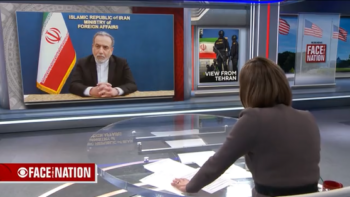
But the reason why they often pretend they weren’t happening is because what was coming out those negotiations completely undermines the argument, which is one of their central pro-war talking points, that supposedly these attacks on Iran are justified because the government of Iran allegedly might or someday could be pursuing nuclear weapons. Hours before the US/Israeli strikes began, the Iranian foreign minister, Abbas Araghchi, went on CBS‘s Face the Nation and said that Iran had agreed to effectively take steps that would make it impossible for it to build a nuclear weapon.
To be more specific, the Iranians had agreed to zero enrichment, without which you cannot build a nuclear bomb. That’s completely expunged from the record that I’ve seen, and certainly from the editorials in the major papers that I’ve looked at for the FAIR piece that I’ve been working on this week, which are from the Washington Post, Wall Street Journal and the New York Times.
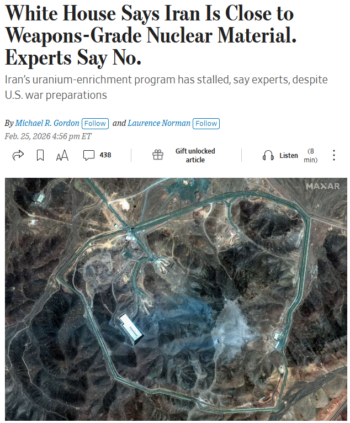
Wall Street Journal (2/25/26)
In addition, we also have statements from the International Atomic Energy Agency, specifically from Rafael Grossi, the director general of the IAEA. He said in late February, second half of February, that he had not seen any indication that Iran was currently working to develop a nuclear weapon. That’s really pretty important, and is not in any of the initial responses to the war.
Now, Grossi came out and reiterated this point on I think it was Monday, a couple days into the aggression against Iran, and that got a little bit of coverage. But in the initial commentary, where you had this specter of nonexistent Iranian nukes, it might’ve been helpful to point out, whenever Trump makes reference to the Iranian nuclear program, that there’s really no proof that, according to the IAEA, that it’s even working on developing a nuclear weapon, let alone having one imminently.
JJ: Let alone having one within reach of California.
GS: Yeah, exactly. And that’s, again, to say nothing of what happened in Oman, which is that in these indirect US/Iranian talks, Iran had apparently agreed to zero enrichment, which would make building a bomb impossible. So it was a charade, then, the negotiations—or at least a charade on the US part, I should say.
And it would be nice if the US population had some insight into that, not only for this bloodbath, which is going to drag on who knows how long, and kill just unthinkable volumes of people, as it already has killed over 1,200 in the first six days—1,200 in Iran, I should say; other numbers in some of the other countries in the region, dozens in Lebanon, which is a direct corollary of attacking Iran.
Yeah, it would also be nice if the public had just another reminder of how little the US government can be trusted on these matters, because I don’t think that this aggression against Iran will be the last time that the US attacks a country. And so the further that people can kind of develop a consciousness around imperialist lies, the better in terms of the capacity to resist those wars.
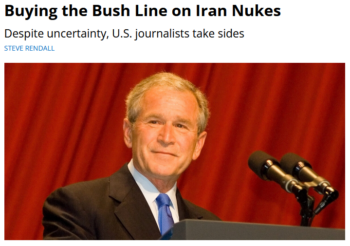
Extra! (9–10/05)
JJ: Absolutely. And on the nuclear question—and I would ask folks to look at FAIR.org; we’ve talked about this many times over the years—there is zero evidence that Iran is developing a nuclear weapon, and, in fact, international agencies, as you’ve said, the IAEA and others, have assessed that, have looked into that. Even the United States intelligence doesn’t say that Iran is developing a nuclear weapon. And I would encourage folks to read the coverage carefully, because you hear “nuclear program,” you know, “nuclear energy,” and then you’re meant to just elide that into weaponry.
And then further, just to take us back to basics, the US has nuclear weapons. Israel has nuclear weapons. And so the idea that the price of participating in “serious people” foreign policy conversation is to accept that some countries should have nuclear weapons and others, if they look like they might be able to potentially develop them, well, we need to bomb them off the map. That is weird. That is not a logical, humane understanding of anything.
GS: Yeah, absolutely. And it’s also worth pointing out—and I meant to get to this point a moment ago—let’s say Iran was developing nuclear weapons, and we had good reason to believe that, the IAEA said they found proof, whatever. OK, let’s say that was happening. There’s still no doctrine in international law that justifies a preventative or preemptive war to disarm Iran.
So it’s basically irrelevant whether Iran was developing nuclear weapons or not. That’s not relevant to the question, “Do the US and Israel have the right to attack it?” They don’t.
JJ: You know, I don’t see silver linings especially, except for increased awareness, right, of horrors and of falsities, and maybe an increased ability to address them, which is, I think, what we’re talking about. This is a big question that I hope you can answer short, but for many listeners, you look at a globe, countries are two different colors, that means they’re different countries; but this is obviously a regional operation. It always has been. For a layperson’s ears, what should we be thinking about, in terms of the region? By which I mean, what headlines are we, as US media consumers, going to be suddenly surprised by in a month? We’re going to hear about Lebanon, we’re going to hear about…. What situation should we be looking out for, in terms of the region, in terms of the impact of this US aggression?
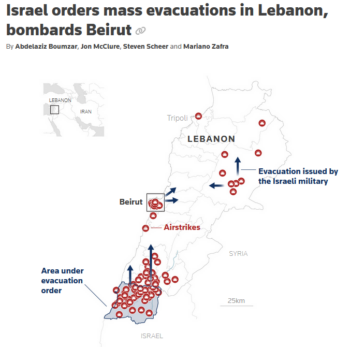
Reuters (3/6/26)
GS: Yeah, the US and Israel, but Israel’s taking the lead on it with regard to Lebanon, are essentially issuing decrees, ordering South Lebanese people to evacuate that portion of the country south of the Litani River, which is a mass displacement of the population, just as we saw in Lebanon when Israel was attacking it in fall 2024, and just as we’ve seen in Gaza as well.
It seems, based on some of the Israeli rhetoric, that there is an appetite inside Israel to get a permanent foothold in Lebanon, just as they’ve done, not only with, obviously, Palestinian land, but also Syria, so I think that there’s a very real risk that Israel, with US support, is going to try to build bases, if not outright settlements, in Lebanese territory, and keep as much of southern Lebanon as they can.
And so you’ll hear probably a lot about efforts to disarm Hezbollah, and efforts to cast Lebanese society as a whole as against Hezbollah, or present them as some sort of rogue operation that has no support in Lebanon, rather than what they are, which is, at this point, a major political player that has twice, in recent years, performed better than any other political organization in the country’s elections. They’re, at this point, an intrinsic fabric of Lebanese society.
It’s not to say that they enjoy majority support, or anything like that, but I think you’re going to see a lot of one-dimensional demonization of Hezbollah to justify something that could push Lebanon dangerously close to another civil war, that is to say, if the Lebanese central government tries to disarm Hezbollah, which they may not do, because they don’t really have the capacity to disarm them, but they might try, at the behest of the US and Israel, and with their support.
But certainly, what we’re already seeing is mass violence against Lebanese people being carried out by Israel with US support. And I think there’s a real risk that that will translate into an attempt to hold onto Lebanese territory for the long term. So I think that’s a major regional flashpoint.
Certainly Yemen and the Red Sea surrounding it, because Ansar Allah, which is often referred to as the Houthis in the mainstream media, is again involved in the US/Israeli aggression against Iran, just as they have been, at various points, involved in supporting Palestinian resistance to genocide.
And so I wouldn’t be surprised at all if we hear rationalizations in corporate media for attacks on Yemen, that will be justified, as previous attacks in Yemen have been, in terms of saying, “Well, the Houthis”—Ansar Allah, as it is typically called—”are interfering with shipping in the region. They’re firing weaponry at Israel. So for these reasons, the US itself perhaps, or if not them, then Israel, needs to ramp up airstrikes against Yemen.”
And it’s worth noting that the areas where Ansar Allah hold power is roughly, depending on which estimate you look at, 70 to 80% of the population of Yemen. Already the country is ravaged by the disastrous US/Saudi war from 2015 onward to a ceasefire a few years back. By some metrics, it’s the poorest country in the region. So I think Yemen will definitely be another focal point, where you’ll see corporate media trying to soften up the population to accept more grotesque violence being inflicted upon the people of Yemen.
JJ: Absolutely. Well, I don’t want to end there. So let me ask you, finally, we do see that these things are not popular. They’re not supported. Whether or not the people who oppose this US aggression have the levers of power to change it is its own question, but I do take heart in the fact that folks see through it. It is very hard to sell killing school girls who showed up to play volleyball. That’s a hard sell, you know? And it takes a lot of work to sell that narrative, and I think that people are resisting it, and are girding themselves against it.
But how do we do that? How do we get ourselves, as citizens in the US—and Canada, as I know you are, and there are analogous issues—how do we gird ourselves? How do we prepare ourselves to stay critical and stay human in the midst of this?
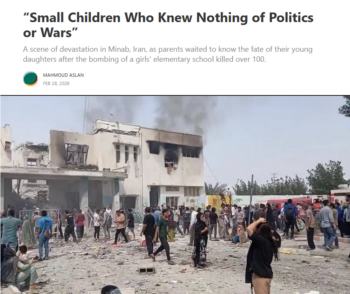
Drop Site (2/28/26)
GS: I am going to venture that just simply by virtue of listening to this, much of the audience already has a pretty good moral compass in terms of understanding that the lives of Iranian schoolchildren matter just as much as the lives of the schoolchildren at the school down the street from wherever you live.
So I’m quite sure that most people listening will be on solid ground there. There is, unfortunately, a segment of the population in both of our countries that doesn’t see it that way.
But I do think that cutting through the propaganda is not only something that happens in the form of writing articles and independent media, as much as I obviously think those things are important, but popular organizing, popular education, these are spaces as well where that counter-propaganda can take place, right? Resistance to propaganda, that happens at rallies, that happens at teach-ins, that can happen, frankly, at a conversation you strike up with your relative or your friend.
So it is something that some of us get to do the flashy, fun things like write articles, but that’s only one part of it. And it’s not necessarily the most effective. It’s certainly not the only effective form of what is, frankly, just very slow, and at times halting work of building resistance to imperialist warfare.
So sometimes you might text your mom and provide a little bit of information about how to understand Hezbollah a bit better than what corporate media offer. And that can go a long way.
JJ: All right. We’ll end there for now. We’ve been speaking with Gregory Shupak, academic and activist, and author of The Wrong Story: Palestine, Israel and the Media, available from OR Books. Thank you so much, Greg Shupak, for joining us this week on CounterSpin.
GS: Yeah. Thanks again for having me.
This content originally appeared on FAIR and was authored by Janine Jackson.