
REVIEW: Asia Pacific Report
West Papuan diaspora, academics, students and community activists warmly applauded the screening of the new investigative documentary, Pesta Badi (Pig Feast): Colonialism in our Time, in its pre-launch international premiere in New Zealand last night.
It was shown for the first time back in West Papua at the southeastern town of Merauke, which is centred in the vast denuded rainforest area featured in the film, and also in the capital Jayapura on Friday.
Dramatic footage of scenes of village resisters against the massive destruction of rainforest in one of the three largest “lungs of the world”, shipping of barge-loads of heavy machinery, vast swathes of forest scoured out for rice and palm oil plantations, and of a traditional “pig feast” — the first in a decade — gripped the audience from the opening minute.
- READ MORE: Pesta Babi – ‘Pig Feast’ . . . a vivid new film exposing Papua’s political ecology
- Indonesia suspends participation in Board of Peace initiative
This is the largest forest conversion project in modern history — turning 2.5 million ha of tropical forest into industrial plantations under the guise of “food security” and the “energy transition”.
“It is a powerful film, rich with data and stories drawn from the lived experiences of masyarakat adat [Indigenous people],” comments Dr Veronika Kanem, a New Zealand-based Papuan academic and researcher, who was at the premiere with a group of her students.
“The film is also grounded in research conducted by Yayasan Pusaka, along with other national and local organisations.” She is pleased that her home village Muyu is featured in the film.
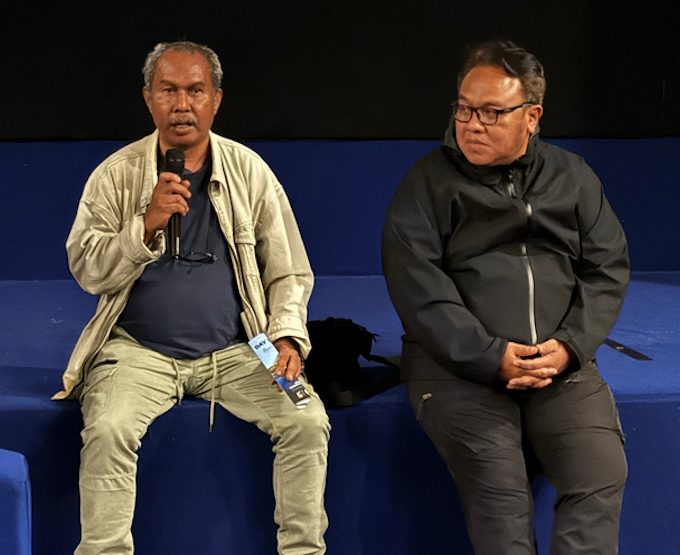
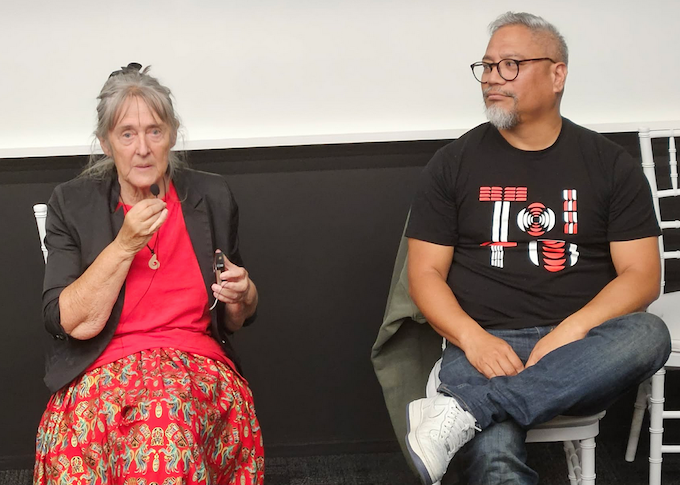
The audience was also treated to Q&A session with the film director, Dandhy Dwi Laksono and producer Victor Mambor, an award-winning investigative journalist and founder of Jubi Media, who first visited New Zealand 12 years ago.
Documented collusion
Investigative filmmaker Laksono gained a reputation for his 2019 documentary Sexy Killers, released just before the Indonesian general election year and documented the collusion between the political establishment and the destructive coal mining industry.
He was arrested later that year over tweets he posted about state violence in Papua.
Laksono and Mambor, along with co-director Cipri Dale, make up a formidable investigative team.
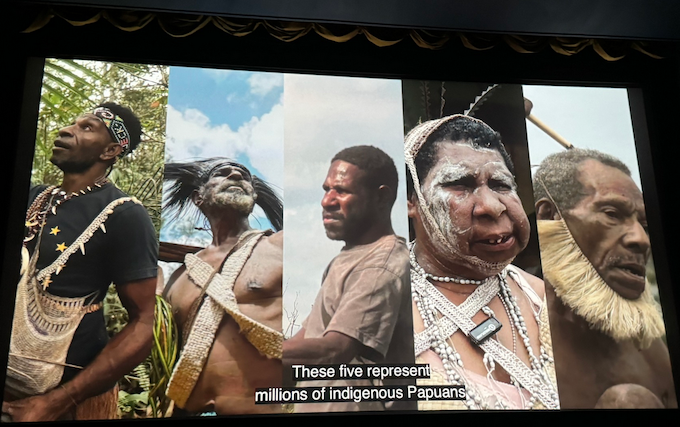
The storytelling focuses on the experiences of five Papuans and their communities:
Yasinta Moiwend was startled when, on a quiet morning, a massive ship docked at her village pier. The vessel carried hundreds of excavators and was escorted by military forces.
It was the first convoy of 2000 heavy machines to arrive in Papua under a National Strategic Project for food production, palm-based biodiesel, and sugarcane bioethanol.
Yasinta, a Marind Anim woman in Merauke, never realised that her village had been chosen as the ground zero for what would become the largest forest conversion project in modern history.
Vincen Kwipalo, from the Yei community, was likewise shocked when his clan’s land was suddenly marked with a sign reading: “Property of the Indonesian Army.” Only later did he learn that the land had been seized for the construction of a military battalion headquarters, at the very moment when a sugarcane plantation company was also encroaching on his ancestral forest.
Red Cross Movement
Threatened by the same project, Franky Woro and the Awyu community in Boven Digoel erected giant crosses and indigenous ritual markers on their land.
Known as the Red Cross Movement, this form of resistance has spread among Indigenous groups across South Papua.
More than 1800 red crosses have been planted to confront corporations and the military—both physically and spiritually. Though a Christian symbol is central to the movement, local Church pastors condemned it as not part of the church.
Dr Kanem says the film could have explored why the Awyu and Marind people chose to use the red cross, a symbol strongly associated with Christian values?
“Why did they not use their own cultural attributes or symbols instead?” she adds.
Laksono says: “Pig Feast combines detailed field recordings with in-depth research to examine the power structures behind the operation.
“It exposes how government and corporate entities — collaborating with military and religious groups — advance international and national goals of ‘food security’ and ‘energy transition’ at the expense of Indigenous communities and landscapes.”
Multinational corporations
The documentary illustrates the networks of Indonesian elites, oligarchs, and multinational corporations that benefit from the project, providing a vivid depiction of the political ecology of Indonesian governance in Papua.
Pig Feast reveals how the system of colonialism remains intact today.
Asked at the screening how dangerous was the film making, Mambor described the hardships their small crew faced to “find the truth” under the noses of the Indonesian military.
He said they walked up to 17 km a day at times to get the exclusive footage obtained for the documentary.
International journalists are banned from West Papua and a 2019 resolution by the Pacific Islands Forum calling for the UN High Commissioner for Human Rights to visit West Papua to investigate allegations of human rights abuses has been ignored by Jakarta.
The film reveals how 10 companies — all owned by one family — gained the backing of three presidents.
The Jhonlin Group, owned by oligarch Andi Syamsuddin Arsyad (aka Haji Isam), ordered about 2000 excavators from Chinese company SANY, considered one of the largest orders of its kind in the world, to clear one million hectares.
‘Second thoughts’ on Gaza
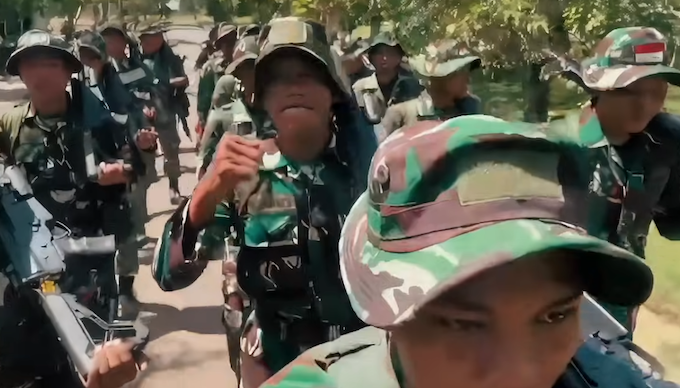
Q&A moderator Dr David Robie, deputy chair of the Asia Pacific Media Network (APMN), notes the massive military involved in the operations in West Papua — as shown in the film — and how Israel has been counting on Indonesia forming “the backbone” of the planned “International Stabilisation Force” for the besieged Palestinian enclave of Gaza with about 8000 troops because of its experience in “suppressing rebellion”.
“However, since the start of the US-Israeli war on Iran it seems that Jakarta has now had second thoughts,” he said.
Indonesia has suspended all discussions on the so-called “Board of Peace” initiative launched by US President Donald Trump, citing the military escalation in the Middle East, reports Anadolu Ajansi.
Critics had argued that joining a council led by the Trump administration could undermine Indonesia’s longstanding support for the “free Palestinian” cause.
Indonesia’s Ulema Council, the country’s top Islamic scholar body, had also called for an immediate withdrawal from the Trump initiative.
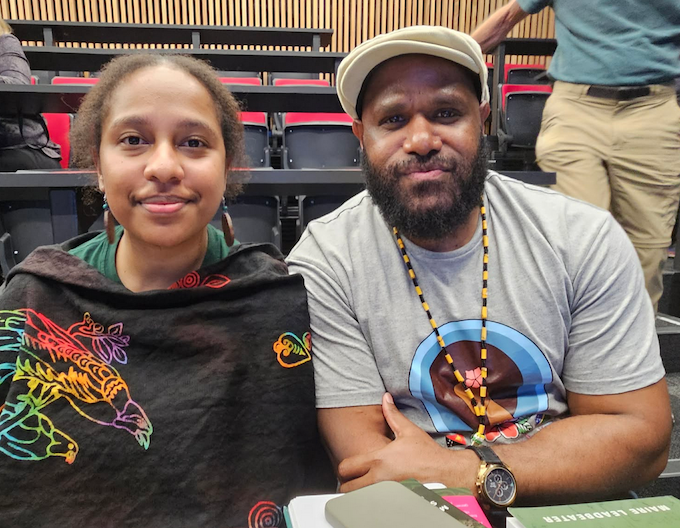
The filmmakers and documetary will now go to Australia for screenings in Sydney, Melbourne and hopefully Brisbane.
West Papua updates
Earlier in the day, at a two-day West Papua Solidarity Forum at the University of Auckland, several speakers gave updates and an analysis on political and social developments in the repressed Melanesian region.
Among speakers were Papuan environmental campaigner for Pusaka Dorthea Wabiser, longtime Aotearoa and West Papua human rights campaigner Maire Leadbeater, Papuan cultural advocate Ronny Kareni , Hawai’ian academic Dr Emalani Case, Ngaruahine researcher Dr Arama Rata, PNG academic at Waikato University Nathan Rew, West Papuan scholar Kerry Tabuni, Green Party Pacific peoples and foreign affairs spokesperson Teanau Tuiono, and forum organiser Catherine Delahunty of the West Papua Action Tāmaki Makaurau and West Papua Action Aotearoa.
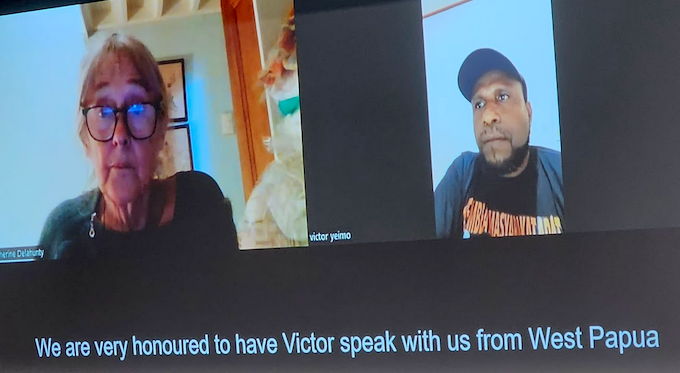
Viktor Yeimo, international spokesperson of the KNPB (National Committee for West Papua) and PRP (Papuan People’s Petition), and several Papuan community spokespeople shared messages by video link.
Yeimo spoke about how many students, activists, journalists, church leaders and communities of faith in West Papua faced risks when they spoke about justice and political rights.
“To ignite a large log, one must first find many small pieces [kindling],” he said. “Each piece alone cannot produce a great fire, but together they create enough heat to ignite something much larger.”
He said one pathway involved meaningful political reform within Indonesia, including stronger protection of Indigenous rights and genuine regional autonomy.
Another pathway involved inclusive political dialogue between the Indonesian government and legitimate representatives of Papuan society, like ULMWP (United Liberation Movement of West Papua).
A third pathway existed within international law, “it is the possibility of a self-determination process supervised by an international institution [such as the United Nations].”
He pointed to the progress of the self-determination processes of Bougainville and Kanak New Caledonia for example.
Yeimo said Papuans wanted to build a Pacific future “grounded in justice and solidarity”.
A Papuan rapper spoke on screen saying he wasn’t afraid of the repression of authorities, “but they seem to be afraid of me and my music.”
This content originally appeared on Asia Pacific Report and was authored by APR editor.