
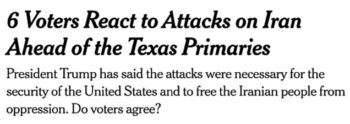
The original New York Times headline (3/2/26).
Polling before and immediately after President Donald Trump’s Iran attacks has shown clear public opposition to war with Iran. Prior to the attacks, polls consistently showed support ranging from to 18% (Quinnipiac, 1/14/26) to 21% (LiveNow, 2/23/26). Once Trump launched the war, Republican support jumped, but overall public support remained strikingly low. Reuters/Ipsos (3/1/26) found 27% approval, while a CNN poll (3/2/26) put the number at 41%, with strong disapproval (31%) nearly doubling strong approval (16%).
While public opposition to the war since it began has received fairly widespread coverage, at the New York Times, public opinion was framed in an entirely different way: The paper spotlighted six right-wing Texans in a piece (3/2/26) purporting to illustrate the question, “What do Americans think of Mr. Trump’s decision to attack Iran?” The Times explained its methodology: “We asked six voters in Texas for their answer ahead of Tuesday’s primary election.” (The paper assigned five separate journalists to this project.)
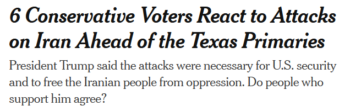
The headline (3/2/26) after someone at the New York Times realized that five Trump supporters and a Libertarian are not a good sample of “voters.”
“Six Voters React to Attacks on Iran Ahead of the Texas Primaries,” read the headline, with the subhead, “President Trump has said the attacks were necessary for the security of the United States and to free the Iranian people from oppression. Do voters agree?” Photos of five men and one woman followed, with descriptions and quotes offering their positions. Five of the six were apparently white; five had voted for Trump, while the sixth had voted for Libertarian candidate Gary Johnson. Only one did not express support for Trump’s decision.
It’s one of the most egregious examples yet of the Times‘ ongoing series we like to call “Trump Supporters Support Trump” (e.g., FAIR.org, 2/15/17, 7/24/19, 2/4/26). Frankly, it’s hard to come up with any explanation for this wildly skewed framing, other than offering a sop to right-wing critics of the paper.
Presumably the editors received pushback, whether internally or externally, because by afternoon the framing had changed. The paper added the modifier “conservative” to the voters named in the headline, and changed the subhead’s question, “Do voters agree?” to “Do people who support him agree?” The question “What do Americans think of Mr. Trump’s decision to attack Iran?” on the other hand, was left to stand.
‘Thorny’…for Democrats?
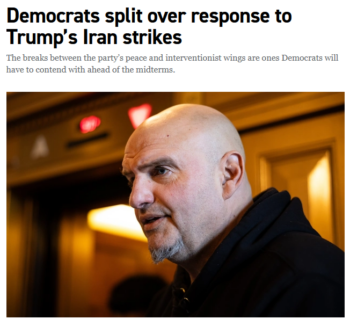
Politico (2/28/26) used the most conservative Democrat of the 119th Senate (according to Voteview) as its poster child for “divisions” in the party over the attack on Iran.
Meanwhile, with more dissension about war against Iran within Republican voter ranks (55% approve, 13% disapprove, according to Reuters/Ipsos) than Democratic ones (7% approve, 74% disapprove), and independents tilting against the war more than 2-to-1, media are still trying to turn Trump’s decision into a problem for the party that didn’t launch the unpopular war rather than for the one that did.
“Democrats Split Over Response to Trump’s Iran Strikes” declared Politico (2/28/26), reporting that Dems “will have to navigate yet another politically thorny foreign policy vote” when they take up a resolution challenging Trump’s military authority next week—that Democrats themselves are advancing.
The reason it’s “thorny,” Politico tells us, is because a few right-wing Democrats intend to vote against the measure. (The politics-focused outlet does not note that these Democrats, like Pennsylvania’s Sen. John Fetterman and Rep. Greg Landsman of Ohio, happen to take gobs of money from AIPAC and other Israel lobby groups.) Why that’s considered thorny for the party, rather than for the specific Democrats who will be overwhelmingly defying their voters’ wishes, is unclear. Also unclear: why the few Republicans who plan to vote for the measure don’t make the issue “thorny” for their own party.
‘Fissures’ and ‘chaos’
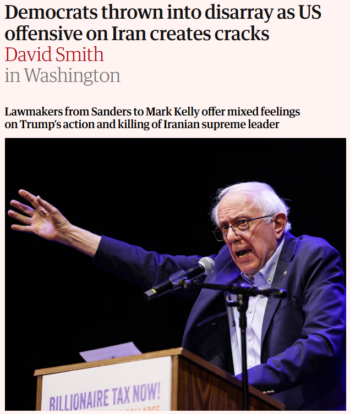
Indicating the paper’s own perspective, the Guardian (3/2/26) reported that some Democrats “felt obliged to acknowledge the authoritarian Khamenei’s death as a positive development.”
The New York Times (3/1/26) similarly reported that “the attacks have magnified fissures in the party,” noting “tensions” among Democrats “over how stridently to oppose Mr. Trump’s use of force.” The Times pointed out that
a small handful of Democrats, including some of the party’s strongest supporters of Israel, which conducted strikes alongside the US, have backed the administration’s operation.
Every Democrat quoted in the piece spoke out with varying degrees of forcefulness against the strikes, except for one: Ohio’s Landsman, who, as the Times does not mention, has received over $1.7 million from the Israel lobby over the course of his career.
“Democrats Thrown Into Disarray as US Offensive on Iran Creates Cracks,” the Guardian (3/2/26) breathlessly reported. The article explained that there are “political traps as Republicans accuse them of lacking patriotism and ignoring the Iranian diaspora who have taken to the streets to celebrate Khamenei’s downfall.” Again, looking at public opinion, those are hardly real traps—but when centrist media lend them credence, they help right-wing hawks spin the emperor’s new clothes.
Axios (3/2/26) brought a primary election angle to the narrative: “Iran Strikes Inject Chaos Into Dem Primaries.” By “inject chaos,” Axios appears to mean “boost progressives,” since the piece simply describes the ways that candidates are inserting more antiwar messaging into their campaigns.
What all these news outlets dance awkwardly around, with their claims of chaos and disarray, is that there is a very real challenge, not to Democrats as a whole, but to the centrist Democratic leadership who have been reluctant to speak out too forcefully against a war led by Israel—despite the fact that the Israeli government is viewed unfavorably by 77% of Democratic voters. These articles show that the press corps is equally reluctant to do anything more than vaguely allude to that mismatch, and to the influence of the Israel lobby on Democratic politicians.
Instead, the corporate media’s framing of Trump’s war as a problem for Democrats turns public opinion on its head, creating a narrative in which opposition to an unpopular war is a political problem.
Featured image: Some of the right-wing Texans the New York Times (3/2/26) passed off as representative of all American voters.
This content originally appeared on FAIR and was authored by Julie Hollar.