
The United States and Israel launched attacks on Iran on February 28, propelling the entire region into a predictable cataclysm of unprecedented proportions.
This puts paid to the alleged “peacemaking” project of US President Donald Trump, who was supposed to be keeping the country out of international wars rather than actively seeking to expedite the end of the world.
The attacks put an abrupt end to the negotiations underway between the US and Iran—to the delight of Israeli Prime Minister Benjamin Netanyahu, who has always viewed as anathema anything remotely resembling diplomacy or the pursuit of peace.
‘Trigger Iran to retaliate’
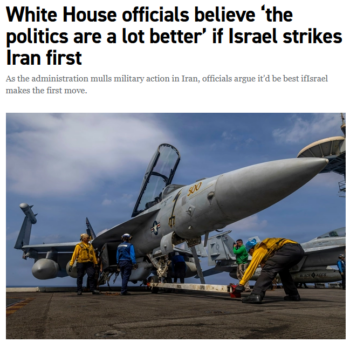
Politico (2/25/26) reported that US warplanners hoped for “an Israeli attack [that] would trigger Iran to retaliate, helping muster support” for a US bombing. Politically useful retaliation, of course, would have involved lots of dead bodies that could be pointed to as evidence of Iranian bloodthirstiness.
So much for subsequent US/Israeli attempts to cast the assault as “preemptive” in nature. Indeed, there is nothing at all “preemptive” about forcing Iran to retaliate; this is instead what you would call a deliberate provocation.
Unfortunately for the “senior advisers,” Trump and Netanyahu ultimately opted to pull the trigger simultaneously, thus depriving the US administration of its fabricated casus belli.
‘A clear explanation of the strategy’
In the aftermath of the strikes, certain US corporate media outlets unleashed ostensible critiques of the war—having apparently spontaneously forgotten their own fundamental role in paving the warpath by devoting the past several decades to demonizing the Iranian government (or “regime,” as we are required to refer to imperial foes).
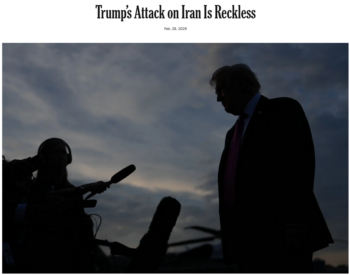
The New York Times (2/28/26) doesn’t object to bombing Iran (with its “murderous ideology”) or killing its leader (“Nobody should mourn the death of Ayatollah Ali Khamenei”). But shouldn’t Trump have had a “detailed conversation with the American people” about it?
The New York Times editorial board (2/28/26), for example, immediately penned an intervention titled “Why Have You Started This War, Mr. President?”—the headline of which was later amended to “Trump’s Attack on Iran Is Reckless.”
This is the same New York Times, of course, that has been known to publish such masterpieces as “To Stop Iran’s Bomb, Bomb Iran” (3/25/15), a 2015 call to arms by former US ambassador to the United Nations John Bolton.
Now, after calling out Trump’s “reckless” attack, the Times editorial board proceeds to undertake its own rationalization of war on Iran—provided it is overseen by “a responsible American president” who takes the time to offer “a clear explanation of the strategy, as well as the justification for attacking now, even though Iran does not appear close to having a nuclear weapon.”
Because Trump could give fuck all about being “responsible,” however, the US newspaper of record assumes the duty of laying out the litany of Iranian transgressions for its readers, such as the killing of “hundreds of US service members in the region”—decisive proof that “Iran’s government presents a distinct threat because it combines this murderous ideology with nuclear ambitions.”
Never mind the hundreds of thousands of regional deaths wrought in recent years by the (already nuclear-equipped) US military, including on account of the 2003 US invasion of Iraq, which the Times and like-minded media did their best to shove down the throats of the American public.
‘Few recent parallels’
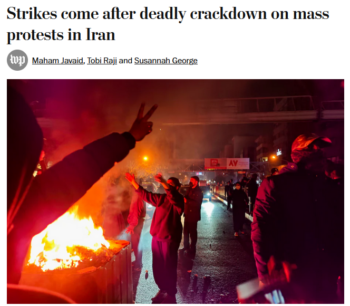
The Washington Post (2/28/26) cited reports of “more than 7,000 people dead” in recent unrest in Iran. It did not mention Israeli reports of “foreign actors arming the protesters in Iran with live firearms, which is the reason for the hundreds of regime personnel killed” (Times of Israel, 1/16/26).
Following the weekend’s strikes on Iran, many US media were quick to mention the Iranian government’s response to protests that erupted in December against high inflation. The Washington Post (2/28/26), for instance, specified that the “strikes come in the wake of a violent crackdown by Iran’s security forces…on anti-government demonstrations.”
Citing reports of “more than 7,000 people dead,” the Post went on to lament that “the level of violence against protesters has few recent parallels, human rights groups say.”
Not mentioned in such reports is the key role devastating US sanctions on Iran—a form of lethal violence in themselves—played in fomenting the protests in the first place. Ditto for Israel’s own admitted interference; Mossad’s Farsi-language X account urged Iranians to “Go out together into the streets. The time has come.” The Jerusalem Post (12/29/25) reported that the intelligence agency continued: “We are with you. Not only from a distance and verbally. We are with you in the field.”
“Foreign actors are arming the protesters in Iran with live firearms, which is the reason for the hundreds of regime personnel killed,” Tamir Morag of Israel’s right-wing Channel 14 remarked (Times of Israel, 1/16/26). “Everyone is free to guess who is behind it,” he winked.
But by repeatedly bringing up Iranian state brutality, US corporate media effectively distract from the brutality of the strikes on Iran, which happen to be perpetrated by two states that have zero “parallels” in terms of “levels of violence.” The ongoing US-backed Israeli genocide in the Gaza Strip has officially killed more than 72,000 Palestinians since October 2023, though household surveys indicate the true toll could be substantially higher (Lancet, 2/18/26).
In its own antiwar-but-not-really dispatch, the Times editorial board also took care to reference how Iran “massacred” protesters, as well as the fact that the government “oppresses women”—forever a favorite talking point of the same media outlets that advocated for bombing Afghan women to save them from the Taliban.
Unuseful victims
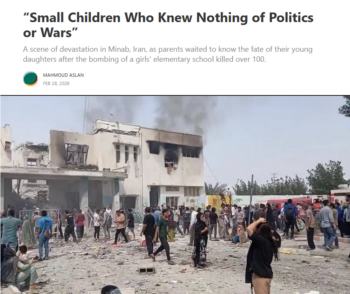
Drop Site (2/28/26) managed to interview parents of some of the girls killed in the US/Israeli bombing of the school in Minab—a journalistic feat that was apparently beyond the resources of outlets like the New York Times.
It can be safely filed under the “can’t make this shit up” category that among the first casualties of the current war on Iran were the at least 175 people confirmed dead in a missile strike on a girls’ elementary school in the city of Minab.
While the establishment media initially treated this particular atrocity as a brief aside (Washington Post, 12/28/26; Wall Street Journal, 12/28/26)—leaving the job of actual reporting to independent outlets like Middle East Eye (2/28/26) and Drop Site News (2/28/26)—it eventually became unavoidable. As the corpses of young children are of no use to the imperial narrative when they are killed by the US and Israel rather than by Iran, however, the requisite moral condemnation has been in short supply.
Nor has much attention been paid to the hundreds of other casualties of the US/Israeli strikes, which is unsurprising given the media’s tendency to humanize Iranians only when they can be portrayed as victims of their own government. While the death toll made headlines in outlets like Al Jazeera (3/2/26) and Truthout (3/2/26), in major US media like the New York Times (3/2/26) and Washington Post (3/2/26), it was basically a footnote.
Three US troops killed in Iran’s retaliatory strikes, on the other hand, have received considerable airtime, with the Associated Press (3/1/26) noting that these were “the first American casualties in a major offensive that President Donald Trump said could likely lead to more losses in the coming weeks.”
And as the entire region rapidly goes up in flames, it seems those senior US advisers may have gotten their casus belli, after all.
This content originally appeared on FAIR and was authored by Belén Fernández.