
US forces launched a military attack against Venezuela on January 3, reportedly killing over 100 people and kidnapping Venezuelan President Nicolás Maduro and first lady Cilia Flores, who also serves as a National Assembly deputy.
Western corporate media have played an active role in recent years in legitimizing escalated US aggression against the Venezuelan people, from whitewashing economic sanctions that killed tens of thousands (FAIR.org, 6/4/21, 6/13/22) to outright calling for a military intervention (FAIR.org, 2/12/25, 11/19/25). They also exposed themselves once again as the fourth branch of the US national security state, opting not to publish information they had prior to the January 3 operation in order to “avoid endangering US troops” (FAIR.org, 1/13/26).
The brazen act of war has elicited zero dissent from the Western media establishment, no urge to challenge Trump’s return to early 20th century “gunboat diplomacy.” Worse, with the White House pushing to impose a semi-colonial protectorate and plunder Venezuela’s wealth, corporate outlets continue working overtime to normalize US imperialist predations.
Damage control
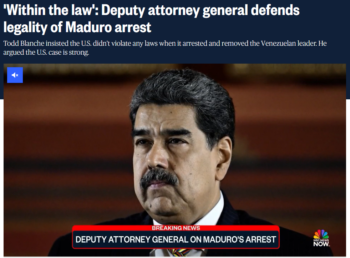
Breaking news! NBC (1/5/26) brought on Deputy Attorney General Todd Blanche to tell viewers that “the US case is strong.”
In the weeks since the attack, Western media have made a point of referring to Maduro as “arrested” (NBC, 1/5/26), “captured” (PBS, 2/10/26) or “ousted” (ABC, 1/5/26). The choice is far from innocent. By not stating that the Venezuelan leader was “kidnapped” or “abducted,” in a blatant violation of international law, establishment journalists are normalizing the US’s rogue actions, denying Maduro the proper protections of prisoner of war status (FAIR.org, 1/20/26).
But it is not just through semantic distortion that corporate outlets have quarantined any critique of the administration’s lawlessness. Another common feature has been a certain “damage control” in covering up Trump’s most outlandish statements.
After the January 3 military operation, Trump stated in a press conference that “many Americans, hundreds of thousands over the years…died because of [Maduro].” No corporate outlets reported the outrageously false statement. (A couple of factchecking pieces—CBS, 1/6/26; New York Times, 1/8/26—addressed his adjacent, essentially unfalsifiable claim that “countless Americans” died due to Maduro.)
The attempts to make Trump’s Venezuela policy claims appear more rational are not new. For instance, in presidential press conferences, he constantly said that Venezuela had “emptied” its mental institutions into the US (X, 10/15/25, 11/2/25, 12/3/25, 1/3/26). But throughout 2025, the New York Times (11/4/25) mentioned this absurd statement just once, and the Washington Post (10/22/25, 12/21/25) did so twice.
On the domestic policy front, corporate journalists have had fewer qualms labeling Trump claims as “false,” when it comes to ending wars (CNN, 1/20/26), immigration (NBC, 2/4/26) or the 2020 US election (Guardian, 1/12/26). But they seem happy to carefully conceal or openly parrot false accusations that build the case for wars of aggression, whether in Yugoslavia, Iraq, Libya, Syria, Iran and now Venezuela (FAIR.org, 8/1/05).
The vanishing cartel
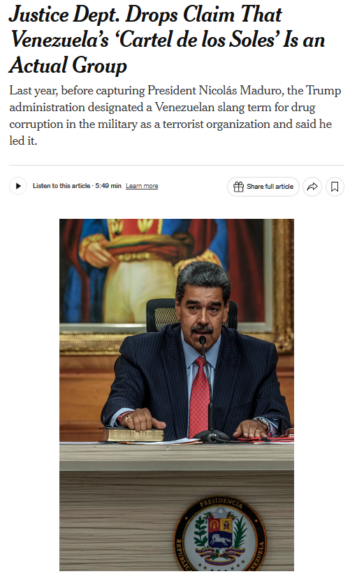
The New York Times (1/5/26) was one of the few major outlets to note that a central point in the Trump administration’s war on Venezuela had disappeared.
In recent years, and especially in the second half of 2025, US officials justified escalating attacks against Venezuela on the grounds that Maduro and associates ran a drug trafficking operation, the so-called Cartel of the Suns. Trump himself, during his January 3 press conference, claimed Maduro “personally oversaw the vicious cartel known as Cartel de los Soles.”
While experts consistently questioned the cartel’s existence, and specialized agencies, including the DEA, found Venezuela to play a marginal role in drug trafficking, media outlets reproduced the warmongering claims without scrutiny, citing only the denials from the Venezuelan president they have systematically demonized for over a decade (e.g., New York Times, 10/06/25; NPR, 11/12/25; CNN, 11/14/25).
But the biggest rebuff came from the Justice Department itself. When the time came to indict Maduro, US prosecutors dropped the accusation that the Venezuelan leader headed an actual drug cartel, and downgraded the Cartel of the Suns to a “patronage system.” In other words, the Justice Department was aware that the cartel charge had no substance, and instead accused Maduro of a much looser “drug trafficking conspiracy.”
But this remarkable about-face brought no accountability for the media establishment. Having spent years echoing claims that US prosecutors admitted would not hold in court, corporate outlets chose to ignore the new development, rather than exposing their shameful stenography over the years and taking responsibility for its deadly consequences. FAIR used Google to search for reporting on this crucial about-face in outlets including the Washington Post, Reuters, CNN, NBC and NPR, and found no results.
The one notable exception in this quasi-state corporate media circus was the New York Times‘ Charlie Savage (1/5/26), reporting on the administration’s quiet dropping of its casus belli. Savage wrote that this “called into greater question the legitimacy” of the administration’s designation of the Cartel of the Suns as a foreign terrorist organization. However, the piece stopped short of challenging the US military operation and illegal kidnapping of Maduro, referring to the Venezuelan leader as “captured” and “removed from power.”
The paper of record was quick to compensate for the vanishing of a flimsy regime-change trope by bringing up another one, focusing on a tried and tested dishonest narrative: Venezuela’s alleged ties with Hezbollah, one of the main opponents of the US and Israel in West Asia (FAIR.org, 5/24/19). Under the headline, “What to Know about Hezbollah’s Ties to Venezuela,” Times reporter Christina Goldbaum (1/19/26) offered nothing but a laundry list of unsubstantiated claims from anonymous officials.
Media connivance with Washington’s official narratives to justify imperialist attacks only pave the way for new iterations. Recently, in tightening the murderous blockade against Cuba, the Trump administration proffered the totally baseless claim of the Cuban government “providing a safe haven” for Hamas and Hezbollah. While the New York Times (1/30/26) uncharacteristically reminded readers that Trump offered no evidence, other outlets (NBC, 1/29/26; CNN, 1/30/26) were happy to echo the accusation uncritically.
Holding a country hostage
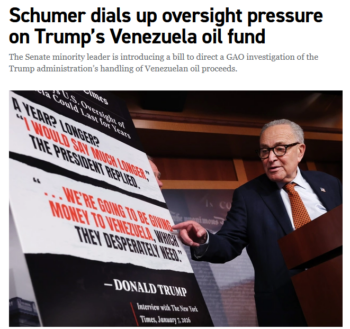
Media like Politico (2/11/26) focused not on the United States’ stealing Venezuela’s oil, but on the question of whether it was doing so transparently enough.
The media establishment’s support for US foreign policy did not end with the January 3 act of war. Since the attacks and presidential kidnapping, the Trump administration has taken control of Venezuelan oil exports at gunpoint after a month-long naval blockade that involved seizing tankers in the high seas for allegedly transporting Venezuelan crude in violation of unilateral US sanctions.
Under an initial agreement, Venezuela surrendered 30–50 million barrels for White House–picked intermediaries to transport and sell. Proceeds were deposited in bank accounts in Qatar, with a portion being returned to Carácas at the administration’s discretion (Venezuelanalysis, 1/21/26, 1/29/26). Analysts have argued that this arrangement explicitly violates the Venezuelan constitution.
Some articles have given space for Democrats to oppose the Trump deal, but mostly on the grounds of lack of transparency or opportunities for corruption (CNN, 1/15/26; Politico, 2/11/26; New York Times, 2/11/26). Readers will find no opposition on principle to the Trump administration’s Mafia-esque extortion of a sovereign nation’s natural resources, from the president himself saying the US will “keep some” of the hijacked Venezuelan oil (CNBC, 1/22/26) to Secretary of State Marco Rubio announcing that the administration is “prepared to use force to ensure maximum cooperation” (New York Times, 1/28/26).
It is hard to find double standards, because no other nation on Earth unleashes this kind of gangster imperialism. But concerning Russia, Western media did not hold back from denouncing its “stealing,” “robbing” or “plundering” of Ukrainian minerals or grain, despite these resources being in territory that Russia occupies and claims sovereignty over (Washington Post, 8/10/22; Guardian, 12/11/23; DW, 8/28/23; New York Times, 6/5/22).
In a nutshell, when Washington imposed deadly sanctions against Venezuela, corporate pundits said these only targeted Maduro and were meant to promote democracy (FAIR.org, 6/14/19, 6/4/21, 6/13/22, 6/22/23). When the White House ramped up military threats, mainstream journalists parroted drug trafficking allegations (FAIR.org, 2/12/25, 11/19/25). When the drug trafficking charges were exposed, Western outlets reheated baseless stories about Hezbollah. And when Trump seized Venezuelan oil at gunpoint, the only mild concern was whether he would use it to enrich himself.
True to its roots in the “yellow journalism” of Joseph Pulitzer and William Randolph Hearst, the liberal media establishment is fully on board with Trump’s “Donroe Doctrine.” They have undoubtedly earned the title, to paraphrase Gen. Smedley Butler, of “gangster journalists for capitalism.”
Featured image: US Coast Guard observing a tanker with Iranian oil that was hijacked by the US on its way to Venezuela.
This content originally appeared on FAIR and was authored by Ricardo Vaz.