
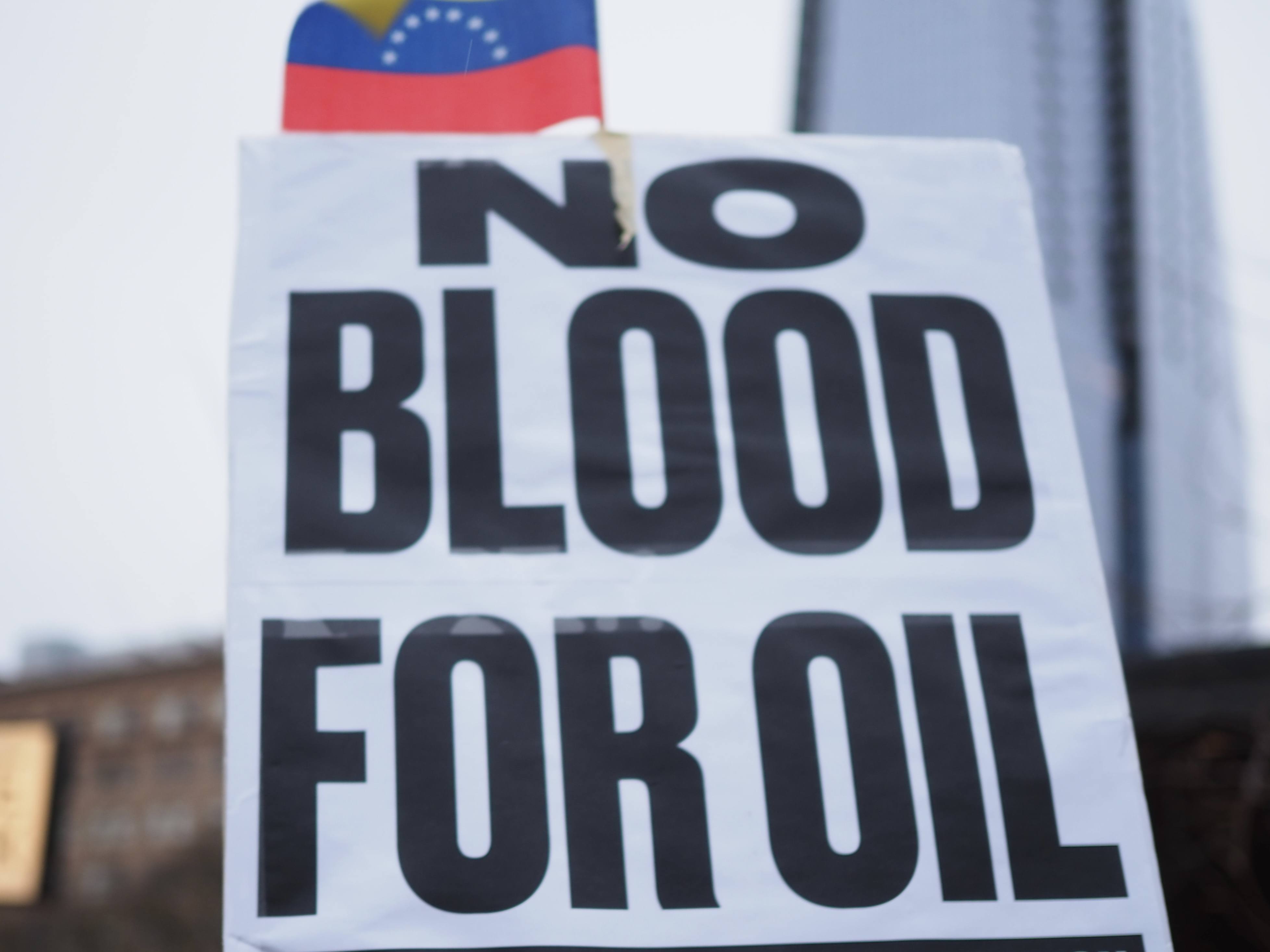


Photograph by Nathaniel St. Clair
Trouble follows oil like a shimmering slick, challenging the ideals of a presumed enlightened world. Ever since Edwin Drake’s famous first find in Titusville, Pennsylvania, in 1859, the dirty side to oil rarely receives attention. A systematic disregard for others is standard in an industry that favours extraction over regulation, speed above safety, and profits before people. In the race to power the world, oil makes its own rules whatever the cost, including waging war to achieve its ends. To support a de facto post-World War Pax Americana, it is no coincidence US military incursions are connected to the world’s number-one commodity.
Despite attempts to keep the peace, war and instability are the norm in oil-rich regions. Conflicts between Iran and Iraq, Saudi Arabia and Yemen, and civil wars within Iraq, Syria, and Libya are all drenched in the smell of oil as was the toppling of Saddam Hussein and the US occupation of Iraq. Large swathes of the Ecuadorian Amazon are contaminated, Nigeria remains impoverished despite vast oil reserves, and terrorist blowback continues after decades of American meddling in the Middle East. Restricted natural-gas pipelines and transit fees were the flashpoint for the 2022 Russian invasion of Ukraine.
Venezuela has been under siege for decades because of its enormous oil reserves in the Orinoco Belt and a short-sighted over-reliance on a single resource (over 90% of GDP from oil), where government-subsidized gas sold below cost (less than 50 cents to fill a tank) and food was cheaper to import than produce. Venezuela once extracted almost 3 million barrels per day at the height of production before US sanctions in 2019 gutted its ability to trade on the open market, ultimately reducing output to under 1 million barrels per day.
Oil scars all with its black-gold luster, turning the world into a giant chessboard as a silent war is waged for control in corporate boardrooms and government offices, spreading damage everywhere. The precarious world order was shattered for good, however, under cover of darkness in the early hours of January 3, 2026, when Venezuelan president Nicolás Maduro and his wife were extracted by US military forces and charged with drug-trafficking crimes, spooking oil markets and raising sovereignty concerns around the globe. With a rogue US in charge, nowhere is safe. The livelihood and safety of billions of people hang in the balance.
To understand the plight of those scarred by oil, one need ask only one question: “Who owns the oil?” In Crude World, Peter Maass lists the options: “Is the oil owned by the [one] who works the land that sits atop the oil? The surrounding community? The state in which the community is located? The federal government in a capital hundreds or thousands of miles away? The foreign company that invested millions of dollars to find it?”[1] Not a simple question, but one that underpins the entire global economy.
One could argue that international crises have followed oil ever since the 1960 creation of the Organization of Petroleum Exporting Countries (OPEC) following discussions between the Venezuelan Minister of Mines and Hydrocarbons Juan Pablo Pérez Alfonzo and the Saudi head of the newly established Directorate of Oil and Mining Affairs Abdullah Tariki. Pérez Alfonzo was the architect of a 50/50 split between oil companies and national governments, while Tariki was known as “Red Sheikh” for his support of Egyptian leader and pan-Arab nationalist Gamal Abdel Nasser as well as his criticisms of the Saudi royal family. Both Venezuela and Saudi Arabia were upset at the low returns their two countries received from foreign oil companies managing their main resource.
Meeting for the first time in 1959 at an Arab Petroleum Congress in Cairo, the idea of a producers’ group was hatched, before further meetings the following year in Baghdad sealed the deal as leaders from Iran, Iraq (representing the Arab League), and Kuwait signed up. As one historian put it, “[Pérez] Alfonzo provided the rationalization; Tariki, a charismatic speaker, the fire.”
The initial impetus for OPEC’s formation was a 10% unilateral cut of oil prices by the Seven Sisters (BP, Standard Jersey, Socony, Texaco, Socal, Gulf, and Shell), who controlled most of the global market, ostensibly to undercut the Soviet Union, whose output had doubled in the previous 5 years such that Soviet production had risen to almost 60% that of the Middle East. The move, however, drastically dented the revenues of the oil-producing countries. The final straw was another 8% cut, led by Standard Jersey.
OPEC transformed international relations, giving oil-producing nations a say in global sales for the first time. Although 50-50 arrangements had already existed in a number of oil-producing countries as begun in Venezuela, the oil-flush states wanted more of the pie, their pie as they began to clamor. As noted after OPEC’s formation, “It was quite clear from the start that the price cuts might precipitate the establishment of what some delegates chose to call a cartel to confront a cartel.”[3]
In creating OPEC, Pérez Alfonzo stole a page from the Texas Railroad Commission playbook, which first regulated oil prices in the US in the 1930s during the East Texas oil glut when prices dropped to as little as 10 cents a barrel.[4] OPEC was using the same playbook as the first great cartel king, John D. Rockefeller, whose Standard Oil once controlled over 90% of the US oil business until it was broken up by a landmark antitrust case in 1911, creating 34 “Baby Standards,” the largest Standard Oil of New Jersey (renamed Esso and then Exxon), Standard Oil of New York (renamed Mobil), and Standard Oil of California (renamed Socal and then Chevron). McClure’s investigative journalist and one-time Titusville resident Ida Tarbell noted how Standard’s economic grip was “so complete that the price of oil, both crude and refined, is actually issued from its headquarters!”[5]
OPEC strategies have varied over time, including production cuts to raise prices (via member quotas) or flooding the market to lower prices and increase market share to undercut the competition (via unlimited member production), for example, to derail high-cost modern producers of shale gas and oil sands and the now competitive renewable technologies of wind and solar. With other oil regions producing more – Russia, the North Sea, American shale deposits, and Canadian oil sands – OPEC’s influence has begun to wane, but is still instrumental in setting global prices. For its part, Saudi Arabia acts as the world’s “swing producer” keeping up to two million barrels per day in surplus, raising or lowering production to maintain (or manipulate) the price to protect the market share of a precious commodity. (As of 2016, Russia agreed to act in concert with OPEC to maintain production and control prices, generally known as OPEC+.)
Initially based in Geneva before moving to Vienna after five years and representing 80% of the world’s oil at the time of formation, the founding OPEC countries were Saudi Arabia, Iran, Iraq, Kuwait, and Venezuela. Currently comprising 12 members, OPEC controls over three-quarters of global oil reserves and one-third production. The big four – Venezuela, Saudi Arabia, Iran, and Iraq – account for more than half of all global reserves and about one-quarter production with annual revenues typically over $1 trillion, although profits have diminished of late with falling prices.
Generating huge revenues for those in charge, oil is nonetheless a curse for governments overly reliant on liquid-gold revenue, propped up when the going is good yet plunged into despair when prices fall. Without diversification, one-resource economies are held hostage to the vagaries of the oil market, a.k.a. Dutch Disease after plentiful natural gas supplies in the Netherlands were overly exploited to the exclusion of other industries. One could argue the United States is no different, staking its future on oil, even at the expense of its own health.
Even worse for underdeveloped countries, oil does little to sustain the local economy, only a small labor force needed to keep the pumps flowing as profits are funneled elsewhere. Maass noted that “High-tech refineries can cost billions of dollars to construct, but once they’re up and running, perhaps a few hundred workers are needed to monitor them.”[6] In Global Fracture, Michael Hudson noted that international oil companies tend to “warp host-country economies into monocultures rather than to stimulate their development and diversification.”[7] Charles Mann wistfully described the reality in The Wizard and the Prophet: “First the derricks, then the bars and brothels. After that the wasteland.”[8]
In Venezuela, oil has ruled the political agenda for decades, reaping massive profits for American oil companies soon after extraction first began in 1914. In 1924, the use of hollow, steel-reinforced, concrete caissons instead of wooden pilings in the deeper shipworm-laden waters of Lake Maracaibo, provided “a technology that would later evolve into the kind of platforms that became the approach of choice in the North Sea and North Atlantic.”[9] Shell, Gulf, and Standard Oil controlled almost all Venezuelan oil extraction until the industry was part-nationalized in 1976.
In 1998, former army lieutenant-colonel Hugo Chávez was elected president of Venezuela, turning the previously nationalized yet quasi-independent Petróleos de Venezuela, S.A. (PDVSA) into a wholly state-run business three years later to “sow the oil,” that is, to spend oil profits on people. Having survived a failed US-backed coup in 2002, the leftist leader of the working-class Bolivarian Revolution, Chávez and his socialist-party “Chavistas” spent Venezuela’s oil wealth on schools, health care, and social programs, helping to redress the staggering inequality in Venezuelan society.
In 2006, PDVSA spent more on social projects ($10 billion) than on oil operations ($5.9 billion).[10] But not all of Venezuela’s revamped success was due to Chávez and his social policies. Fulfilling a local saying that “Venezuela does not have good or bad presidents, just presidents who serve at times of high or low oil prices, Chávez had the good fortune to be in power when oil soared from $12/barrel to $140/barrel in 2008.”[11] His successor, Nicolás Maduro, was less fortunate after a sharp drop in oil prices in 2014, battling a well-heeled opposition as Venezuela struggled to diversify and make good with less.
In the midst of bypassing the Venezuelan parliament in 2017 to change the constitution and safeguard the fledgling revolution – widely condemned by foreign governments – the then US president Donald Trump added to the chorus of disapproval, stating “I’m not going to rule out a military option,” before recognizing the opposition leader Juan Guaidó as president after an anti-government protest in early 2019, a seemingly new-styled American soft coup.
In 2026, after 35 alleged “drug-boat” bombings with over 100 dead in the Caribbean Sea, a months-long oil blockade, and numerous invasion threats by a reelected Donald Trump, the United States deposed Maduro via a 2-am morning raid that killed at least 80 soldiers and citizens, a so-called “decapitation strike” to end the command and control of his leadership. Perhaps emboldened by the Venezuelan opposition leader María Corina Machado’s 2025 Nobel Peace Prize for “for promoting democratic rights,” the US claimed Maduro was involved in terrorism and drug trafficking, citing a 2020 US indictment against him and his wife Cilia Flores that made no mention of fentanyl, the drug Donald Trump has repeatedly claimed is exported by neighboring countries to the United States. According to the US government’s annual National Drug Threat Assessment report, Venezuela has never appeared as a source of fentanyl.
Governments across the world immediately condemned the illegal strike and extraction, which was in defiance of international law and UN charter Article 2. The attack on Venezuela appears to be another in a long line of provocations as US aggression is normalized once again: Iraq (9% of global oil reserves), Iran (13%), Libya (3%), Nigeria (2%), and now Venezuela (19%).[12] In a press conference the following day, Trump offered up another typically implausible notion that the US would “run the country” and rebuild Venezuela’s “broken infrastructure” to pump a now presumed American-controlled oil.
The “narco-terrorism” motivation is suspect given that Venezuela owns the largest oil reserves in the world (300 billion barrels). More likely a message to China (lost imports), Canada (lost exports), and Russia (lost revenues from lower oil prices). Or payback for alleged Venezuelan interference in Trump’s 2020 election loss. Nor does anyone believe the US interest in liberating Venezuela from a dictator, who like Trump didn’t recognize the results of a presidential election, or promoting democracy (fake news!) in a country that nationalized American assets and sold oil to long-time American adversaries such as Cuba. Indeed, the US wants to assert control over the Western Hemisphere and “run” its own turf.
The United States plans to control oil extraction and critical minerals in its newly proposed sphere of influence, by force if required. Texas Democrat state representative James Talarico called out the hypocrisy, citing Trump’s earlier promise of “a great deal” to American oil executives who donated $1 billion to his campaign: “This new war is not only illegal and reckless: it is deeply corrupt.” Even controversial MAGA acolyte and Republican congressperson Marjorie Taylor Greene noted, “If US military action and regime change in Venezuela was really about saving American lives from deadly drugs then why hasn’t the Trump admin taken action against Mexican cartels?” Similar concerns were expressed about Trump’s earlier pardon of Honduran ex-president Juan Orlando Hernández, jailed for 45 years for cocaine trafficking.
Citing the 1823 Monroe Doctrine that declared the Western Hemisphere closed to European colonialism while relinquishing American interests in Europe, the US is reasserting control over the Americas. One could say the US is swapping the Middle East for Venezuela (and other resource-rich countries in its presumed regional sphere of influence). Unlike Franklin Roosevelt, who initiated a special relationship with the Saudi royal family – personally cemented at a 1944 secret meeting between the American president and Saudi king Ibn Saud aboard the USS Quincy on Great Bitter Lake in the Suez Canal after Roosevelt’s return from the Big Three Yalta Conference – Trump’s self-styled “Donroe Doctrine” began the moment the US Department of Defense was renamed the Department of War.
Deemed strategically unimportant during World War II, Saudi Arabia escaped the carnage wrought across much of Europe, primarily because of its still immature wells. Although Roosevelt had referred to Saudi Arabia in 1941 as “a little far afield for us,” the US soon saw the importance of keeping the Saudi king happy. American interests were slow to materialize, but FDR would ultimately reappraise the US-Saudi relationship in a 1943 statement: “I hereby find the defense of Saudi Arabia vital to the defense of the United States.”[13]
Today, it seems the US is uninterested in managing far-flung oil regions. Nor acting as an honest player in a global march for prized resources; instead seeking advantage by lies and subterfuge. The “rules-based” world order designed by the US has been usurped by a gang of suited thugs. In a transactional free-for-all, what’s to stop authoritarian regimes following the US model, emboldened by an approved jungle law where might is right, such as Russia moving on Kiev (and the end of NATO) or China on Taipei (beginning a new Cold War)?
After the US aggression against a democratically elected socialist government, Brazil, Ecuador, or Mexico could be next. Brazil’s leftist leader Luiz Inácio Lula da Silva, a.k.a. Lula, continues to challenge the financial elite in one of the world’s poorest countries, restricting access to oil companies looking to exploit Brazil’s large deposits of offshore “presalt” oil by bypassing the state-owned Petróleo Brasileiro S.A. (Petrobras). Lula has also instigated many popular changes to help combat poverty such as Fome Zero (national health education, access to microcredit, and support for subsistence family farming) and Bolsa Família (financial aid via direct and conditional money transfers). He also chose not to pardon Trump’s friend, ex-president Jair Bolsonaro, who instigated a coup after refusing to accept the results of Brazil’s 2022 presidential election.
Ecuador has repeatedly tried to collect unpaid judicial fines against US oil companies that have polluted the environment. Texaco started drilling for oil in 1967 in the remote northern Amazon rainforest region known as the Oriente, under a joint-venture government agreement, followed in 1992 by state-owned EP Petroecuador (Empresa Pública de Hidrocarburos del Ecuador). For years, safeguards were disregarded, including gas flaring and dumping of waste water into unlined pits that leaked into the ground, contaminating everything in its wake and turning the untouched rainforest where Andean glaciers melt to form part of the headwaters to the Amazon River into an ecological disaster.
American lawyer and human rights activist Steve Donziger has fought for the indigenous Ecuadorian population for decades, suing Texaco and Chevron (which acquired Texaco in 2000) on their behalf and calling the Oriente “a toxic Three Mile Island.” Donziger’s class-action suit has been batted around for years between the American and Ecuadorian legal systems, blocked by Chevron at every turn. Eventually choosing to try the case in Ecuador and hoping for an easy dismissal from a compliant judiciary, Chevron was found liable in 2011 for $18 billion in damages, reduced to $12 billion on appeal to the Supreme Court. Miffed at the Ecuadoran court’s ruling, Chevron wanted the case retried in the US and blamed the contamination on EP Petroecuador despite substantial court evidence.
Denying responsibility for destroying farmland, polluting waterways, and the increase in cancers, Chevron claimed fraud and racketeering, vowing to “fight this thing until Hell freezes over.” To ensure Hell stayed hot, Chevron removed all its assets from Ecuador, forcing 30,000 indigenous peoples and local farmers whose land was ruined to seek justice elsewhere. Chevron further retaliated by discrediting the litigants and demonizing Donzinger, who was dubiously charged with contempt in the US District Court for the Southern District of New York and subjected to the longest-ever home detention of a lawyer in US history.[14]
To facilitate access for oil extraction, clear cutting has also decimated vast areas of the rainforest, one report finding that “Since the early 1970s about 30% of the Ecuadoran Amazon has been deforested and/or polluted [while] entire indigenous cultures, such as the Cofan and Huaorani, have been placed in danger of extinction as a result of the oil industry and accelerated colonization facilitated by the oil roads.”[15] Upon visiting Ecuador in 2015, Pope Francis put the issue quite simply: “The tapping of natural resources, which are so abundant in Ecuador, must not be concerned with short term benefits. As stewards of these riches which we have received, we have an obligation towards society as a whole, and towards future generations.” Sadly, no one believes that US oil companies have any interest in improving let alone protecting the lives of citizens in the oil regions of Ecuador, Brazil, or Venezuela.
The problems of petroleum are not only found in developing countries on the periphery of modernity. Nigeria would likely be poor without oil, while Venezuela, Brazil, and Ecuador all aspire to enlightenment ideals beyond the corridors of mass poverty. The same cannot be said of Russia, where the transition from a communist to capitalist economy can only be regarded as a failure since the heady days of the dissolution of the Soviet Union.
Since the break-up of the USSR, Russia has become one of the world’s largest kleptocracies, overrun with former Soviet oil managers cum billionaire oligarchs who looted the national purse during a supposed capitalist makeover. The oligarch-in-chief and seemingly permanent leader is Vladimir Putin, reputed to be worth over $200 billion after years of unopposed rule. Having evolved from nuclear-era Cold War threats, Putin now controls his continental neighbors with a new-found weapon: the gas tap.
Although Forbes can’t verify enough of his assets, Time wondered if Putin was secretly the world’s richest man with large holdings in the commodities trader Gunvor, 37% of the oil company Surgutneftegaz, and 4.5% of the state natural-gas company Gazprom (its de facto manager). Putin’s Black Sea palace has been valued at $1 billion to go with 19 more, 4 yachts, and 58 planes.[16] Does King Donald aspire to such spoils?
Is it a coincidence that in Trump’s first term an offshore oil ban was rescinded everywhere except Florida, where the president has a golf course and a home, while the Trump-Putin bromance may have more to do with promoting the oil and gas industry and increased exploration in the Arctic than electoral collusion, bad debts, or dodgy dossiers? As Putin noted at their first summit in 2018, “I think that we as a major oil and gas power, and the United States as a major oil and gas power, as well, we could work together on regulation of international markets.”[17] The game playing continues.
Perhaps the greatest player of all was Jean Paul Getty (1892–1976), although he preferred the less French-sounding J. Paul Getty. The son of a millionaire American oilman, Getty was an independent wildcatter and world’s first oil multi-billionaire, who made his fortune in the Neutral Zone, an area between Saudi Arabia and Kuwait created by British mandate in 1922. He received a 60-year concession in 1948, paying the Saudi king Ibn Saud $9.5 million upfront, a $1 million annual royalty, and 55 cents per barrel of oil, 2.5 times what the majors were paying in the Middle East.[18]
Getty’s gamble paid off in spades as he became one of the world’s richest men ever, famously stating “The meek shall inherit the earth but not the mineral rights.” Alas, Getty was so cheap he had a pay phone installed in the hallway of his home. Rockefeller had given away dimes at the end of his life. Getty was still collecting them by the end of his. After Jean Paul died, Getty Oil was sold to Texaco for more than $10 billion.
The plight of the poor is only one problem petroleum has wrought across the globe. A mercantilist global economy perpetuates a system of low resource prices and lax safety measures in underdeveloped countries, while keeping commodity prices high in the developed world, which serves only to maintain the economic divide between rich and poor nations. Is it wrong to ask that nature and those who live by its bounty be included in the oil equation? Isn’t it time to put an end to the farcical oligarchic game-playing? What’s the hurry to win if everything is destroyed?
How much longer can we ignore such willful damage and corruption, wrought by hypocritical governments and uncaring oil companies that continue to destroy the environment and wreck lives wherever oil is found?
Notes
[1] Maass, P., Crude World, p. 53, Penguin Books, London, 2009.
[2] Yergin, D, The Prize: The Epic Quest for Oil, Money, & Power, p. 515, Simon & Schuster, New York, 1991.
[3] Sorkhabi, R., “The road to OPEC 1960,” GeoExPro, Vol. 7, No. 5, 2016.
[4] Yergin, D, The Prize: The Epic Quest for Oil, Money, & Power, p. 511, Simon & Schuster, New York, 1991.
[5] Tarbell, I., “The rise of the Standard Oil Company,” Chapter 16 in The history of the Standard Oil Company, McClure, Philips & Co, New York, 1905.
[6] Maass, P., Crude World, p. 206, Penguin Books, London, 2009.
[7] Hudson, M., Global Fracture, p. 203, Pluto Press, London, 2005.
[8] Mann, C.C., The wizard and the prophet: Science and the future of our planet, p. 251, Picador, London, 2019.
[9] Freudenburg, W.R. and Gramling, R., Blowout in the Gulf: The BP oil spill disaster and the future of energy in America, p. 93, The MIT Press, Cambridge, MA, 2011.
[10] Maass, P., Crude World, p. 215, Penguin Books, London, 2009.
[11] Maass, P., Crude World, p. 212, Penguin Books, London, 2009.
[12] “Annual Statistical Bulletin,” p. 22, OPEC, Vienna, 2025.
[13] Barr, J. Lords of the desert: Britain’s struggle with America to dominate the Middle East, p. 36, Simon & Schuster, London, 2018.
[14] Weyler, R., “How did a lawyer who took on Big Oil and won end up under house arrest?,” Mother Jones, August 10, 2020.
[15] Maass, P., Crude World, p. 242, Penguin Books, London, 2009.
[16] Wile, R., “Is Vladimir Putin secretly the richest man in the world?” Time: Money, Jan 23, 2017.
[17] Holthaus, E., “Trump and Putin are clearly in cahoots — over propping up fossil fuels,” Grist, July 16, 2018.
[18] Fontevecchia, A. “The Getty Family: A Cautionary Tale of Oil, Adultery, And Death,” Forbes, Apr 23, 2015.
The post One More in the Name of Oil and Empire appeared first on CounterPunch.org.
This content originally appeared on CounterPunch.org and was authored by John K. White.