
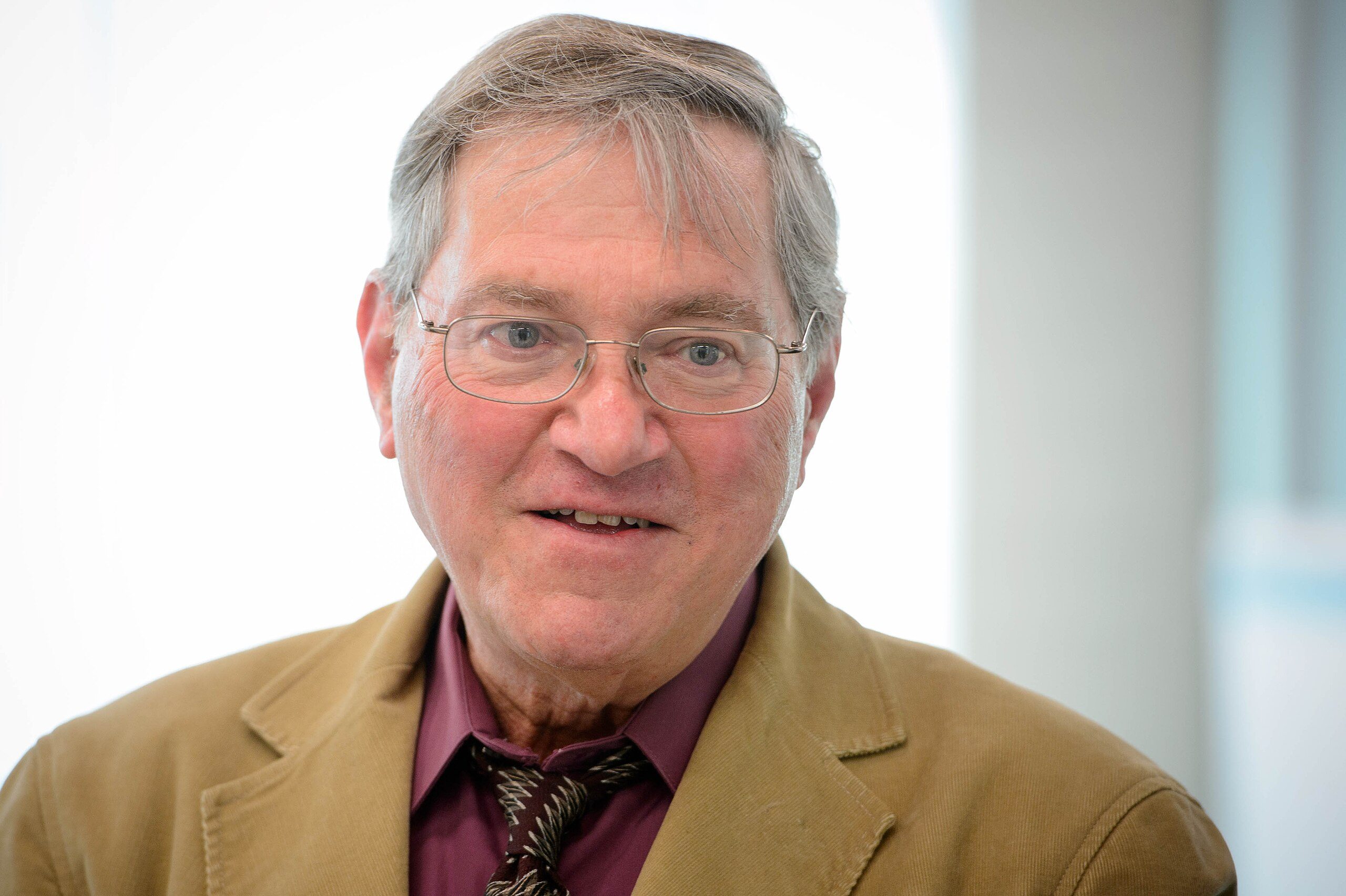

Michael Klare in 2013. Photograph Source: Heinrich-Böll-Stiftung from Berlin, Deutschland – CC BY-SA 2.0
Every movement needs researchers and writers who present technical matters in ways that activists and organizers can understand and apply. Michael Klare has been doing that for more than 50 years and especially since the War in Vietnam and the protests against it. A diligent reporter with a deep-seated curiosity, passion and conviction, Klare has written about war and peace, the environment and energy, the military and its foes. I have known him since about 1960 when we were undergraduates at Columbia College in NY and created a campus political party that lobbied for the abolition of HUAC, an end to nuclear testing, the creation of a co-op bookstore on campus and scaling way back loco parentis, the administration’s medieval policy of treating students like children. Klare currently serves on the Board of Directors of the Arms Control Administration and is the Defense Correspondent of The Nation. He is a Professor Emeritus of Peace & World Security Studies at Hampshire College.
His books include War Without End: American Planning for the Next Vietnams, Supplying Repression, Rogue States and Nuclear Outlaws, Blood and Oil, and most recently All Hell Breaking Loose: The Pentagon’s Perspective on Climate Change. In “Goodbye to American Century: China and India now Rising” published in Fair Observer he wrote “China, India, and the United States are likely to dominate any future world order. Sadly, that doesn’t mean they’re destined to cooperate—far from it.” He added, “Competition and conflict will undoubtedly remain an enduring characteristic of their relationships, with the ties between any two of them constantly waxing and waning.” We shall see.
Q: Friends and acquaintances tell me the political and economic situation is worse today than ever before. I usually remind them of Vietnam, the cold war, the red scares, the genocide against Indians, slavery, Jim Crow, racism and misogyny. But it doesn’t make sense to me to try to gauge whether now or then is worse. What do you think?
A: This is an interesting question, and I wonder about it all the time. I think the answer is both: Things are both better and worse than they were 50-75 years ago, when we first became involved in politics.
Back then, nuclear Armageddon could occur at almost any moment, the US had 100s of thousands of troops in Vietnam, Black people couldn’t vote in much of the US (let alone hold office anywhere), and gay people couldn’t marry or lead normal lives in most places; today, the risk of nuclear war is greatly reduced (if not eliminated entirely), the US is not engaged in large-scale military conflict, Black people can vote and hold office in most places, and gay people can marry and live together openly. So those are big differences.
But I also see trends that worry me deeply. Climate change didn’t exist as an issue 50 years ago; today it threatens to devastate the planet, erase food and water supplies for 100s of millions of people, and produce killer heat waves. Likewise, we didn’t worry about artificial intelligence 50 years ago (let alone 10 years ago), but now AI threatens to destroy jobs for 100s of millions of people, empower hatemongers everywhere, and turn us into nitwits. And then there’s Trump’s drive to turn the world into a battleground between competing imperial power—-an outcome that historically has ended in world war. All this leads me to believe that the future could prove a lot worse than the past.
Q: You have been in the business of tracking and writing about war, saber rattling, and the struggles for global power for decades. As a reporter, what are the challenges today that you face to go on covering the conflicts you have been covering? Is it more difficult to obtain accurate information? Is there more censorship?
A: Here again, it’s a mixed picture. The US Dept. of Defense has imposed much tighter controls over coverage of US military operations. I once flew as a reporter on a B-52 bomber during a simulated nuclear attack on Russia; that would be inconceivable today. On the other hand, the advent of social media makes it much harder to control news. Observers of the war in Ukraine for example, can view an abundance of video coverage of front-line combat.
Q: Your first book was titled War Without End. It was published in 1972. Did you mean that book to be a prophecy? If so, you seem to have been spot on.
A: Well, I meant it then as a prophecy of more counterinsurgency-type wars to come, akin to Vietnam. (The book’s subtitle is “American Planning for the Next Vietnams.”) I did not anticipate the Gulf War of 1991 or the 2003 US invasion of Iraq. However, Iraq turned into a counterinsurgency-type war, as did the war in Afghanistan. I see the potential for a lot more such conflicts in the years ahead.
Q: Two other books by you seem to hint at Venezuela and beyond. I’m thinking of Rising Powers, Shrinking Planet and The Race for What’s Left. Is there still a lot of oil underground, and from an imperial perspective is it worth fighting for?
A: To answer this, I have to begin by saying that both books were concerned with other vital resources besides oil. But first, about oil: Yes, there remains a lot of oil underground, and that oil remains the world’s single most valuable commodity; the world is slowly moving away from oil as a major energy source, but nothing else has yet overtaken oil as the #1 economic commodity, so yes, it is worth fighting over.
Now, as I wrote in The Race for What’s Left, other resources are beginning to approach oil in value. As the world transitions to an AI-driven economy and an electricity-based energy system, certain minerals used in computer chips and car batteries—especially cobalt, lithium, and the rare earth elements—are becoming incredibly valuable. And, like oil, these minerals are only concentrated in a few, hotly-contested areas (like Greenland). So I anticipate conflict over these materials, like the wars over oil.
Q: You did the narration for the film “Blood and Oil.” What is the likelihood that American and Venezuelan blood will be spilled for Venezuelan oil?
A: Well, Venezuelan blood has already been spilled in the US attack on Caracas, which was supposedly intended to apprehend a drug suspect but, as Trump has made explicit, was designed to ensure US control over Venezuela’s oil. I expect more blood to flow in the future.
Q: Predicting the future seems to me to be a matter of reading accurately current trends and extrapolating them. Is that what you do? How do you know what’s going to happen tomorrow and the next day?
A: Yes, extrapolating from current trends is the most reliable way to predict future events. But one also has to look at things like science and geology: if we keep pumping CO2 into the air the way we are now, it will alter the chemistry of the atmosphere and produce irreversible climate effects. Likewise, oil, lithium, cobalt, and rare earths are only concentrated in a few areas, so you can be pretty certain that they will become areas of contestation. I wrote about Greenland in The Race for What’s Left not because I had a crystal ball showing the advent of Trump’s claims for it, but because it possesses valuable minerals and, with global warming, it’s bound to become a site for raw material contestation.
Q: When you were a college student US made cars and US controlled oil dominated world markets. That’s no longer the case is it? How did such a powerful nation lose its edge?
A: The post-World War II US domination of world markets and industrial production was an anomaly. The war destroyed the industrial capacities of Britain, Germany, Japan, and Russia—America’s leading industrial competitors at the time. But it is very hard to perpetuate a moment like that. Britain never fully recovered, but Germany, Japan, and Russia have re-emerged as major competitors and China has emerged as a powerful new competitor. (But recall that 500 years ago, China probably had the world’s biggest GDP). So the US did not so much lose its edge as the natural order of multiple world economic centers reasserted itself. (This, by the way, appears to be the underlying logic behind Trump’s strategic vision, such as it is.)
Q: I remember in the 1960s you and I and our friends talked about contradictions in the American ruling class. Is there a ruling class today and if so what are its main contradictions?
A: This deserves a long conversation over coffee or a beer. I think it’s more accurate to say that we have a small billionaire elite with inordinate wealth and power; unlike anything seen in our college days. Bernie Sanders talks about this, as do others. Right now, this class appears to be in full control of most key levers of power in America.
What are its contradictions? I would say its leading contradiction is an absolute lack of concern about anything but their own wealth and power, meaning they have no class loyalty but fight amongst themselves, causing havoc, and have no interest in preserving the institutions and processes necessary for maintaining global and national order (such as banking regulation, public health, environmental protection, pandemic prevention, and AI restraint), increasing the risks of global catastrophes they cannot prevent or control.
Q: Are there novels and works of fiction that you would recommend that outline the world to come? Are their successors to Orwell’s 1984?
A: I’m not the best person to answer this, as I mainly read non-fiction related to my work. But I would recommend a book that straddles the border between the two, If Anyone Builds It, Everyone Dies: Why Superhuman AI Would Kill Us All, by AI gurus Eliezer Yudkowsky and Nate Soares (the title tells it all). There’s also a lot of climate change-disaster sci-fi that I would recommend, including The Water Knife, by Paolo Bacigalupi and Eiren Caffall’s All the Water in the World (the first about water scarcity in the American West, the other about a submerged NYC).
Q: Empires can take decades or longer to fall. The American Empire will likely be around for your lifetime and mine, won’t it? Or not?
A: What people call the “American Empire” (there’s a lot of disagreement on what that entails) once stretched across the globe, from Europe and the Middle East to Asia, Africa, and Latin America. President Trump has pretty much stated publicly that those days are over, and that the American Empire will now be confined to the Western Hemisphere, while China will rule in Asia and Russia in Europe. (This is precisely the world envisioned by George Orwell in 1984.) I don’t see this new order changing any time soon, but, as in 1984, we can expect constant fighting among these three imperial centers.
Q: What are the options for citizens who want to save the planet, protect human and civil rights and bring about lasting peace.
A: I would like to say we need mass popular movements around the world aimed at installing sane, honest, public-spirited, planet-respecting, minority-respecting, responsible leaders, as I have been saying for a long time. But I think the answer to this will have to come from younger generations and the growing populations of the non-Western world. It is their future that’s at stake, and they will need to fight for it, as we once did.
The post Michael Klare: Radical Politics With Passion and Conviction appeared first on CounterPunch.org.
This content originally appeared on CounterPunch.org and was authored by Jonah Raskin.