

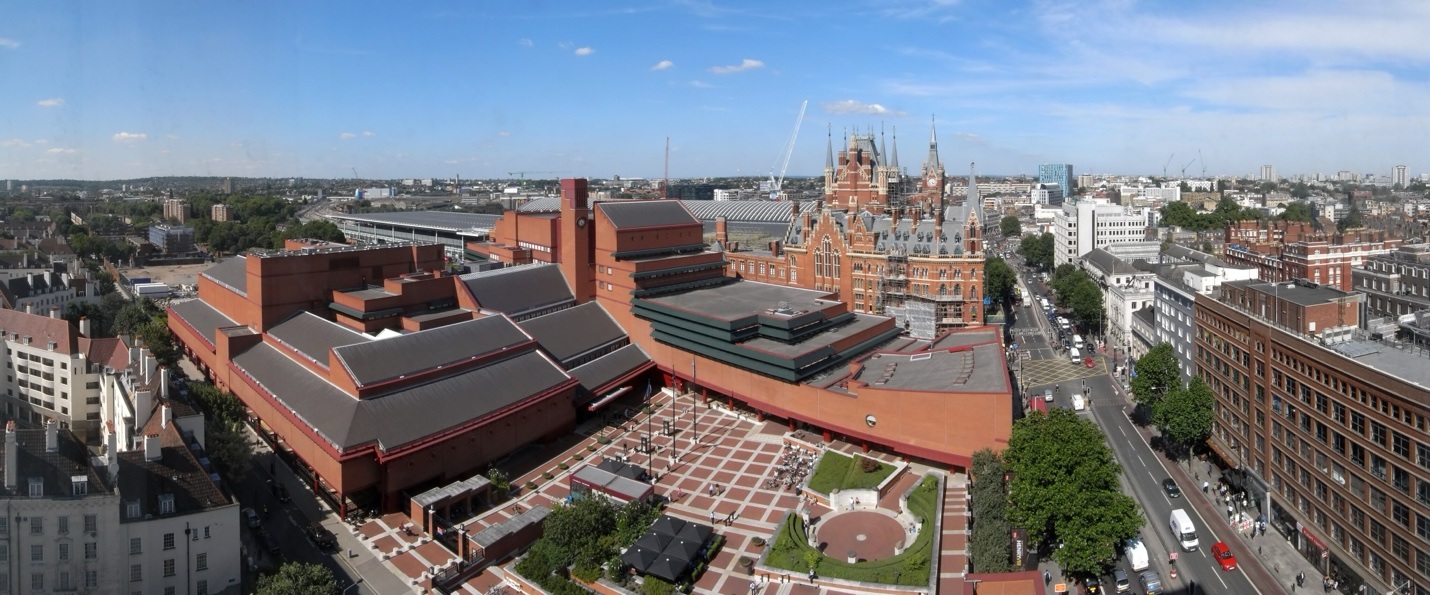
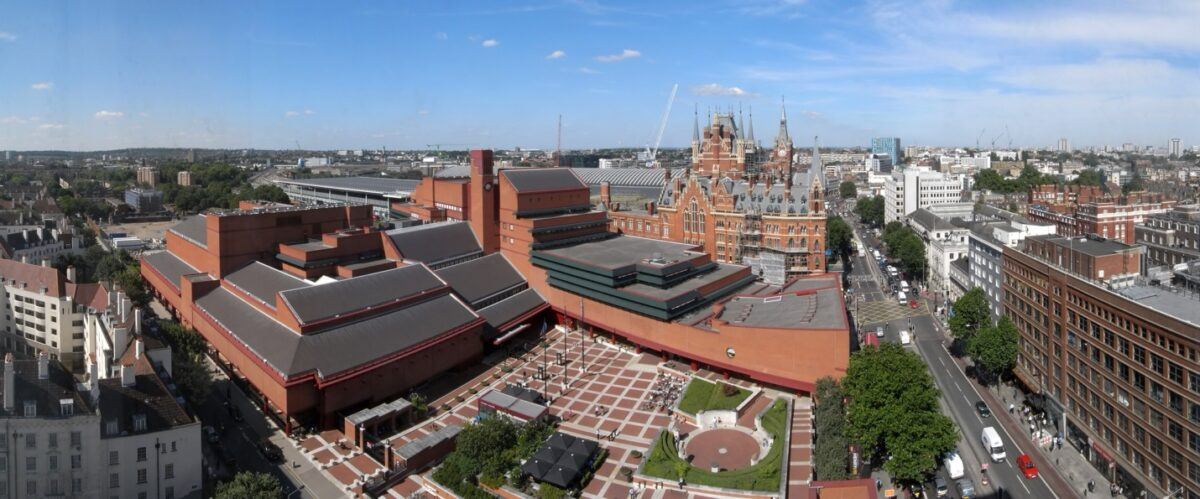
The British Library with St Pancras railway station, London. Photo: Patche99z.
Seen from within its courtyard off busy Euston Road in London, the British Library is meant to look like a stately ocean liner pulling out to sea against the gables, turrets, and clock tower of St. Pancras railway station. The single porthole cut into the long brick hull seals the reference to maritime splendor, that one round window a postmodern wink amidst the riot of Victorian whimsy behind.
St. Pancras was built as a grand railway hotel in the 1870s, and after its great days and those of the Empire were over, it spent many defunct decades in the mid-20th century. It’s now a Marriott. Together, the two structures might seem to evoke the glories and allure of travel to India or other colonies, the big red ship of research allowing intellectual journeys during which the mind moves even as the building doesn’t.
The seas His Majesty’s knowledge vessel cuts through of late have been stormy. If a building could enact the “pathetic fallacy,” the British Library would be listing badly to port, only kept from capsizing by the piers of St. Pancras.
Two years ago, the hacker collective known as Rhysida attacked the information systems of the library and gained access to hundreds of thousands of files. Since then, these tech banditos have amassed a diverse CV of mayhem, including actions against the Chilean army, the City of Columbus, Ohio, the schools of Rutherford County, Tennessee, and the Maryland Department of Transportation, among other targets.
The group’s method of ransoming their British Library booty was to auction it off with the opening bid set at 20 Bitcoin, then worth about $700,000. The British Library refused, and Rhysida dumped scans of passports and other vital personal information of employees onto the dark web. The library’s online catalog was taken down, and individual research and various initiatives and programs were severely hampered or suspended.
Lack of funding was blamed for the porous cyber defenses. Members of staff, already strained by overwork and low wages that force many to take second jobs elsewhere, were on the front lines of library-user anger, whereas managers and directors were largely insulated from the discontent. At the end of a two-week walkout by employees earlier this fall, the library’s CEO, Rebecca Lawrence, resigned from the post, which she had taken only in January of this year. The initial ransom price demanded by Rhysida has proved to be about a tenth of the estimated price tag for repairing the digital damage, never mind the cost to relations with staff and patrons.
Leading literary figures like the novelist Zadie Smith defended the strikes and decried the lack of support for staff and the insufficiency of funding for culture and research. Writing in The Guardian, Smith lamented that “in England one of the most famous libraries in the world is treated as an afterthought, an embarrassment.” She went on bitterly:
You can keep selling yourself, to foreigners, as the country of William Shakespeare and Jane Austen, and luring busloads of tourists to Stratford-upon-Avon and Bath, and put a statue of George Orwell in front of the BBC, and imagine yourself a cultured and literate nation, which the rest of the world admires for its devotion to the written word—but if you then chronically underfund your cultural institutions, and treat your cultural workers with contempt, many people will suspect you of being full of it.
The library happens to be located in Prime Minister Keir Starmer’s Holborn & St Pancras constituency. The beleaguered Labour Party leader has shown rather vague support for the rights of lowercase labor, but he has faced increasing criticism for his failure to intervene, especially during last week’s second work stoppage at the library, which led to a shutdown not just of the reading rooms but of the whole building. Starmer now has a literally graver strike to deal with: National Health Service doctors have walked out just as the U.K. reports its highest rate of flu infection ever at this time of year.
When I arrived to work at the library last month, the newly constructed online catalog was not yet ready. Things limped along with a provisional system put in place after the cyberattacks. But no books or manuscripts could be ordered; only the reference items on the shelves running along the walls of the reading room were to hand. Users could work at numbered desks, equipped with elegant lights and pigskin writing surfaces, but no leatherbound volumes by the likes of Paracelsus or Gibbon or Rousseau were to be seen at these stations next to the MacBook Pros. Though writing with a pen in hand is a rare activity now in the library, the pigskin allows for a soft landing for laptops, and there are power sources at the tabletop level.
That no books were being pulled out of the stacks, the catalog was still down also meant that there was no line at the circulation desk of patrons waiting to get the materials they had ordered or respectfully holding items to be returned. That was often one of the most entertaining rituals—the spectacle of some grandstanding don commenting on the first editions some unsuspecting graduate students carefully held as they stood in line. In my memory, this glory hound was always a he, and always a he with an English accent.
There are long sightlines across the hundreds of workplaces in the cavernous Rare Books and Music Reading Room. Light pours in from windows tucked in below the high, raked ceiling. Maybe it’s supposed to be like being in the hold of a ship not yet filled with cargo.
If you were trying to avoid a colleague you’d tangled with at some previous academic conference, or who was in general worth evading, you could generally hunker down behind a folio volume or two and escape detection. But if you had ordered materials, you had to queue up at the desk, ready to be looked over and possibly surveyed by the quietly nosy, queried by the naturally curious, or interrogated by the extrovertedly inquisitive.
The new British Library catalog, worked on assiduously since the cyberattack, was due to go back online on Monday, December 8. I had hoped to inspect a copy of J. S. Bach’s Clavierübung III from 1731, his first publication of keyboard music. The volume in the British Library’s holdings had been personally corrected by the composer. It had come to the library thanks to Paul Hirsch, one of the greatest music collectors and bibliophiles of the 20th century. A refugee to England from Nazi Germany, he sold his holdings to the British Library in 1946, five years before his own death. Hirsch had wanted his beloved library to remain intact and therefore had resisted higher offers from the United States.
A talented amateur musician, gifted with considerable discernment, expertise, and a substantial fortune, he amassed important, unique materials from Bach, Mozart, Beethoven, and Schumann, among many other composers and writers on music. He was fascinated by Renaissance music theory and also by the beauty of the books he bought, especially drawn to those rich in images—woodcuts, engravings, annotations. He acquired one of only three surviving copies of the first book published about the organ, Arnolt Schlick’s Spiegel der Orgelmacher und Organisten (Mirror of Organ Builders and Organists) of 1511, which I have been lucky enough to hold in my hands, though that was in the Round Reading Room of the old British Library, then in the British Museum about a mile away from the current location. That was before the ocean-liner British Library was launched in 1998.
But the longshoremen and women, the bibliophilic pursers, shipwrights, went on strike the same day the new catalog went online. The library was mothballed for my remaining days in London.
My Bachian voyage would have to be postponed. Turns out I won’t be holding Hirsch’s Bach score when this ocean liner of the mind goes down—not in the freezing North Atlantic, but in the post-industrial, post-imperial maelstrom of malaise.
The post Read the Room appeared first on CounterPunch.org.
This content originally appeared on CounterPunch.org and was authored by David Yearsley.