
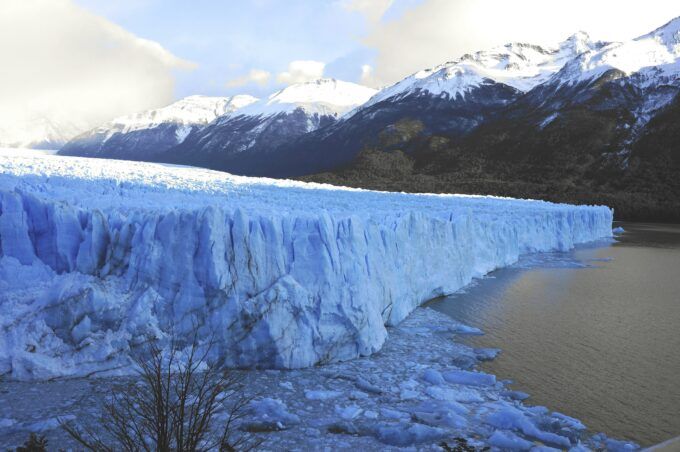
Image by Amar Adestiempo.
Thwaites, the most studied glacier in the world, commands attention because it is not only the widest in the world at 80 miles but also the shakiest. And its nickname “The Doomsday Glacier” certainly sets it apart from the 500 other named glaciers in Antarctica. Based upon new research of 2024-25, polar scientists have been speaking out like never before, making public predictions about a rapidly deteriorating situation and insisting upon an end to burning fossil fuels, or else!
The new studies identify new concerns: (1) undersea storms that deteriorate/melt from below (2) hundreds of ice earthquakes, fracturing the glacier (3) Thwaites Eastern Ice Shelf, a major portion of the glacier, seriously losing stability.
And finally, a final goodbye to the iconic International Thwaites Glacier Collaboration (ITGC) as it goes dark by year-end 2026. The Trump administration’s FY2026 budget request includes severe cuts to polar science, aiming to end support for the research icebreaker Nathaniel B. Palmer (NBP).
Going forward, Thwaites cascading ice shelves will be unanticipated by polar researchers, as the Nathaniel B. Palmer icebreaker, a veteran of 30 years, is no longer available. It’s been canceled by budget cuts, and the only way to study sea ice is with a vessel. From this point forward, Thwaites abstruse behavior will come as an unwelcomed surprise to coastal megacities of the world.
Nevertheless, as of today, Thwaites followers can exhale because ITGC concluded that the monster glacier will continue to retreat but will not collapse this century and will only account for several inches of sea level rise by 2100. This conclusion is confusing as several recent studies outside of the purview of ITGC are issuing alarm signals of imminent danger and catastrophic sea level rise for today’s generation, which comes as a real shocker, explained herein. This troubling difference of opinion amongst polar scientists likely points to the difficulties in analyses of an ice continent the size of Antarctica, or the US and Mexico combined; thus, subjective opinions become more prominent and can easily radically disagree. Of special note, the disagreement by scientists over future sea level rise is wide enough to drive a Mack truck through.
Thwaites is so over-the-top controversial that it has its own international study group: International Thwaites Glacier Collaboration involving 100 scientists from world-leading research institutes, but going dark soon. Interestingly, the ITGC web site states: “Thwaites Glacier’s retreat has accelerated considerably…, our findings indicate it is set to retreat further, and faster, through the 21st and 22nd centuries, and general collapse of the West Antarctic Ice Sheet over this timeframe cannot be ruled out.” The date of this general statement on the web site is not provided, but ITGC was established in 2018. Additionally, a solution is offered: “Immediate and sustained climate change mitigation (decarbonization) offers the best hope of delaying this ice loss and avoiding initiation of similar unstable retreat in marine-based sectors of East Antarctica.”
In stark contrast to ITCG’s assessment of sea level rise, other studies reported over the past 24 months by polar scientists, who are not necessarily with the ITCG, are bone rattling, e.g. an August 2024 meeting of the Scientific Committee on Antarctic Research, 1,500 scientists: “Antarctica’s glacial melt is advancing faster than ever before in recorded history.” Gino Casassa, glaciologist and head of the Chilean Antarctic Institute, one of the attendees: “Based upon current trends, sea levels will be up 13’ by 2100,” which begs the question of how high by 2035, one decade from now, and furthermore, this projection by Dr. Casassa is wide of the mark of the ITCG. In fact, this is the first known public statement of such an aggressive prediction. Additionally, in general support of Dr. Casassa’s 13-feet, in November 2024, 450 polar scientists held an emergency summit in Australia, stating: “If we don’t act, and quickly, the melting of Antarctica ice could cause catastrophic sea level rise around the globe within our lifetimes.” It is believed this is the first time such a shocking statement, specifically about Antarctica, has been issued by a major gathering of scientists. “Catastrophic, within our lifetimes” is a real punch to the gut.
Both instances go well beyond expectations by the Intergovernmental Panel on Climate Change (IPCC) and ITCG and published research in general. Both call for immediate halt to greenhouse gases, specifically carbon dioxide CO2 emissions from fossil fuel burning as well as decarbonization. Nevertheless, in the face of scientists’ warnings of deep, deep trouble, the United States is taking a path of climate change ignorance. This puts the world at risks which most of today’s American politicians will not have to face because of indeterminate timing, making it easier to “go for the money” and “screw the environment.” As such, sorrowfully, money becomes the new Golden Calf (Book of Exodus). How’d that biblical story work out?
A chilling new study in Science News, University of Manitoba, with a telling headline: Satellites Spot Rapid ‘Doomsday Glacier’ Collapse, Summary: “Two decades of satellite and GPS data show the Thwaites Eastern Ice Shelf slowly losing its grip on a crucial stabilizing point as fractures multiply and ice speeds up. Scientists warn this pattern could spread to other vulnerable Antarctic shelves… The study notes that the pinning point, once a key factor holding the TEIS in place, has slowly shifted into a feature that now contributes to its instability. This four-stage pattern of structural decline may be a signal for other Antarctic ice shelves that appear to be entering similar phases of weakness.” (Debangshu Banerjee, et al, Evolution of Shear‐Zone Fractures Presages the Disintegration of Thwaites Eastern Ice Shelf. Journal of Geophysical Research: Earth Surface, 2025)
Another new study, as of December 2025, published in Nature Geosciences is the first to systematically analyze how the ocean is melting ice shelves over just hours and days, rather than seasons or years, another real shocker. Swirling underwater storms are the protagonists that aggressively melt from down below. The study is listed in CNN Climate, Underwater ‘Storms’ are Eating Away at the Doomsday Glacier. It Could Have a Big Impact on Sea Level Rise d/d Dec. 10, 2025.
Another new study of Thwaites discusses glacial earthquakes, which weaken the gigantic glacier. About two-thirds of the events detected, 245 out of 362, were located near the marine end of Thwaites. Most of these glacial earthquakes are due to capsizing icebergs. A glacial earthquake is created when tall, thin icebergs fall off a glacier into the ocean. When icebergs capsize, they clash violently with the “mother glacier.” This generates strong mechanical ground vibrations, seismic waves, that propagate thousands of kilometers from origin. (Hundreds of Iceberg Earthquakes Detected at the Crumbling End of Antarctica’s ‘Doomsday Glacier’, Phys.org, December 14, 2025).
Whether the Doomsday Glacier craters with a big splash today, tomorrow, or next century, the fact remains that polar scientists agree it is ultra-high risk surrounded by uncertainty. The dimensions are well known, timing of sea level rise is guesswork. But because it is huge and known to be extremely unstable, someday it’ll disrupt civilization beyond the comprehension of today’s stubborn ill-informed climate deniers. And, assuming the 450 polar scientists are close to correct; they’ll see it during their lifetimes. Then what?
The post The Doomsday Glacier Flunks 2025 Checkup appeared first on CounterPunch.org.
This content originally appeared on CounterPunch.org and was authored by Robert Hunziker.