
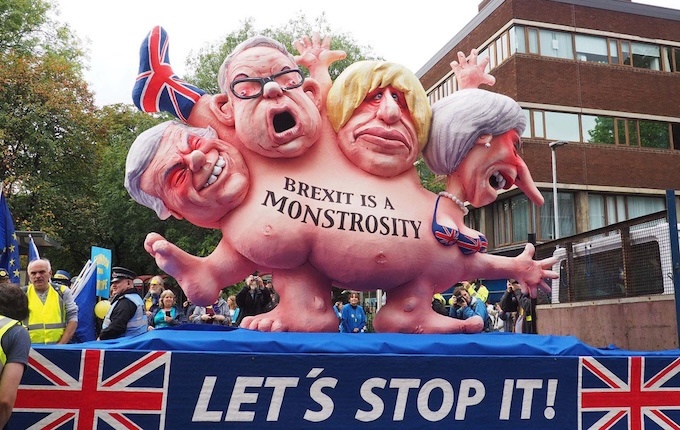
Anti-Brexit protesters in Manchester. Photo: Robert Mandel, Wikimedia Commons. CC BY 4.0
The tenth anniversary of the British vote to leave the European Union raises two immediate questions: Was it worth it? Can it be undone? The answer to the first is increasingly clear. Experts generally agree that the British economy has suffered for a decade, accompanied by political instability. The second question is more complex. Democracies are built on the assumption that citizens can change their minds. Elect a new government. Hold another referendum. Reverse course. But can a nation ever truly return to where it was before a fateful decision?
Philip Stephens described the “dismal verdict” about Brexit ten years after in the New York Times: “A decade later, the cost of that freedom — of the return, as Mr. Johnson repeatedly put it, of precious national sovereignty — is blindingly apparent. The vote to leave the European Union was a real cry of pain from a large section of the electorate that thought itself left behind by economic progress. The desperation remains. The ‘sunlit meadows’ were a mirage.”
In 2016, Britain voted 51.9% to 48.1% to leave the European Union. Ten years later, opinion has reversed. Most polls now show that, if given another referendum, a majority of Britons would vote to rejoin the EU.
Can Brexit be undone? Would rejoining restore Britain to its pre-Brexit condition? The answer depends on a distinction we do not often make: reversing a decision is not the same as restoring the world that existed before it.
Brexit is not unique. Democracies—and great powers in particular—repeatedly confront decisions that later generations wish they could reverse. Brexit is only the latest example of a larger historical puzzle. Every generation seems to have its irreversible moment—the event that commentators declare has changed everything forever.
There were two “last helicopters” in my lifetime: Saigon in 1975 and Kabul in 2021—moments that seemed to close a chapter. The question is whether they really did. The Vietnam War is now widely recognized as a mistake. Years later, former Secretary of Defense Robert McNamara admitted, “We were wrong, very wrong.” The sight of the last helicopter leaving Saigon on April 30, 1975, remains ingrained in many people’s memories as the defining image of American defeat.
What was the narrative that followed? The decline of the United States as a dominant world power. Ken Burns and Lynn Novick accurately described the moment: “America’s illusions of invincibility had been shattered, its moral confidence shaken.”
Yet the decline narrative proved remarkably short-lived. After the collapse of the Soviet Union in 1991, Vietnam disappeared as the defining story. Francis Fukuyama proclaimed The End of History. Joseph Nye argued that the United States was Bound to Lead. Madeleine Albright called the United States the “indispensable nation.” Less than two decades after Saigon, euphoric triumph had replaced humiliation.
Then came Afghanistan. The United States again watched its final evacuation as the Taliban returned to power. Commentators once more declared the end of American primacy. “This was the greatest humiliation suffered by the United States since the fall of Saigon in 1975,” Victor Davis Hanson wrote. “Kabul 2021 is our Saigon,” Niall Ferguson observed.
Brexit, Vietnam, Afghanistan—and now Trump. “Future scholars will sift through Trump’s digital proclamations the way we now read the chroniclers of Nero’s Rome,” David Remnick wrote in The New Yorker. Will post-Trump resemble post-Vietnam, with America eventually recovering? Will Britain rejoin the EU? Can either country return to what it once was?
Or are there moments in political life that cannot be undone? When MAGA supporters promise to Make America Great Again, what exactly does “again” mean?
Gal Beckerman, in How to Be a Dissident, offers a different way of thinking about political renewal. He distinguishes reversal from reconstitution. “If death focuses the mind on the point of living,” he writes, “birth flips our thinking, so that what matters is all the possible permutations of life.”
He then quotes Hannah Arendt: “It is the nature of beginning that something new is started which cannot be expected from whatever may have happened before.”
Beckerman’s point is that “A dissident lives with this sense of natality.” That insight suggests a different answer to the Brexit question. He concludes that Arendt “doesn’t believe that everything will turn out fine. It’s the feeling, rather, that you can always begin again.”
If Britain rejoins the EU, Beckerman’s argument suggests that it will be a different country. More than a decade of going it alone will have changed Britain’s understanding of both itself and Europe. Rejoining would mark the beginning of a new relationship, not a return to the old one.
The same principle may already be visible in the United States. Political renewal rarely comes from restoring an earlier consensus. Instead, it takes shape through political innovation. The election of the Democratic Socialist Zohran Mamdani as Mayor of New York City and the success of younger progressive candidates in Democratic primaries suggest that American politics is generating something new rather than recreating the liberal order that preceded Trump.
This is not simply a return to an earlier American socialism. After all, Eugene Debs ran for president five times on the Socialist Party ticket, and Norman Thomas was the party’s nominee six times. Neither came close to winning the presidency. If a democratic socialist current is gaining influence today, it is doing so through different coalitions, different constituencies, and different political languages. It is another example of Beckerman’s point: democratic renewal comes through new beginnings, not the restoration of old movements.
History does not have an “undo” button. But neither is history irreversible. Beckerman suggests something more subtle than the view of history implied by Paul Kennedy’s The Rise and Fall of the Great Powers: Economic Change and Military Conflict from 1500 to 2000 as a simple pendulum. Kennedy sees history as recurring cycles of rise and fall. Beckerman sees history as the possibility of genuinely new beginnings.
A democracy can change direction, but it cannot recover the country it would have become had it chosen differently. Robert Frost’s traveler cannot return to the fork in the road and choose again. Democracies cannot either. If democracy is to be renewed in the United States, it will take generations. And it will not be like the glory years I grew up with after World War II.
Britain’s debate over rejoining the European Union points to something larger than Brexit. Democracies do not recover by returning to the past. They recover by becoming something new. History permits reversals. But it never permits restorations.
The post There is No Going Back: How Democracies Can Begin Again appeared first on CounterPunch.org.
This content originally appeared on CounterPunch.org and was authored by Daniel Warner.