
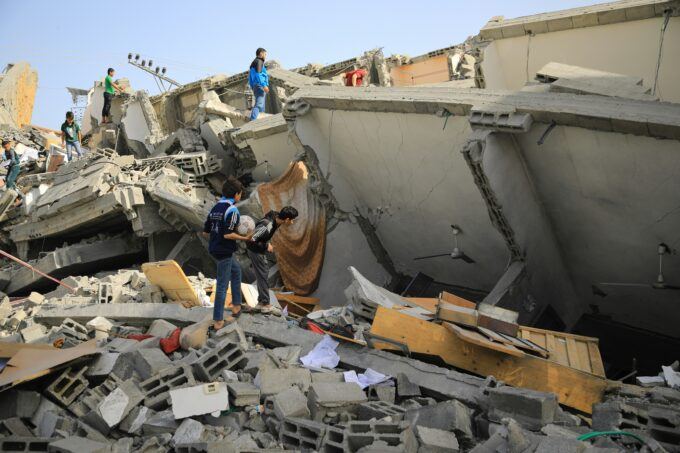
Image by mohammed al bardawil.
There is no shortage of things that should astonish us about the West’s indifference to Israel’s genocide in Gaza, but the treatment of children stands apart. In ordinary life, care for children is the deepest moral reflex we have: parents structure their days around it, laws and institutions exist to enforce it, and even distant or imagined threats to our children are enough to produce panic, outrage, and decisive action. When one of our children is hurt – physically or emotionally – we feel it in our own bodies; a small injury can be agonizing, a night of fear can undo us, and the death of a child is rightly understood as the most shattering loss from which families often never fully recover. And yet, when Palestinian children are killed, maimed, starved, orphaned, displaced, detained, or psychologically traumatized in the tens of thousands, this supposedly deeply-ingrained instinct no longer obtains. What is treated as sacrosanct everywhere else becomes contingent here, revealing a moral collapse that no amount of rhetoric can conceal.
The Unchilding of Palestinian Children
A landmark report released in June 2026 by the UN Independent International Commission of Inquiry concludes that Israeli authorities and security forces have deliberately targeted Palestinian children, finding that these acts constitute evidence of genocide, crimes against humanity, and war crimes. Examining the period from October 2023 through October 2025, the Commission records at least 20,179 children killed and 44,143 injured, while emphasizing that these figures almost certainly underestimate the true toll.
More fundamentally, the report argues that the deliberate targeting of children is not incidental to Israel’s military campaign but a calculated strategy and one of the principal indicators of genocidal intent, observing that “by targeting children, Israel is attacking the very capacity of the Palestinian people to exist and to determine their future.” The report documents repeated cases of children killed by rifle and drone fire or suffering gunshot wounds to the head and torso, alongside the systematic destruction of schools and hospitals and the eradication of the conditions necessary for children’s survival and development. Worse still, documented accounts from medical personnel and witnesses describe the intentional, surgical targeting of children by Israeli soldiers, including reports of systematic sniper fire in which different days were allegedly devoted to shooting children in different parts of the body – “like a game of target practice.” The scale of this assault on Palestinian children is almost impossible to comprehend.
This devastation is reflected in the official numbers. According to the Commission’s findings, children account for roughly 30 percent of all those killed, while UNICEF and other humanitarian agencies estimate that thousands more have been injured, orphaned, displaced, or psychologically traumatized. Yet even these staggering figures conceal the true scale of the devastation. Numerous humanitarian organizations have stressed that the total overall casualty data – across the entire population – almost certainly represents a substantial undercount, perhaps by as much as 35-40 percent. UNICEF has also warned that every child in Gaza now requires intense mental health support, with widespread trauma, sleep disorders, and fear responses across the entire child population. In Gaza City, large-scale surveys have found overwhelming levels of severe psychological distress among children living through repeated bombardment, displacement, and loss.
This psychological fracturing is exacerbated by the collapse of family and societal networks, occurring despite the endurance of Sumud – the deeply ingrained practice of courageous and steadfast resilience rooted in mutual care, collective identity, and familial cohesion. Indeed, the ongoing calculated assault is aimed precisely at the social fabric that makes such collective resistance possible. More than 58,000 children have reportedly lost one or both parents, while thousands more are unaccompanied or separated in destroyed family networks. In hospitals, clinicians have coined the term WCNSF – “Wounded Child, No Surviving Family” – for children pulled from rubble as the sole survivors of their households. Many arrive unnamed – too young, too traumatized, or too injured to identify themselves, with no surviving relatives able to claim them.
The assault on childhood survival is nowhere more painfully visible than in the catastrophic rate of pediatric bodily trauma. UNICEF reporting has documented children undergoing amputations at extraordinary rates, often without anesthesia, with some estimates describing multiple children per day losing limbs under conditions of relentless bombardment and medical collapse. Gaza now has the highest per capita population of child amputees in the world, a statistic that has no parallel in recent history. This physical destruction is compounded by a deliberate Israeli policy of medical denial, which systematically blocks thousands of these amputees from leaving the Strip to receive the urgent reconstructive surgeries and rehabilitative care unavailable within Gaza’s collapsed healthcare system.
UN Special Rapporteur Francesca Albanese, in her reports on the Occupied Palestinian Territories, has described this structural erasure as the “unchilding” of Palestinian children – the systematic destruction of the societal conditions that make childhood possible at all. Her subsequent work, including Anatomy of a Genocide, documents how mass death, starvation, displacement, detention, and psychological trauma function as part of a deliberate and systematic assault on the conditions necessary for children’s survival and development, threatening the very possibility of a Palestinian future and their right to self-determination.
The Bereavement Multiplier
The demographic concept of the bereavement multiplier helps clarify what raw casualty figures conceal. Developed by demographers during the COVID-19 pandemic, the bereavement multiplier refers to the number of close family members and loved ones who experience significant grief and loss following a death. A child killed does not represent a single loss but a cascading network of bereavement – parents, siblings, grandparents, caregivers, classmates, neighbours, and extended kin – often resulting in ten or more deeply affected individuals per death. Applied conservatively to Gaza’s reported child death toll alone, this suggests that several hundred thousand people have already been afflicted by the deep grief associated with the death of children. But in Gaza’s dense familial and social networks, these layers of mourning overlap to compound the impacts: families lose multiple children, survivors mourn entire households, and communities experience repeated exposure to widespread death. The result is not isolated bereavement, but population-wide psychological devastation extending far beyond the official death and injury totals. When the trauma borne by Palestinians in the West Bank and the wider diaspora is added, the number of people living under conditions of sustained traumatic stress likely reaches into the millions.
The Psychology of Unchilding
The psychological consequences of life in Gaza cannot be understood by conventional models of post-traumatic stress, which typically assume that traumatic events have ceased and recovery can begin. For Palestinian children, the threat itself has become relentless. More than fifteen years of blockade, repeated military assaults, and forced displacement have been compounded by the destruction of homes, schools, hospitals, and cultural institutions, the loss of parents and caregivers, and the deprivation of food, clean water, healthcare, and education. The result is an environment in which danger is not episodic but continuous. As psychologist Triantoro Safaria argues, Gazan children are living under conditions of “continuous traumatic stress” – a state characterized by unremitting and inescapable threat rather than exposure to discrete traumatic events.
A comprehensive synthesis of the recent research by Anies Al-Hroub likewise concludes that conventional psychiatric models are fundamentally inadequate for understanding the psychological condition of Palestinian children. Instead, it calls for a framework that integrates continuous traumatic stress with structural violence, recognizing that children’s mental health is inseparable from the political, historical, and material conditions in which they live. The evidence consistently demonstrates extraordinarily high levels of post-traumatic stress disorder, depression, death anxiety, existential distress, and complicated grief, with many studies reporting clinically significant symptoms in 70–90 percent of children assessed. Because bombardment, displacement, and deprivation continue unabated, children rarely experience the safety necessary for healing and recovery. Cumulative exposure to war-induced trauma multiplies the risk for long-term harmful effects, creating what researchers now describe as a “continuum of trauma.”
The Destruction of Childhood Itself
The sustained environment of violence directly lays bare the psychological dimension of Albanese’s “unchilding” framework. Orphanhood, repeated displacement, and the collapse of family and community life compel children to prematurely assume adult responsibilities for daily survival long before they are developmentally capable of doing so.
Play, learning, exploration, and socialization are entirely displaced by hyper-vigilance, scavenging, child labor, family caregiving, and the daily struggle to secure basic necessities. Emerging research suggests that these extreme conditions will permanently affect children’s neurological, emotional, and social development, underlining what Safaria describes as a collective “crisis of childhood itself.”
Intergenerational Trauma and Complicated Grief
The mental health consequences of these devastating conditions extend well beyond children’s direct experiences of the violence. Caregivers themselves are coping with overwhelming trauma, grief, displacement, and deprivation, giving rise to what researchers describe as secondary traumatization, whereby children’s emotional suffering is intensified through the distress of parents and other caregivers. The result is an intergenerational cycle of perpetual trauma in which post-traumatic stress responses are systematically transmitted through entire family systems.
Clinical grief literature uses the term “complicated grief” to describe mourning that becomes prolonged or destabilized following sudden or violent death, the loss of a child, suicide, fractured relationships, or circumstances in which grieving and mourning cannot be safely processed. These are already among the most devastating forms of human bereavement, encompassing both the emotional experience of grieving and the cultural expressions of mourning. In Gaza, however, such circumstances are no longer exceptional – they have become the ordinary conditions under which significant loss and deprivation occur.
Thus, viewed through the lens of grief and trauma studies, Gaza presents not merely a crisis of bereavement but one of complicated grief and complex trauma on a population-wide scale. Death occurs amid displacement, starvation, and destroyed homes, with children witnessing the deaths and disappearances of siblings and parents. In this same wreckage, parents search through rubble for the remains of their children, sometimes recovering only fragments of their bodies. Deprived of even the dignity of a proper burial, families are denied the conditions necessary to process their grief and integrate profound loss into their continuing life narrative. Trauma is sustained because the conditions producing it do not cease, ultimately fracturing the family and community connections that normally shelter and protect children during crises.
Western Complicity and Moral Collapse
The brutal murder of Hind Rajab was never an isolated atrocity. As Lama Khouri recently observed, there are “tens of thousands of Hind Rajabs” in Gaza – children whose names will never be recognized, but whose undocumented suffering is the very foundation of this assault on Palestinian childhood. While we may show fleeting sympathy for the few children whose stories break through to the outside world, countless others disappear without witness, memorial, or public reckoning. It is this exact silence that allows the machinery to keep moving. We look away when the news cycle shifts, but as Khouri notes: “Our forgetting is not innocent. It is the thing the killing needs from us, and it is being counted on.”
None of this is to deny the suffering of children in other war zones – including Sudan, Yemen, Congo – where violence against civilians persists amid profound international indifference. Gaza, however, occupies a distinct place within Western political life. Israel is not an isolated or marginal actor; it is armed, funded, diplomatically protected, and rhetorically defended by the very governments that most loudly proclaim their commitment to human rights, international law, and the protection of children. Yet these high-minded principles collapse with startling ease in the case of Palestinians.
More concerning still, this extraordinary deference to Israel has increasingly been accompanied by efforts at home to curtail civil liberties, suppress protest, and narrow the boundaries of acceptable political dissent. The pain and suffering of these young victims are not simply ignored; they are justified, normalized, and often suppressed from public view to preserve a strategic alliance with a rogue regime. Through this domestic enforcement, citizens in North America and Europe become not merely observers of these crimes against Palestinian children, but accomplices – however unwillingly or unwittingly – in the political structures that sustain them.
To maintain their facade of moral enlightenment, Western societies do not simply fail to respond; with the aid of complicit media, they have learned how to “forget” while the killing continues. Reality is permitted to appear only in fragments – briefly visible before the next wave of headlines. We witness the slaughter, mutilation, and starvation of Palestinian children as if it were no more than an unsettling news story – shocking to look at, but detached from any claim upon our conscience or sense of compassion. The total abandonment of these innocent lives takes place amid a resounding silence that persists even within many progressive humanitarian organizations, suggesting not just hypocrisy, but something more disturbing: a profound erosion of our shared humanity.
Our complicity and failure to act force a disturbing question upon us: how will we explain to our own children that we stood by and watched the “slow erasure of a people“ through the annihilation of its children?
James Baldwin articulated a moral truth that speaks directly to this situation: “The children are always ours, every single one of them, all over the globe; and I am beginning to suspect that whoever is incapable of recognizing this may be incapable of morality.”
The post Mass “Unchilding” and “Forgetting” of Palestinian Children appeared first on CounterPunch.org.
This content originally appeared on CounterPunch.org and was authored by Ross MacKay – Lynne MacFadgen.