
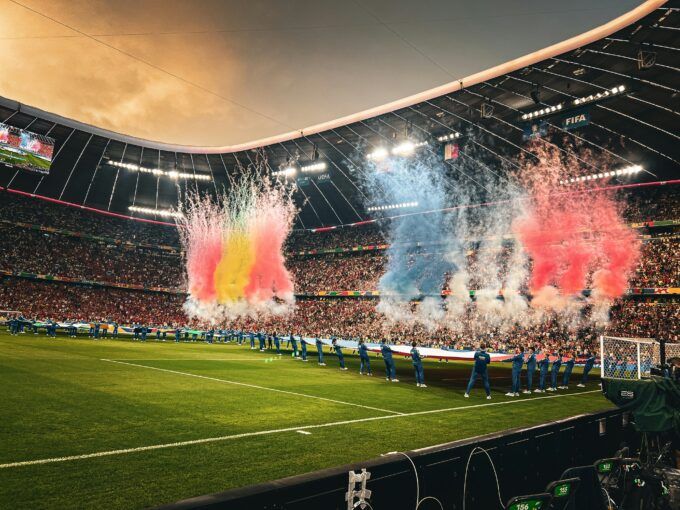
Image by Johannes Hübner.
The FIFA World Cup is one of the few global events whose legitimacy does not derive from the power, wealth, or political influence of its participants, but from the principle of “competitive equality.” Millions around the world follow this tournament because they believe that, at least for ninety minutes on the pitch, differences between nations are not determined by economic size, military capability, or geopolitical weight, but by performance on the football field. It is precisely this perception of equality that has turned the World Cup into the world’s most significant sporting event. Yet, on the eve of the 2026 World Cup, a critical question is emerging for global football: if all teams do not enter the pitch under equal conditions, can the competition still be considered fair?
What is being discussed these days regarding potential restrictions on certain teams in the World Cup may, at first glance, appear to be merely a political or administrative dispute. However, at a deeper level, the issue touches one of the most fundamental principles of global sports governance. The core issue is not that one country has political disagreements with another or that certain players face more restrictive entry or residency conditions. Rather, it is that for the first time, signs are emerging of a new emerging precedent—one in which the host country can, without altering the formal rules of competition, asymmetrically shape the competitive environment for different teams.
In political science and public law, the legitimacy of any competition is grounded in “procedural justice.” People generally accept outcomes only when they are confident that the process has been equal for all participants. This principle applies to elections, courts, tenders, and even sporting competitions. If participants believe that some competitors enjoy advantages to which others do not have access, trust in the outcome gradually erodes—even if the formal rules appear identical for everyone.
Modern professional football is also built on this logic. Contrary to common perception, competitive fairness is not limited to the rules on the pitch. At the professional level, the match begins long before the referee’s whistle. Players’ recovery quality, ease of travel, access to training facilities, psychological stability, scheduling consistency, accommodation conditions, and freedom of movement are all part of a team’s competitive capital. This is why clubs and national teams spend millions optimizing the smallest details of preparation. At such a level of competition, an extra flight, a few hours of delay, an administrative restriction, or a persistent mental burden can influence the outcome as much as a tactical mistake.
From this perspective, the developments related to the 2026 World Cup must be examined. The concern is not merely that some teams may face visa challenges or administrative restrictions; rather, the real concern is that such restrictions could become part of the competitive environment itself. If one team can fully focus on technical preparation, training, and recovery, while another must allocate part of its energy to resolving residency issues, permit renewals, travel restrictions, or re-entry complications into the host country, then the conditions of competition are no longer truly equal. Inequality here is not produced within FIFA’s formal regulations but within the operational environment of the tournament.
This is precisely the point at which the issue transcends political disagreement and becomes a structural challenge for global football. For decades, the host nation has typically been viewed as a facilitator of competition. Its role was to provide infrastructure, ensure security, facilitate team entry, and create conditions in which all participants could compete without external burdens. However, what now appears to be emerging is a paradigmatic shift: the host is no longer merely an organizer of the tournament but is becoming an actor capable of shaping competitive conditions through its sovereign administrative powers.
The real risk lies precisely here. If such a precedent becomes accepted practice, its consequences will extend far beyond the 2026 World Cup. In that case, every future host country could, under the justification of political, security, immigration, or administrative considerations, create differentiated conditions for participating teams. One country might make entry more difficult for certain players. Another might impose movement restrictions on specific teams. A third might use bureaucratic mechanisms to increase the indirect costs of participation for selected competitors. In all these cases, the formal rules of the competition would remain unchanged, yet the principle of competitive equality would gradually erode.
Iran’s case is merely one illustration within a broader trend. Imagine players or members of a national team being required, during the tournament, to deal with time-sensitive residency or administrative constraints. Imagine part of their recovery and rest time being diverted from preparation to managing issues related to their legal status in the host country. Even if such restrictions are not explicitly embedded in tournament regulations, their impact on competitive conditions is undeniable. In such a scenario, teams are no longer competing solely against their opponents; they are simultaneously absorbing costs that others do not face.
What is particularly noteworthy is that this trajectory contradicts the philosophy that global football has promoted for decades. FIFA has consistently described football as a universal language among nations and has emphasized principles such as inclusivity, equality, and non-discrimination. Yet these principles only carry meaning if they are guaranteed in practice. Competitive equality is not merely a promotional slogan; it is the foundation of public trust in tournaments. If this trust is weakened, even the most exciting competitions will lose part of their legitimacy.
Ultimately, the question today is not whether a particular team will face visa issues in the World Cup. The deeper question is whether global football is willing to accept that a host country may impose burdens on some teams that others do not face. If the answer is yes, then what is at stake is not the fate of a single team or country, but the gradual erosion of one of the fundamental principles of international sport.
The World Cup has always symbolized the idea that all teams start from the same point. Some may have better players, more experienced coaches, or greater resources, but the rules of the game remain identical for all. What is at stake today is not the outcome of a single match or the fate of a particular team, but the gradual erosion of this foundational principle. If some teams are required to face obstacles before stepping onto the pitch that others do not, then the match effectively begins before the whistle is blown. In such a scenario, the host is no longer merely an organizer of competition; it becomes an actor influencing the balance of the game itself. And that may be the most dangerous precedent global football has faced in decades.
The post World Cup in the Age of Inequality appeared first on CounterPunch.org.
This content originally appeared on CounterPunch.org and was authored by Peter Rodgers.