
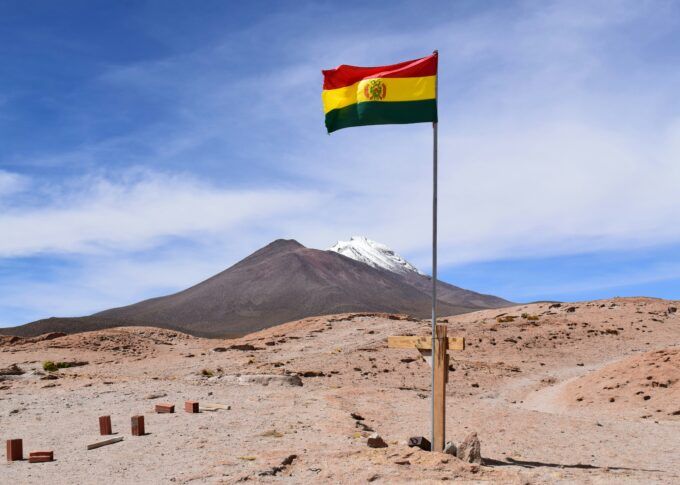
Image by Milos Hajder.
What is democracy? Few have answered this question with more needed might than German-American Jewish political theorist and philosopher Hannah Arendt. Writing in the immediate aftermath of the Nazi Holocaust, Arendt sought to protect humankind from ever again facing such totalitarian destruction. She argued that totalitarianism reduces human beings to abstract cogs in a machine, denying what she called the “living soul” of bodypolitik. For Arendt, the people’s will, and the demos, are fluid. As she writes in On Revolution, it is not a static document or a single day of voting; but a river that changes course according to the lived reality of citizens, however complex and sometimes naive. To freeze that river, and attempt to contain popular will through growing restrictions, is to invite tyranny into hallowed halls.
Today, in Bolivia, and in much of the region, we are witnessing the consequences of ignoring Arendt’s warning. The protests and blockades that have gripped key areas of the country for 6 weeks are not, as many elites claim, a negation of democracy. They are democracy in its most raw and vital form; the fluid will of the people pushing back against a government that has forgotten its oath.
The right, including the Paz government, the far-right in Santa Cruz, the US government, and other Latin American autocrats, have called the protesters everything from “sore losers,” “threats to the democratic order,” and even, as Secretary of State Marco Rubio put it, “terrorists and drug traffickers.” Maria Corina Machado, Javier Milei, Jose Antonio Kast, and others have also said the protesters were attempting a “coup” and “attacking democratic institutions and stability,” nevermind the fact that they themselves are autocrats who support right-wing coups and dictatorships. To them, voting is but a sacrosanct ritual reserved for the most deserving; anything else is anarchy against the balance.
Yet, the protests and direct action have mass support and represent a wide array of sectors, including labor unions, indigenous groups from everywhere between the Amazon and Altiplano, social sectors, mining unions, student unions, teachers’ unions, cocaleros, transport unions, and more radical leftist nationalists. They are also supported by the main two leftist political parties in opposition, and some in Paz’s own government. For the most part, these actions have remained overwhelmingly nonviolent. When violence has occurred, it has overwhelmingly come from two sources: government repression, or the far-right paramilitary groups that see the current crisis to, as El Pais put it, revive a race war.
Yet, listening to the right, you would think the country had fallen into rule by, as they call them, “violent minorities”. In their view, democracy is reduced to a transactional vote every five years. The people should simply choose between the names on a ballot, no matter how constrained or compromised those choices are, and then remain quiet until they get another chance. Accept any and all government policies. No protests, no unrest, no negotiation, no fluidity between the people and their government. Just elitist rule with a brief, ceremonial interruption for an election. If this sounds like monarchic rule, we’re not that far off.
Claure and his cohort do not understand, or perhaps pretend not to understand, that most of the blockaders actually voted for the current government, particularly the Vice-President, populist Edmand Lara. They were, put simply, forced to, having to pick between two rotten apples in the same barrel. The left was weak, divided, and systematically destroyed by the 2019 coup and subsequent insurrectionist regime. The PDC, despite its historical ties to the brutal Banzer dictatorship, portrayed itself as an inclusive, social democratic, liberal government. It promised to protect most (and even create some) social programs, defend indigenous rights, and preserve the economic gains of the previous 14 years, while providing the required stability and openness to grow the country further, outward. It promised it would not be another Tuto Quiroga, another Samuel Doria Medina, or another Carlos Mesa.
The people believed that promise, and entrusted the PDC with their sacred vote. And the minute the PDC got into government, it began governing as if there had never been a choice. No matter what, the result would be a government with deeply oligarchical and authoritarian tendencies. As if, they had voted for the PDC-ADN 1997 ticket. By the way, Tuto was the VP on that ticket, and ran against a presidential ticket headed by another Paz family member.
The reality has been a betrayal, much like when Paz’s great uncle, upon taking government under a “leftist” banner, sold out to Banzerismo and the far-right. This Paz government’s first move was to cut taxes for the rich. It bowed to Trump’s United States, reversing Bolivia’s hard-fought foreign policy. It imposed austerity, slashing subsidies for fuel and food that working families depend on to survive. It went after political opponents with a vengeance while rewarding the coup plotters of 2019 and the far-right who had been convicted on various criminal charges – many of them are back on the street today and terrorizing the protesters. In San Julian one week ago, those same forces attacked protesters with illegal weapons, with protection from the state. It dismantled the judiciary, packing the courts with loyalists. And then came the coup de grâce: the administration attempted to reclassify indigenous lands to benefit the very oligarchies that now hold Paz by the throat.
The social sectors, indigenous groups, and the rump left met the moment. “Betrayed” is a word I’ve heard already hundreds of times among them. What do you expect when a large ideological segment of the population, by most polls the largest, has no national political representation? President Paz has even gone after that. His government has gone after the only two socialist former presidents. He has jailed protest leaders. The government kidnapped a MAS senator in broad daylight, and arrested and injured journalists. Its coalition has systematically isolated any and all leftist figures, including the Vice-President, who are arguably the only people left with genuine street credibility and the ability to mediate.
This is where we are at. This government and its sheltered allies may pretend the protests are undemocratic while they and the United States try to turn this continent into a mafia empire. But the people are reminding you of this crucial Arendt lesson, which you ignore at their own peril, with their bodies on the line, that this is not how this works. Democracy is living. It’s messy, and can be a bit prepubescent sometimes, no matter your monarchical sensibilities for a beautiful, perfect, gatekept vote only for the most pious. And you will have to govern with them, not without them, no matter what you tell yourselves.
We must speak plainly about what this kind of right-wing faction actually believes. They do not believe in democracy. They believe in controlled opposition. They believe in a system where the popular will is expressed once, then locked in a vault for half a decade, during which the government can loot the treasury for their friends and family, weaponize government, dismantle indigenous protections, and crush dissent without consequence.
The rule they have forgotten, the rule that Hannah Arendt understood while staring into the abyss of totalitarianism: You rule for the people, not for the oligarchies. When you rule for the oligarchies, when you treat democracy as a sham, the vote as a chore, and protest as a crime, you bring about the destruction of the very thing you pretend is sacred. Denying people their space for political participation may lead a desperate people to resort to violence to regain its voice, creating a vicious cycle of political violence that may never be undone. The last time Arendt was ignored, the President’s great uncle had the 1952 Revolution on his hands.
The post Arendt in Bolivia and How The Right Gatekeeps Democracy appeared first on CounterPunch.org.
This content originally appeared on CounterPunch.org and was authored by Joseph Bouchard.