
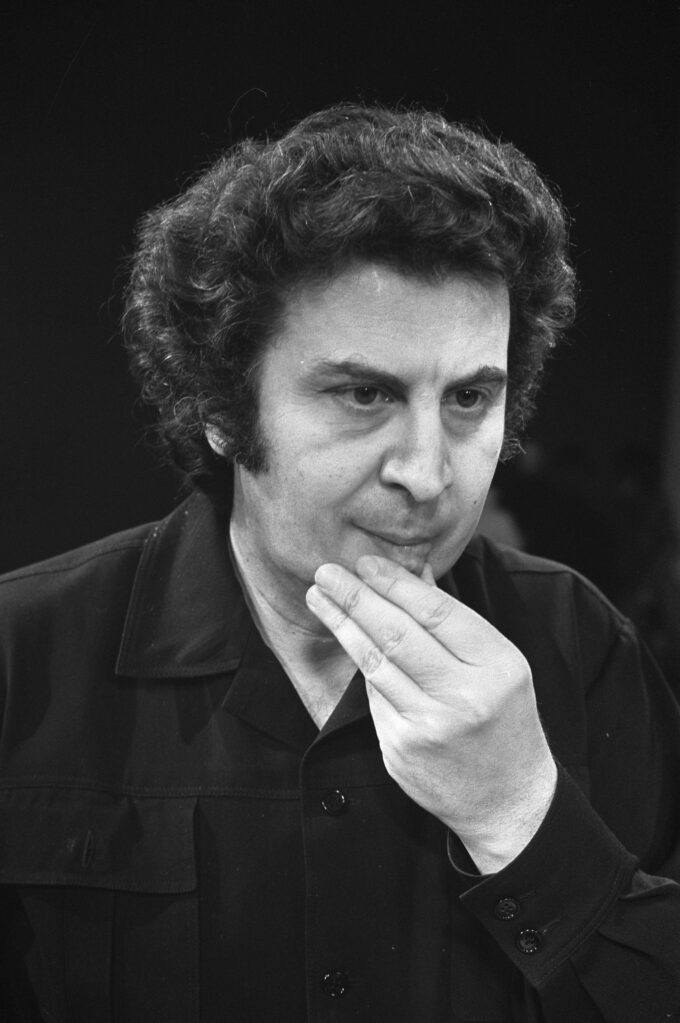
Mikis Theodorakis in the Netherlands, 1972. Wikipedia Commons.
Prologue
Mikis Theodorakis was an internationally recognized Greek symbol of resistance to capitalism and foreign influence in Greece. When I left Greece for the United States in 1961, he was 36 years old. He was supporting communism, which the United States considered enemy of enemies. Indeed, the Cold War, 1945-1989, mirrored the irrational hatred plutocrats had for the Soviet Union that, officially, had adopted communism as state ideology and policy. This international weaponization of class conflict became history with the return of the Soviet Union without its empire back to Russia in 1989-1990.
Communism and Greece
Communism brought civil war to Greece. It started in 1943 and ended with the defeat of the communist resistance forces in 1949. The British and Germans sparked this vicious struggle of the Greeks killing Greeks.
Illiterate communists in the village I was born, Valsamata, in the Ionian island of Cephalonia, assassinated two brothers of my father and they almost killed my father as well. Why? I really don’t know. My father and his brothers owned a few small pieces of land from which they raised wine, olive oil, wheat, barley, hay and lentils. We also had small flocks of goats and sheep as well as a few chickens, a donkey, a mule, a dog and more than one cat. Did the killers of my uncles think their murders helped communism? I cannot answer this question, though civil wars like the Peloponnesian War, 431-404 BCE, are irrational slaughterhouses. They automatically divide people ready to commit atrocities. Reason, national identity, family relationships, speaking the same language, worshipping the same gods / god and having the same history take a vacation.
In the 20th century, the Germans and the British did not want the Greeks to realize they were the descendants of fabulous ancient Greeks and institutions like democracy, science, gorgeous architecture, art and advanced technology. Or that their ancestors were the Minoans, Myceneans, Achilles, Odysseus, Telemachos, Homer, Helen, Agamemnon, Palamedes, Orpheus, Daidalos, Lykourgos, Solon, Kleisthenes, Sapho, Korinna, Hypatia, Herakleitos, Pythagoras, the military genius of Miltiades (490 BCE) and Themistokles (480 BCE); Pericles, the building of the Parthenon, the fabulous tragic poets of the fifth century BCE (Aeschylos, Sophocles and Euripides), the inimitable Aristophanes, poet of satire and comedy, great philosophers Plato and Aristotle, Alexander the Great, the mathematicians Euclid and Archimedes, the great astronomer Hipparchos and the Antikythera Mechanism, the astronomical computer of genius of the second century BCE. These inventors of civilization — and countless other achievements of the Greeks — triggered the hatred of the British and Germans against modern Greeks. They still don’t like them. The Germans nearly annihilated Greece. They also looted the country’s archaeological treasures, which they have yet to return. The British, meanwhile, bribed one of the two small resistance groups fighting the Germans. British agents convinced those fighters that the British government would fund and arm them provided they turned their guns against the other resistance group because, the British said, that group was communist, fighting the Germans for the benefit of the Soviet Union. Thus a lie launched the civil war that engulfed the starving Greeks, adding blood to more blood.
Music: a universe of beauty and freedom resurrecting Dionysos
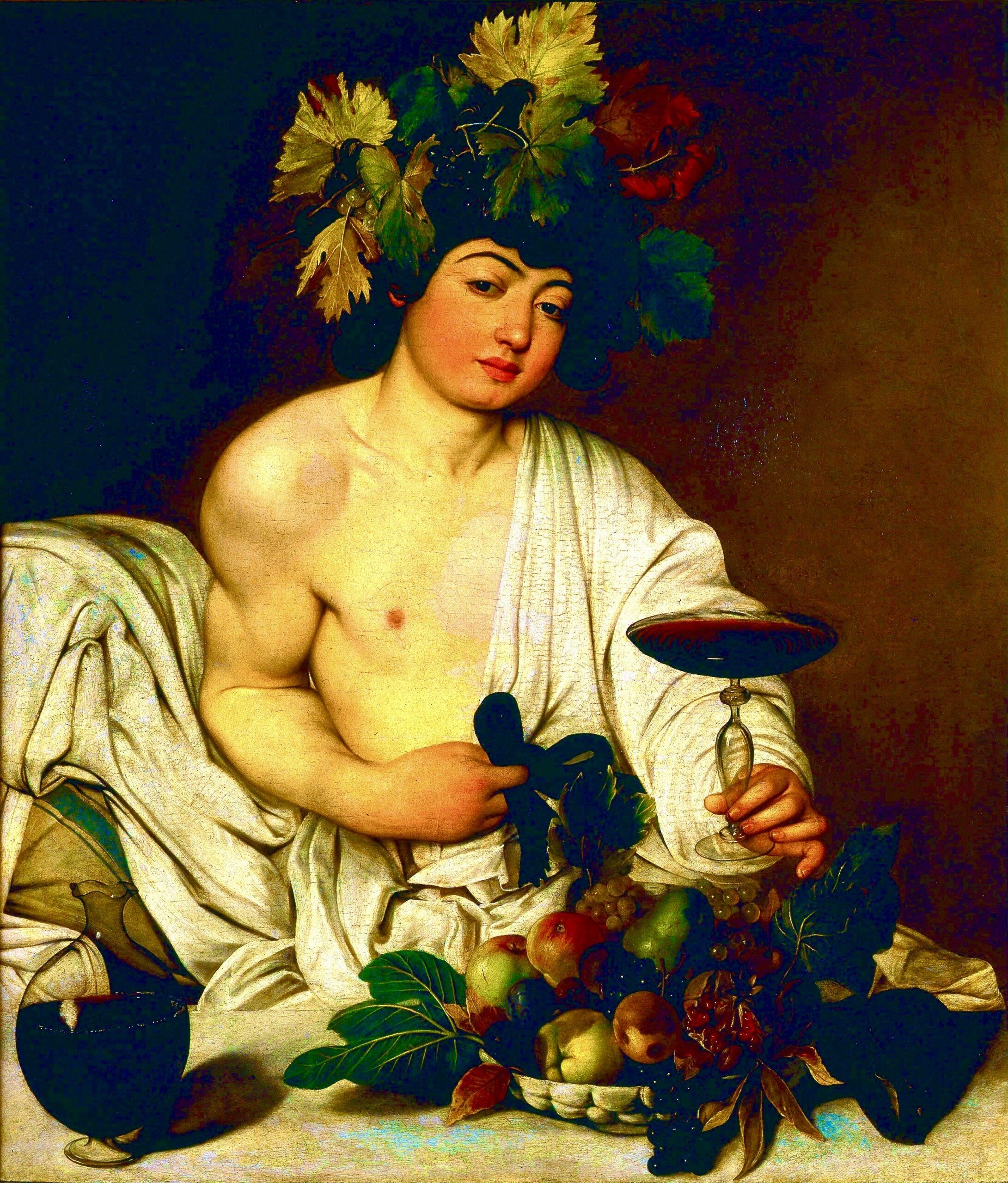
Dionysos by Michelangelo Merisi da Caravaggio, 1595. Public domain.
I had heard of Mikis Theodorakis, especially about his fabulous music.
In 1964, I saw the outstanding movie, Zorba the Greek, and I enjoyed immensely its music, a gift of Theodorakis. Years later, my interest in Theodorakis increased dramatically. Here’s why.
Of all Greek history, the existential trial of Hellenism in the 20th century struck me to the core. History taught me that the gods protected us. My grandmother, Demetra, was a pediatrician in the Hippocratic tradition. She delivered me and all babies in the village. She was a paradigm. I have a child’s image of that gentle woman. I remember her visiting us with her pockets always full of walnuts, almonds and chocolates. I was about 4 years old when Demetra passed away. I still miss her. She was inspiration and love.
I learned more about Theodorakis from watching several relevant hours-long videos documenting his music and enormous influence. His divine music was a voice from ancient Greece. I am not exaggerating. His voice, the lyrics, the meaning of those lyrics that tell brief important stories, the movements of his hands, a tall man directing orchestras or singing, tell a secret story of ancient voices and meanings of Hellenic culture coming, once again, to light and life, especially during dancing.
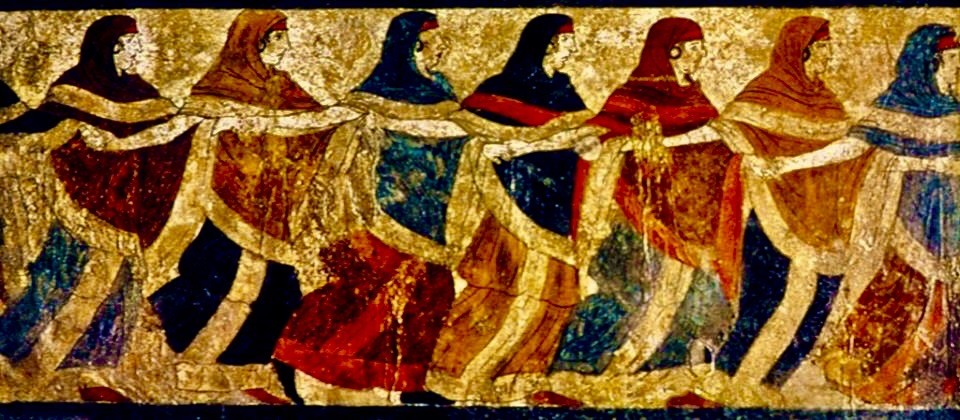
Fresco of Greek Peucetian women dancers. Tomb of the Dancers, Ruvo di Puglia, Apulia, Magna Graecia, 5th century BCE. Public Domain.
Theodorakis was a great poet and music composer, as close as we can imagine to Orpheus, a Thracian prince, poet, bard and prophet and extraordinary musician. His music was so powerful and emotional it even captured the attention of animals and the natural world. Orpheus was at the center of the Greeks’ celebration of god Dionysos. Paradoxically, maenad followers of Dionysos killed him because of his constant mourning of his wife Eurydike.
In a 2010 musical symposium celebrating the 85th birthday of Theodorakis, he admitted that Dionysos and modern Greece are inseparable. They march, resist tyranny, fight for freedom and dance together. Rural and city festivals celebrated the mighty god of wine, tragedy, theater and freedom. Dionysos was the model for the resurrection of Greece.
Theodorakis also revealed why he survived the persistent persecution by the government during the Greek civil war, 1943-1949, but especially during the ninety seventies regime of the military, 1967-1974. The New York Times painted this icon of the controversial musician. Mikis Theodorakis was “renowned Greek composer and Marxist firebrand who waged a war of words and music against an infamous military junta that imprisoned and exiled him as a revolutionary and banned his work.”
True, the music of Theodorakis was banned. Theodorakis was convinced the Greek colonels planned to shoot him. While in exile in the prison island of Makronesos, his father visited him and secretly gave him a piece of paper with an important message. “Don’t worry my son,” the father wrote, “they will not kill you.” Theodorakis learned why he survived the military tortures. The Minister of Foreign Affairs of the Soviet Union told the Greek ambassador in Moscow that if the Greek military shot Theodorakis, the Soviet Union would avenge his murder.
A life of resistance
Michael / Mikis Theodorakis, 1925-2021, was born in the Aegean island of Chios. His father was a lawyer. He grew up at a time Greece was going through a terrible political, economic and cultural crisis. The collapse of the Megali (Grand) Idea, 1919-1923, and the failure of the Greek army in Asia Minor to defeat Turkish forces in order to capture and claim even a small part of ancient Greek land and civilization in Asia Minor, like Smyrna, had catastrophic consequences. Greece lost about 100,000 soldiers not because of the cowardliness of the Greek troops but because of bad leadership in Athens and primarily because the so-called allies, France, Britain and America, abandoned Greece and joined Turkey. The European powers and the US secretly were negotiating petroleum deals with Turkey, which still controlled Iraq. Meanwhile, the Soviet Union was arming Turkey. But the Soviet Union was also exporting the revolutionary doctrine of Marxism or class struggle in societies divided between the few plutocrats and the many poor.
Greece was ripe for communism after the Asia Minor catastrophe, which added hundreds of thousands of uprooted Greeks from Asia to Greece.
What is communism?
Communism is a heresy of Christianity blended with ancient Greek ideas of equality and strife between rich and poor. In addition, WWI had greatly expanded poverty, plagues, terror and misery – all over Europe and America. This was the political environment conducive to radical change. The Soviet Union was the first international consequence of war defeats and gross inequalities at home. Communism promised perfect equality and a secular paradise. But like Christianity, it became another form of domination by party leaders, while erasing millennial traditions fundamental to human identity and civilization. In other words, the communists did to the countries they took over what the Christians did to ancient Hellas in the fourth century and after: smash civilization and pretend you create a new order of justice for all. This Christian model wrecked communism from the beginning. Like bureaucratic Christianity, state communist ideology became a spark for settling scores in a slow-moving strife (έρις) between rulers-wealthy people and the vast number of impoverished peasants and the rising class of urban workers. Add to this toxic mixture the inimical and anti-Greek influence of Britain and eventually the United States and you have an existential conflict in Greece during the 1920s and 1930s.
The music of Theodorakis
Mikis Theodorakis absorbed the strife during the German-occupation of Greece, April 1941-October 1944, and after. He lived in Athens. But he never let strife define him. Freedom, patriotism and music made him. He absorbed music from schools in Athens and Paris, but especially from the rich cultural tradition of ancient and medieval Greece. The Orthodox ecclesiastical and liturgical musical treasures of the Orthodox church enriched the music of Theodorakis. But he also created his own music, which explores the hopes and aspirations of the Greek people for a better life and freedom, especially freedom from local plutocrats or foreign influence or foreign occupation. He was simply a “left patriot.” He struggled continually to protect and enrich Greek musical and poetic culture and civilization.
He crossed the borders of Greek history, becoming a powerful supporting classical column of Hellenic culture. Greeks who knew him personally praise him to heavens. Some think of him as Homer-like teacher. Others think of him like ουρανός, the immense sky that covers all Greeks.
He admired Pythagoras, his passion for harmony. He also found the Pythagorean concept of chaos useful. But the Greek vision of Theodorakis also includes ancient Greek art, science and technology, temples, festivals, music, theater, and, above all, freedom and patriotism. Like Homer, he says that freedom is everything, defining the intellectual and political life of man or woman. Without freedom, he says, a citizen disappears.
He admitted Greece has no friends. “We are antagonistic to each other, much less to foreigners,” he said. He informed his friends that Europeans “dropped their pants to Hitler” with the exception of Greeks who fought back. The Greeks also resisted foreign occupation fiercely.
During the last national celebration honoring him in the Olympic stadium of Athens in 2019, he appealed to the Greek people to unite and bring back their glorious past achievements. A speaker called him “lyric river,” another a “great windstorm” and still another thanked him for the Spring he brought to Greece. His music, thought and actions touched millions of Greeks.
Theodorakis earned a worldwide reputation as a renowned composer. His music was a paean for both Greece and the world. In the 20th century, his music genius raised him to the very top of artistic excellence in Europe. His enormous productivity and international acclaim and awards made him one of the top three world musicians.
He wrote symphonies, ballets, operas. He directed orchestras and sang countless popular and classical songs.
“He also wrote anthems of wartime resistance and socialist tone poems about the plight of workers and oppressed peoples. His most famous work on political persecution was the haunting “Mauthausen Trilogy,” named for a World War II Nazi concentration camp used mainly to exterminate the intelligentsia of Europe’s conquered lands. It has been described as the most beautiful music ever written on the Holocaust.”
Theodorakis earned respect –and plenty of money. He became the honored guest of famous people in the capitals of the world. There’s no doubt that despite censorship and state violence against him, Theodorakis became a celebrity, a star of stars. He was the guest of “leftist” politicians like Salvador Allende of Chile, Gamal Abdel Naser of Egypt, Marshal Tito of Yugoslavia, Yasir Arafat, leader of the Palestinians and President Francois Mitterrand of France.
Epilogue
Mikis Theodorakis lived for nearly a century. At his death in 2021, he was 96 years old. His life covered an era full of wars, occupation of Greece by Bulgarians, Italians and Nazi Germans. This was a time of trial and determination to live free of die. The country of Greece we know came out of that traumatic experience.
The Greeks met the enemy, and the enemy was partly themselves and mostly the Germans who almost exterminated them. The horrific consequences of the wars exhausted the already impoverished country on the verge of extinction.
Theodorakis fought internal and external oppression. He survived the dangers by sheer stubbornness that he was a Hellene. He said the Parthenon and other magnificent art from ancient Greece convinced him the German occupiers were not as tall as they thought they were. On the contrary, the Hellenic idea inspired him to resist and fight the barbarians.
Yet the material needs of the times confronted him with the vision of capitalism and communism. He chose communism. But after WWII and the Greek military regime of 1967-1974, he acted above ephemeral and political party ideologies. As a member of the Greek Parliament, 1981-1986, 1989-1993, he represented the communist party as well as the new democracy party. In the 1980s, the Soviet Union awarded him the Lenin Peace Prize.
Nevertheless, he drew his talent, ingenuity and genius from ancient Greece, the home of Dionysos, the great god of theater, tragedy, wine, rural culture, patriotism and freedom.
The music of Theodorakis is a gift of the gods: poetry, eros, pleasure, resistance to tyranny, hymns of joy for Greece, encouragement for having a good life and the worship of harmony, moderation and eudaimonia / happiness / flourishing. His life is a model for the virtues of freedom and patriotism. He repeatedly spoke about the advantages of unity among the Greeks.
His legacy as a teacher of the Greeks includes beautiful music and songs and patriotism. These virtues are an inexhaustible source of inspiration, which increase the self-confidence and solidarity of the Greeks. Moreover, the patriotism of Theodorakis strengthens the Hellenic identity of the Greek people at a time of turmoil, instability and foreign dangers.
The post Hellas within Me is a Very Beautiful Young Woman: The Music of Mikis Theodorakis appeared first on CounterPunch.org.
This content originally appeared on CounterPunch.org and was authored by Evaggelos Vallianatos.