
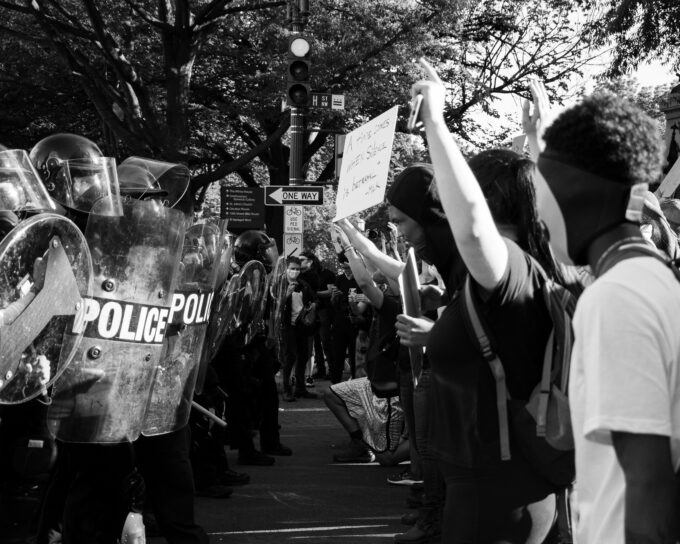
Image by Koshu Kunii.
An outreach mental health client of mine, years ago – I’ll call him Gregory – had (as a very young child) been beaten across the head by his step-father, molested multiple times by caretakers, slapped in the face routinely by his mother, and then, as the ultimate confirmation that reality had run astray, been told by his siblings that he had made up these allegations out of some spiteful delusion. Both his older sister and brother, Gregory, told me, had an intense, unshakable belief in the goodness of their parents.
This left him broken, powerless, angry and scattered, but free to justify his own transgressions against others, free to live a life of trivial, almost random acts of sequential retribution. He argued with store clerks, intake workers, car mechanics and all of the faceless officials who supervise poverty. The yearly meeting at the Housing Authority had him quaking with rage, as did applications for fuel assistance and SNAP benefits. Sometimes supervisors were called in to outmaneuver Gregory’s sense of injustice – trained flack-catchers, skilled at miming sympathy, but immovable in their intent to keep assembly lines rolling, usually managed to calm him. Occasionally the police were called.
Gregory, a young white man with no income, belonged to the group that Charles Dickens referred to as “the surplus population,” who linger like spare parts in a storage vault. US society both hoards and despises “extra” bodies; tens of millions marinate in the understanding that institutions of petition (courts, bureaucracies, mental health agencies, local governments) view the dispossessed as so many abstract items to be processed and discarded. Gregory attempted to work after dropping out of high school in tenth grade, but the challenges and strains of obedience proved impossible. Criticism cut like a blade. The Social Security System fights like a wounded animal to deny benefits, to make claims of emotional disability into a Mount Everest expedition, but after years of refusals even the SSI courts capitulated. Gregory was “officially” disabled, deemed eligible for a $700 monthly survival stipend.
Gregory became something of a caricature of the systems that frustrated him. He shop-lifted, found every way to return purchases with complaints, and used his charm to manipulate free merchandise. He hoarded his ill-gotten booty until his Section 8 apartment became a prison with no place to lay down or sit. Landlords threatened to evict him. With his childhood trauma driving his mistrust, he proudly accumulated a collection of conspiracy theories – that aliens were everywhere, that the Great Pyramid had been built as an energy generator by interstellar, reptilian wanderers, that Templars and Free Masons invisibly instructed the “hidden hand.” Both curious and dyslexic, he spent hours in a lonely vigil before The History Channel.
One should not mistakenly assume that people like Gregory have no value to the powerful. They shop in Dollar Stores, buy cheap food, plow their benefits back into the game via lottery tickets, cell phones and cable subscriptions. Their kids, if they have any, stock the enormous, bloated military that allows the US to inflict terror and extract oil.
And there are medications – mountains of pills gotten on the streets, off of the dark web, written neatly on prescription pads, or purchased legally in gas stations. Kratom, a deadly, addictive pseudo-opiate can be bought in most towns. Phenibut, a highly addictive, unregulated central nervous system depressant, has not been approved by the FDA, but can be bought online – usually as a sleep aid. In the United States of Insomnia, where people toss and turn privately, and seek relief one by one, countless tormented people seek to claim their lost right to vacation from life’s demons. Eight hours can be stolen back with the right chemicals. Gregory used pot daily, had a prescription for a fentanyl patch for a degenerative spinal condition, and dabbled with over-the-counter elixirs. It all added up to at least 12 hours of sleep daily.
Injustice in the United States has always been more than a manifestation of unfair courts. The ultimate penalty – incarceration, has cast its shadow upon the free masses. The need for punishment diminishes in a society where people willfully channel their discontent toward some form of preferred isolation. How many people avoid prison by imposing solitary confinement upon themselves? Gregory realized that a battle against disinterested flack catchers offered neither satisfaction nor relief, but punished him to relive each altercation as an ongoing, rotating series of PTSD flashbacks. He lived in mortal fear of his own easily triggered rage – most of all he worried about prison. He had a few arrests, but nothing stuck. Not all of my clients lived in dread of life behind bars, but many told me about the agony of cold turkey opiate withdrawal and the shear boredom of life in lockup. Others spoke about the grim reality of friends and girlfriends who didn’t visit. Incarceration creates a private plebiscite in which community indifference forces jailed victims to contemplate how little they are missed. Gregory leaned on modern life’s most potent consolations – opiates, benzos and internet cable.
Resentments in an unjust society have to be managed, diverted and diminished. In ancient times “bread and circuses” brought the masses together and required public crowd management and cleanup. Emperors and kings traded free public entertainment for mass loyalty. Now, in the world of hyper-capitalism, nothing is free, and, where some castrated, residual form of democracy exists, power is sustained more by mass indifference than by passion. Isolation serves power better than torch-light parades. The greatest commodity for oligarchic rule is an enormous pool of non-participants, non-voters. Since no US political faction strives to represent or enfranchise the dispossessed, isolated masses, it is in the interest of the powerful to sell drugs and entertainment to the discontented millions – not merely as a matter of profit, but as a means of control.
Put in legal terms, cable TV, public events (like The Super Bowl) and euphoria producing pain killers might be thought of as settlement cash – hush money for the masses. The public need not even sign a non-disclosure agreement. And, of course, people have to pay for their escape mechanisms, so the process of “mass settlement” becomes yet another scheme of enrichment.
It is easy to believe that Peter Thiel and Elon Musk consciously manipulate the details of mass anomie, but that gives our oligarchs way too much credit. I prefer to imagine our Splendid Isolation as a sort of serendipitous byproduct of capitalism. I rather reject the more conspiratorial ideas regarding a meticulously contoured system of repression, in favor of the notion that capitalist culture innately manages to disable the human mind. Thiel and Musk are cunning, but deeply stupid people, incapable of thinking on the abstract level needed to create a perfect dystopia.
I could choose dozens of former clients to paste into Gregory’s role – people who have been successfully disenfranchised, yet willing to subsist quietly, wholly out of public view. Not all of the poorest people suffer from chronic loneliness – many people endure poverty and, at the same time, find fulfilment within tight family and community networks. Nevertheless, isolation and poverty have been correlated in countless studies. Viewed as a social trend, mass isolation serves societal inertia, the interests of powerful corporations, the war machine, the tech giants, the fossil fuel empire and the Ivy League trained political class. Eleanor Rigby’s voting status didn’t become a touchpoint for Lennon/McCartney, but I would venture that she was a no show for UK elections.
Voting demographics may be an imperfect proxy to determine the structure of disenfranchisement, but it may be the best we have. Anyone who has read my views on the matter, understands that I feel that voting has little to do with social participation – a true activist sees voting as being far less effective than civil disobedience. Electoral procedures are easily shown to be a sham imposter for real democracy. Citizen engagement requires sortition or other structural outlets for the “public will” to manifest government policy.
With that said, a study of non-voting patterns helps explain why Gregory has never voted, or had any sense of agency in determining public direction. The statistics align almost exactly with my anecdotal observations working in the systems of US poverty for many decades. Some 90 million US eligible voters, did not vote in the 2024 presidential election – a larger chunk of the public than either Trump or Harris voters. These 90 million are not a random group, by any means, but generally reflect the hopeless capitulation of those people who have a marginal role in US society.
Gregory, with a tenth grade education, typifies the voting habits of those with no college – some 56% of this group did not cast presidential ballots in 2024. Since Gregory received only about $9,000 in yearly benefits he fits in with the 62% of voters making less than $50K annually who did not vote in 2024. Even those making between $50K and $100K are substantially more likely not to vote than to vote. Of those making more than $100K annually, almost 60% voted. All demographics align according to wealth. 63% of white eligible voters voted in 2024, compared to only 38% of Black eligible voters. Older people vote more than younger voters – theoretically because younger people have lower incomes.
Statistics, however, divorced from the intimate details of US alienation, US anomie, offer little insight regarding strategies of remediation. Political indifference cuts across all demographics. Even those making a comfortable living have checked out politically, and you don’t need to scrutinize voting patterns to know this. Almost 40% of those making better than $100K annually find participation in politics to be meaningless. It is quite ironic, but with all the outrage around voter suppression, the US public has avidly embraced a self-imposed, voluntary means of culling the voter rolls. Add to this that Republican fascism aspires to restrict voting eligibility to precisely eliminate the exact same demographics that already have given up the ghost.
Who would Gregory vote for, if he had to vote? First of all, most poor folks, in my experience, see politicians as an extension of the intricate web of authority figures who manage, manipulate and oversee their existence. If you are a well off person or have a solid income, you don’t have to answer to the housing authority, the fuel assistance program, the DSS worker, the SNAP benefits administration, the parole officer, the court mandated therapist, and you might have never interacted with a cop in your life. Poor people in America are subjected to an authoritarian matrix of anonymous officials who have considerable leeway in the arbitrary way that their day to day decisions will create crippling consequences. All in all, poverty creates a sense of quasi incarceration, of non agency, of following an intricate set of rules that may not make much sense. Poverty in the US has been seemingly designed to create a mood of fatalistic resignation. Therefore, when I ask who Gregory might hypothetically vote for, it is a trick question – no candidate will change the conditions of his life. The paltry stipend, the enormous wait list for housing, the utter lack of restorative dental care, the dwindling snap benefits, the completely absent sort of nuanced job training that might offer a path for emotionally fragile people to find meaningful work, will still be firmly present when the sun rises the day after ballots are cast.
I can even quote Gregory directly: “things are going to suck for me no matter who I vote for.” The enormous segment of the US population living at, below, or barely above the poverty level, has been called a “sleeping giant.” How deeply are they asleep, and what would it take to enfranchise the poor as, perhaps, the cutting edge of a radical political vision?
In the past, when I have written about poverty and politics, I frequently note that readers leave comments about poor people supporting Trump. I can’t state this strongly enough: the very poor in America – Black, White or Brown are NOT interested in joining MAGA. Poor folks are no more a monolith than any other class faction, but the few Trumpers in my caseload were almost invariably the most secure and affluent employed people in their communities. Pew Research backs me up here – middle income and upper middle income voters comprise Trumps wheelhouse. I don’t know where the idea that very poor white folks gravitate toward Trump came from, but not a single one of my poorest white clients, in mostly white Franklin County, Massachusetts, ever had a good word to say about Trump.
I have pretty much the same answer to every political question: Why is a deranged, psychopathic dipshit running the US? Because poor people have been given no voice. Why is the US constantly at war? Because poor people have been given no voice. Why do fossil fuel companies, big tech and the military industrial complex determine every single US policy? Because poor people have been given no voice. Why does the Democratic Party fail to eviscerate the disgraced, unpopular fascist ruling party? Because, within the Democratic Party, poor people have been given no voice.
The US is the cancerous tumor destroying the world via climate, war and capitalist, imperial aggression. It can only continue forward if the poor have no voice. If no political movement can ally with the poorest people there will be no radical change, no humanitarian progress, and no viable future. A meaningful change in the back and forth electoral farce of half-hearted Democratic reform, and merciless Republican cruelty requires an alliance between the sincere humanitarian elements of the educated class, and the very poor. This must not be a recapitulation of the quid pro quo between the ultra-rich, and the duped White working class. In that alliance, the wealthy make all the decisions and the white working class receive crumbs of performative cruelty. A new alliance, if it is to succeed, will put the needs of the poor first.
This piece first appeared on Nobody’s Voice.
The post There is No Radical Transformation in the US Without Poor People in the Forefront appeared first on CounterPunch.org.
This content originally appeared on CounterPunch.org and was authored by Phil Wilson.