
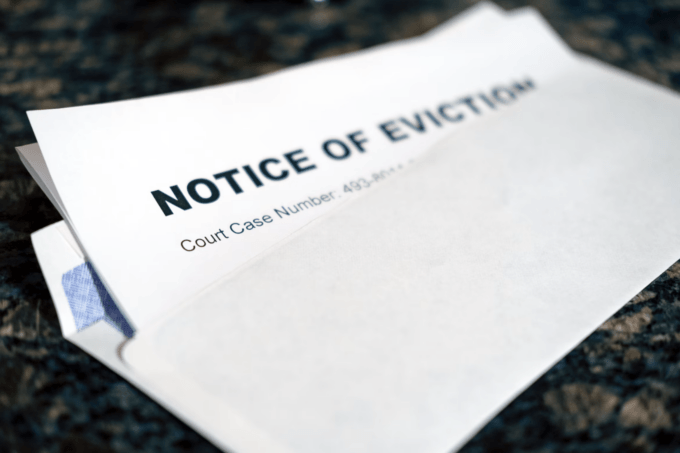
Photo by Allan Vega
I once faced eviction in a landlord’s scam. I live in an apartment in New York City and pay my rent every month, but my landlord once refused to process my rent checks for three months and I received an eviction notice. When I got the notice, I was freaked out and asked a friend who was a lawyer what to do.
My lawyer friend said she’d go to NYC Housing Court with me to fight the eviction order. Most surprisingly, the day before I was to report to Housing Court, my bank account showed that – mysteriously! – the three outstanding rent checks had been processed. In Court, my case was dismissed, and my landlord’s lawyer said nothing and went on his way.
I’m a white guy who had a job and could cover the outstanding rent and had access to a lawyer, so I was technically not worried about the eviction. But millions of Americans are not so fortunate.
“Ms. D,” a Hispanic woman from New York, said, “It started back in 2020 during the Pandemic.” She added, “I live with my mother in the Bronx, and we got the rent-relief checks that were passed out and that helped us cover four months of rent. When our landlord received it, they – it shows in the rent ledger – doubled our rent,” she adds.
“We’d get an email from them [the landlord] saying we had a rent balance for something like $2,000 as they’ve been accumulating and, again, we would respond [and] tell them that the amount was incorrect and that they had to check out their accounting, because their accounting was always off,” Ms. D. explained. “But they’d never get back to us.”
“Despite us sending proof to their lawyers showing what out actual rent amount is per the DRIE [Disability Rent Increase Exemption] and proof of payments and disputing the amount – we have proof of all the payments we’ve made for all the years – they still went ahead and took us to court.”
For people evicted – or facing eviction – from their apartment or home, it can be a nightmare. One’s life can be completely uprooted, especially if one has children. All your possessions can be forcibly removed and dumped on the sidewalk. Some may have enough money to move into temporary accommodations like an affordable hotel or motel; others may seek temporary living arrangements from relatives or friends; still others may seek help from local social services agencies; and some may end up on the street.
Ms. D added, “in June of this year [2025] part of the ceiling collapsed in my mother’s bedroom, and it was a really big hole. … It was a really bad situation. We almost got all the stuff on top of us. So, when that happened, we called the super and we told you about this situation and you did nothing about it – and didn’t fix it for months, and now we have this big issue. And the super response was, ‘Well, did anyone get hurt? Did anyone die? – then you guys are fine.’”
“So, after we got the court date, I reached out to CASA [Community Action for Safe Apartments] to see how they could help us – and, honestly, they’ve been a lifeline for us,” added Ms. D. “We spoke to a lawyer, and they said, ‘This is open-and-shut as you’ve got all the proof. It’s obvious that they are overcharging you guys and doing all this stuff, like harassment, and were very neglectful when it comes to repairs.’ So they were able to guide us on just how to move forward and what the legal system is, and that we have a right to counsel – and let the judge know that we want counsel for our case.”
The U.S. is facing a housing crisis. As the National Low Income Housing Coalition reminds us, “There is no state or county where a renter working full-time at minimum wage can afford a two-bedroom apartment.”
The housing crisis is being made worse by the federal government shutdown, in which federal workers are not being paid, thus possibly losing their housing, and cuts to Section 8 rental assistance programs.
Princeton University’s Eviction Lab found that there were 1,176,803 eviction filings over the one-year period ending March 2026, in the 41 cities in 10 states that it tracks. In addition, an estimated 580,000 people are experiencing homelessness – being unhoused – on any given night.
Grace Hartley, research specialist at the Eviction Lab, said, “We’ve tracked over one million eviction filings over the last 12 months.” She noted, “We have a pretty good sense that this date is reflective of the U.S. housing crisis. We know this crisis is not limited to these 36 cities in 10 states but is relevant for the entire country.” She added, “The Eviction Lab estimates that in an average year 7.6 million people experience an eviction filing.”
Going further, she pointed out that “eviction is a process with several steps. People might leave their homes at any time in the process even before the filing, in what experts call an informal eviction or out-of-court eviction, which might be illegal in some cases. But tenants could be leaving after the hearing, the judgment or the execution of the writ by a sheriff/constable.”
Marika Dias is managing director of the Urban Justice Center’s Safety Net Project, a social justice organization that provides legal services, advocacy services and social support to New Yorkers, especially the homeless. She further clarified the eviction process. “To be honest with you,” she said, “I think the eviction crisis is significantly undercounted, under-documented because these numbers that will tell you the number of evictions in a given year — that is the number of households that are actually evicted by a marshal or sheriff.” Most disturbing, she argued, “So, if we look at the number, you might quadruple that number for the people impacted by the eviction if we assume most households contain a number of people in it.”
Diaz stresses that undercount is itself misleading. “Those numbers account for the ‘official’ number of evictions executed by marshals and sheriffs in towns and cities across the U.S.,” she said. “But in addition to that, one should also look at the number of cases where people are facing an eviction case in court and, as a result, are pushed to leave their housing before it reaches the point of an official eviction by a marshal.”
Going further, she insisted, “we have even a greater number which is, for example, people who can’t afford to pay their rent – and perhaps don’t pay because they can’t afford it – but at some point, when they fear the landlord might take them to court, they themselves take themselves out of that apartment.” And then there are those whose “landlord is harassing them – warning them if they don’t pay, they’ll be thrown out — and they self-evict.” She stressed, “these evictions don’t typically show up on the court data as an eviction case. These are interactions happening outside of court, forcing people to self-evict.”
Most disturbing, the Princeton Lab reports that every year, nearly 3 million children under age 18 are threatened with eviction and 1.5 million are evicted. They account for two-fifths of those threatened with eviction each year. And the eviction has a profound impact on the child’s development. “Across the life-course, the risk of experiencing an eviction—a deeply traumatizing event—is highest during childhood,” it notes. “Evicted children face increased risk of food insecurity, exposure to environmental hazards, academic challenges, and a range of long-term physical and mental health problems.”
The Lab’s assessment is reinforced by the MortgageCalculator.org. It warns, “America is undergoing a severe cost-of-living crisis that has only been deepening with each passing year.” Siting U.S. Census Bureau data, it adds, “… renters experience the brunt of this burden; almost half of all renter households are cost-burdened, paying around 31% of their income towards housing. For 70% of extremely low-income families, over half of income goes to housing.”
Most disturbing, it identifies the five U.S. metro areas with the highest eviction rates and highest foreclosure rates overall:
+ Dallas-Fort Worth-Arlington, TX — eviction/foreclosure rate at 39 percent.
+ Houston-The Woodlands-Sugar Land, TX — eviction/foreclosure rate at 35.2 percent.
+ Chicago-Naperville-Elgin, IL-IN-WI — eviction/foreclosure rate at 34.1 percent.
+ Phoenix-Mesa-Chandler, AZ — eviction/foreclosure rate at 34.1 percent.
+ Detroit-Warren-Dearborn, MI — eviction/foreclosure rate – 33.7 percent.
When asked what precipitated the current eviction or housing crisis facing the country, Hartley noted, “Yes, that’s the question we all want to know.” And she answered: “The big answer is that we have a housing affordability crisis. Cut and dried, if people had the money to afford housing, we wouldn’t see people being displaced like this.”
Hartley further clarified her analysis, arguing: “Rents can fluctuate from month to month but overall, rents have jumped over the last five years and that’s quite significant.” She suggested that $200 per month as a working average over the last five years and adds, “$200 as a medium jump may not sound like too much money, really $200 can be a breaking point for many families. $200 a month adds up to $2,400 a year.”
Going further, she pointed out: “The median rent now is, I believe, between $1,300 and $1,400 a month. So, $1,400 is a really slim margin for anyone, especially a family that is rent burdened, which is defined as people paying over 30 percent of their income just for housing, which puts you in the bucket of rent burdened.”
Hartley defined “rent burdened” as “people paying more and more of their income to rent. So, if you are paying that much of your income to rent, if the slightest thing happens — like any kind of emergency, like your car breaks down or you have to go to the hospital – those bills could total over $1,400. So there goes your rent, there goes your housing. We do see the increasing number of rent-burdened families and higher rents, but also we see that wages are not keeping up with rent inflation.”
Diaz concurred in this assessment. “From the situation in New York City and from what we hear from our colleagues from across the U.S. in cities, suburban and rural areas, across the board, housing has increasingly become unaffordable for working people. Especially for people who depend on a modest income for the essentials of life.”
She stressed, “For most people, the kind of housing they need is increasingly out of reach because it has become unaffordable. That’s leading to a situation of increasing homelessness and increasing numbers of people facing eviction. The result is that are unable to stay in communities where they have been living or had a job or in a location needed for their children’s schooling.”
As a result, we are seeing a housing crisis. Diaz noted, “People are losing the housing that they have because it’s becoming unaffordable to them. And then they are unable to find new housing because the housing that is on the market is too expensive. We are facing a situation in which people are being forced to move further and further away from their children’s schooling or their jobs or their communities.”
When asked what kind of protections renters have, Hartley pointed out that “different municipalities have different friendly rent regulations.” She identified rent control and higher eviction filing fees that landlords have to pay as some protections. She added, “In some places it’s very cheap, so the landlord will file to get a tenant out, but if the fee is $300, you might think twice before filing and work something out with your tenant.” She singles out New York’s Right to Council laws and notes that “Philadelphia is another one that has implemented a lot of tenant-friendly rent protections.”
“New York was the first city to pass and implement the Right to Counsel laws after an historic battle by tenants to secure that right,” Diaz stressed. “We have seen a Right to Counsel in eviction cases being adopted across the nation in different cities and states,” she pointed out. “So, I think, the very first thing people should do when facing an eviction is to check to see if they have a Right to Council or if some other attorney support is available to them.”
Going further, she noted, “There is a lot that can be done by having an attorney in an eviction case, even in those cases where it might be impossible to ultimately stave off an eviction – it can help people secure time to move; perhaps an option to pay back-rent or other arrears so as to avoid eviction, to do defend against eviction and prevail in their case. … Often, tenants are unaware that the court can have discretion to give them time to move or to pay rent arrears owed. Attorneys enable tenants to learn their legal options and so that they can avoid eviction or, if need be, get time to look for other housing and move out on their own terms.”
Diaz argues, “We also recommend to people that they look for tenant organizing groups in their local areas where tenants are coming together with other tenants to not just defend against their own individual interests – individual evictions – but to try to collectively come up for solutions to the broader housing issues that are encompassed by the overall housing crisis.” She identified these as “unaffordability of rents, bad housing conditions, unscrupulous landlords who are harassing tenants and the bigger issue of the corporate capture of housing stock that’s taking place across the country and is generating this crisis.”
The post Eviction Nightmare appeared first on CounterPunch.org.
This content originally appeared on CounterPunch.org and was authored by David Rosen.