
Janine Jackson interviewed the Center for Constitutional Rights’ Baher Azmy about justice for Abu Ghraib victims, for the March 20, 2026, episode of CounterSpin. This is a lightly edited transcript.
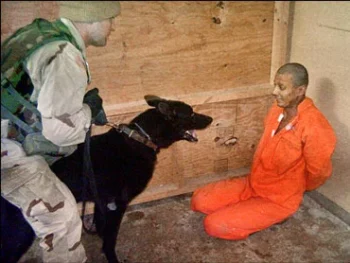
CBS (5/21/04)
Janine Jackson: If I say “Abu Ghraib,” you likely think of pictures, nightmarish pictures. The thing is, those were pictures of human beings being tortured by human beings, which you are absolutely correct to think was a crime. But the images of Iraqi people, not convicted of anything at all, being horribly abused was somehow, for the US news media audience, churned into “terrible, yes, but” somehow not anything that anyone needed to actually answer for.
So ask yourself: Why wouldn’t they do it again? What actually changed to indicate substantive opposition to what happened at the Abu Ghraib “hard site” that we were told was “seared” into our consciousness?
While corporate media manufacture forgetting, human rights advocates have stayed on the actual case. And now, as of last week, we have a court, the Fourth Circuit Court of Appeals, saying, “Yes, the plaintiffs are right that they were harmed, and yes, the courts are competent to decide that, even though ‘we’ were in ‘wartime.’”
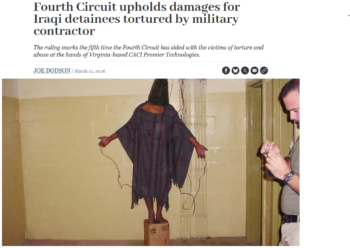
Courthouse News (3/12/26)
Corporate media expect you to forget, or maybe to unknow, things that they don’t put in front of you day to day, but that’s not how life works. In reality, it matters very much that a court has affirmed a jury verdict that CACI, a private contractor hired to provide “interrogation services” at Abu Ghraib, is actually liable for violations of international law, including torture.
CounterSpin has been trying to track this case. We are joined now for an important update by Baher Azmy, legal director at the Center for Constitutional Rights. Welcome back to CounterSpin, Baher Azmy.
Baher Azmy: Hi, nice to be with you.
JJ: Well, sincere congratulations. Terrible things have happened; people have tried to respond. But Al Shimari v. CACI is the only lawsuit, as I understand it, brought by Abu Ghraib torture victims to make it to trial. So folks know they saw what they saw, but this has been a very hard case to move, hasn’t it? And why is that?
BA: These kinds of human rights cases and human rights claims, brought in the context of armed conflict or “national security,” have historically been hard to bring, as these things get. This is, as far as I’m aware, the only post-9/11 case seeking accountability for torture and related human rights violations to ever reach a jury. They’re almost universally thrown out early in the case, through the invocation of all sorts of complicated doctrines designed to protect the executive branch’s warmaking through, I loosely call it, the imperial courts protecting the war-making project of the United States, and giving them license to operate clearly without accountability.
So it took us 18 years, six trips to the Federal Court of Appeals and two trials to finally get some measure of justice for our clients, and build a record about the horrors that were inflicted to them by private military contractors working with the United States there.
JJ: And I think listeners will remember the horrors, and I think will imagine, well, surely someone was held to account. Surely it was recognized—because we heard it being recognized—that this was horrific, that this was criminal, and yet the idea that somehow the law can’t quite get at that, and we’re supposed to just imagine that a horrible crime can happen, but, you know, there’s really no way to account for it. That seems like a very slippery thing to try to sell to people.
BA: Yeah. The democratic space, the spaces for accountability, are shrinking across the board, I think probably led by the attempts to get accountability for what I call the human rights crisis created by the Bush administration after 9/11. And that just metastasized more broadly into all sorts of areas of the law, including conventional civil rights law. So this is going to take a long time to reorient our institutions, to seeing victims of human rights abuses and civil rights abuses get relief in US courts, and to transform the law.
And we hope that this is—I don’t know if I can say it’s a model, because it took 18 years and endless effort, but a portal of hope anyway. And that’s how I think some people are reacting to the decision, when there’s some bleakness, the recognition that three individuals, three incredibly courageous individuals, won’t give up on themselves, and the possibility of justice for others.
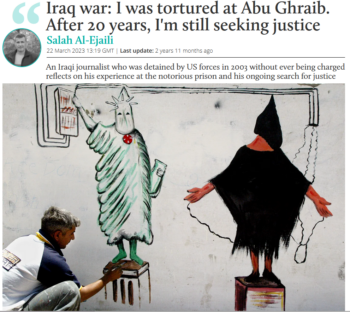
Middle East Eye (3/22/23)
JJ: I like the expression “portal of hope.” And I asked CCR’s Katherine Gallagher, but I’ll ask you again, to please say the names of the people in this case, because they’re not cardboard cutouts. They are human beings.
BA: Yeah. Suhail al-Shimari. He’s a middle school principal in Iraq. Asa’ad al-Zuba’e. He runs a grocery and fruit market near Baghdad. And Salah al-Ejaili, who is now a freelance journalist. He was an Al Jazeera reporter at the time of his arrest and detention, and now he lives in Sweden, with refugee status there with his family.
JJ: I think one of the aspects of this is that it’s about the relationship between corporate contractors and the US government. So these corporate contractors, like CACI, they say, “Well, we borrow all the immunity. We have all the immunity of the US government.” And the government says, “Well, this is wartime, and so all bets are off.” And so there’s this air of specialness that is meant to cloud these corporate contractors, and this space of time. And that’s been part of the problem here, right?
BA: Yes. The contractors, their entire effort throughout this litigation—other contractors are doing the same—is to do as much as possible to clothe themselves with the sovereign shield, and to say, “Suits against us, because we’re working for the government, should be dismissed for the same reason they would be dismissed against the government.” And it’s a dangerous doctrine; it reflects an Eric Prince-ian vision of total impunity, so that potentially they live in this dystopian world where contractors, clothed with that kind of immunity, can enter wars and kill with impunity, in the way that soldiers can, as long as they’re acting lawfully.
JJ: And yet they are going to be paid as contractors, and somehow—at least from the perspective of journalists—they’re in somehow a different category. So it gets very murky, in terms of accountability there.
BA: Yes. It’s very problematic.
JJ: I said to Katherine Gallagher how frustrating it is to see this Al Shimari v. CACI reported as just a lawsuit, and not a human rights crisis. There’s been a narrowing of the understanding of liability and what we should make of this case, but it’s actually about a whole lot of things, and not just this particular company and this particular instance. I mean, corporate contractors in wartime obviously are a major issue. And so how this case is considered has deep implications going forward.
BA: That’s our hope, that this will have some sort of deterrent effect, but we do live in a war-making state, with enormous momentum towards militarism, and profit from war-making. At the same time that this is a significant litigation win, I think no one should have any illusions that the courts are the right place to really primarily fight these battles. We have to stop the war-making in the first place, which is a political process, and involves working with an elected representative, changing our elected representatives and being on the streets as much as we can.
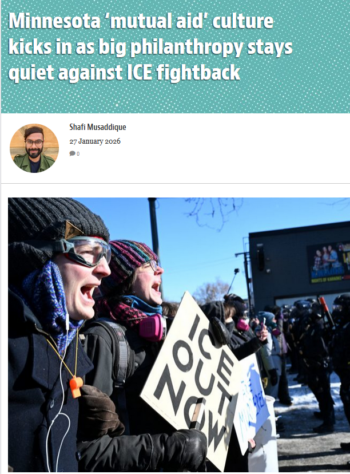
Alliance (1/27/26)
JJ: Actually, that’s just what I wanted to follow up, because I know that some listeners will understand that you, Baher Azmy, are also on the legal team of two Trinidadian men who were killed last October in the US missile strike in the Caribbean. You are on the legal team of Mahmoud Khalil, the graduate student at Columbia who is a Palestinian activist, and criminalized for that. So you’re seeing these wild overreaches from the executive branch as a piece.
And I wonder where you see the countervailing forces. You’ve just kind of indicated it, that we can’t just say, “Lawyers save us.” This is a multi-front effort. And I wonder where you see the power to stand up to the things that we’re facing.
BA: The power lies with people and communities and forms of solidarity. I think the real model here isn’t necessarily this litigation, it’s Minneapolis, and the demand that we organize, organize, organize and stand together, not only in these forms of resistance, but in the collective work of supporting each other and building power through those forms of connectivity, so that everyone understands we’re all looking out for each other. We stay resilient and hopeful and strong in the face of all the forces that are coming after us.
JJ: I’ll just finally say, as a media critic, media told us that the images from Abu Ghraib were seared into our consciousness, that we had been changed as a people on the basis of these images.
And yet I don’t see a tremendous amount of interest in the actual outcome of the legal follow-ups to bring accountability there. I saw a New York Times story; that was fine. I didn’t see a lot of interest from a lot of other media.

Baher Azmy: “I do think mainstream journalists need to understand the intersection between profit-making and incentives to go to war.”
And I just wonder what you would ask of reporters who are trying to track the US accountability in wartime, and also the influence of corporate contractors, and that confluence of corporate America with militarism and all of that. What would you ask from reporters?
BA: Look, this case is happening in the middle of multiple, multiple crises, so I’m not terribly surprised it’s not front-page news on every newspaper. But, yeah, I do think mainstream journalists need to understand the intersection between profit-making and incentives to go to war. They’re symbiotic and incredibly dangerous.
JJ: All right then. Well, we’ll look for folks to look to CCRJustice.org to find your work and that of others on this particular case, and on the other deeply relevant and interconnected cases.
We’ve been speaking with Baher Azmy, legal director at the Center for Constitutional Rights. Again, their work is online at CCRJustice.org. Baher Azmy, thank you so much for joining us this week on CounterSpin.
BA: My pleasure. Thank you for having this important conversation.
This content originally appeared on FAIR and was authored by Janine Jackson.