
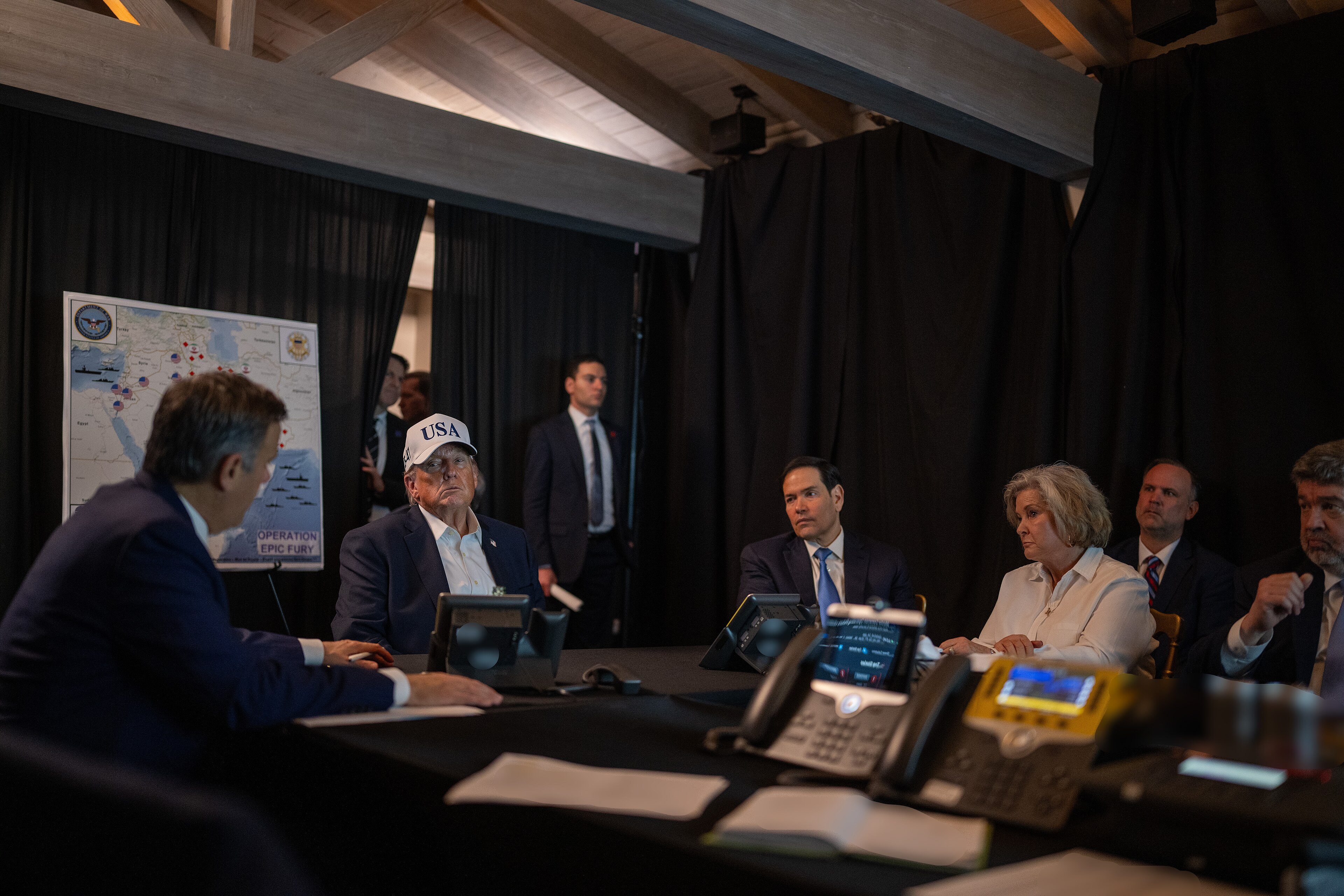

Photograph Source: The White House – Public Domain
In early reporting on the Iran War as “the ultimate war of choice,” the New York Times spoke, as usual, in the sanitizing language of political realism. This is the lingua franca of the foreign policy elite in the Atlanticist alliance, consisting of the self-anointed ‘liberal democracies.’ It is definitely a more refined and less objectionable manner of labeling an unprovoked ‘war of aggression’ than the brazen utterances of the U.S. president, Donald Trump, who had the audacity to trivialize the bloodshed and devastation traumatizing Iran’s innocent population as ‘an excursion.’
This language is so ill-suited to wartime by the political leadership of a sovereign country putting its own citizens, including members of the armed service, at uncertain risk. It not only demeans whatever policies are being advocated, but such formulations bordering on the jovial convey an impression of an unstable pathology, an attitude of extreme insensitivity to human suffering or ecological disruption in an adversary sovereign state. In the unlikely event there had been credible goals for launching the Iran War, they would be discredited by Trump’s words: “We took a little excursion because we had to, to get rid of some evil, and I think it is going to be in a short-term excursion.” Even if the U.S. stops attacking today, there is no assurance that Israel will not persist, but even if both countries were to stop immediately, the aftermath of this war will leave many burning embers afflicting the lives of the Iranian people, and even among their neighbors. Such a partial discrediting of this Constitutionally unauthorized and internationally unlawful war that has already had dire secondary effects on the poor and vulnerable by spreading lethal harm far beyond the borders of Iran, indeed, throughout the world.
Trump’s War in Iran
Trump initially rationalized the unprovoked war against Iran as justified by the alleged repression of the Iranian people by the governing theocracy, using missiles and bombs while urging the Iranian people to take the country back as if he cared. He secondarily cited Iran’s engagement in arming and funding Islamic terrorism, which public opinion even in the West increasingly regards not as terrorism but as legally justified collective resistance to the violent encroachment of the U.S. and Israel upon the sovereignty of Middle Eastern countries, and especially of partnering with Israel, aborting the rights of the Palestinian people while championing Israel’s project of territorial expansion and state terrorism. sustained by apartheid rule and recourse to genocidal tactics, and additional aggressive moves against such helpless adversaries as Lebanon and Syria. Thirdly, he voiced concern about Iran’s nuclear program that was supposedly obliterated in the US/Israeli war a year earlier, but somehow in the short interim not only revived but was augmented by sophisticated missile capabilities.
In essence, Trump, without bothering to address nuances, is speaking the same language as Washington’s foreign policy elites in and out of government that control the political discourse of the U.S. State Department, and the Potomac River security-minded Washington think tanks. These foreign policy professionals purport to proffer objective advice on how to promote national interests, while hiding their affinities with and loyalties to CIA/Pentagon/Private Sector arms dealers/Israeli ambitions. While Trump’s narcissistic geopolitics is polarizing even in America, political realists have deep roots in the bipartisan political consciousness of the two major political parties. In my judgment, both of these political parties bear responsibility for their deep failure to realize that the U.S. deep engagement with the world is contributing to apocalyptic dangers that could and should be mitigated with a sense of urgency.
Trump highlights these dangers by his mercurial, petulant style that frightens more rational and humane political actors, both among rivals and allies, into submission as illustrated by bullying even the UN Security Council into lending its unanimous support for his Board of Peace while remaining silent during the prolonged Israeli genocide in Gaza and about the two wars of aggression against Iran. [see S/Res/1803, 13-0-2, Nov. 17, 2024] And as shockingly, a similarly unanimous resolution, with the astonishing abstentions of Russia and China, that condemns Iran’s retaliatory strikes at American military assets in the region, while rejecting a separate resolution condemning the U.S./Israel attack. [S/Res/2817, 13-0-2, March 11, 2026] Never before have the political organs of the UN given such support to a flagrant violator of the most basic of human rights or of its core prohibition of aggression in the UN Charter, and given it by a consensus that included countries of the Global South, including regional Islamic neighbors of Israel and Iran, even inducing geopolitical rivals, Russia and China, to withhold their right of veto by abstaining in circumstances that might have lessened the damage to the UN reputation and even its legitimacy. It stretches the political imagination beyond its breaking point to anticipate U.S. geopolitical forbearance at the UN in response to comparable transgressions by Russia or China.
Washington ‘Political Realism’: Special Interests Dominate
Political realists shift their more professional discourse away from ‘wars of choice’ by a reliance on the terminology of national interests. In effect, this is an implicit endorsement of ‘wars of choice’ as a viable option for American foreign policy in the aftermath of the Cold War. That such a rationalization persists in the post-colonial world, where nationalist mobilizations have since the Vietnam War achieved a record of political victories for militarily inferior adversaries, seems inattentive to changes in ‘reality,’ particularly the decline in the agency of military superiority to determine the political outcomes of international conflicts. To be sure, these ‘victories’ by the military underdog often couple the defeat of the American foreign policy with the lasting effects of massive human suffering and widespread devastation for the political victor, producing national destinies of chaos and internal strife as has been the experience in Libya, Afghanistan, Iraq, and Yemen.
National Interest ‘Political Realism’
Despite the claims of realism, this dominant ideology of imperial foreign policy, drawing on the political unity of the anti-Fascist struggle in World War II and the Cold War, rigidly excludes even the most eminent of self-styled ‘political realists’ who adopt dissenting views about the priorities of national interests. For instance, academic personalities who reflect the policy views of liberals in America, such as John Mearsheimer and Stephen Walt, who have among the hard-core political realist credentials of high repute, are excluded from the inner circle of foreign policy elites, while neo-con extremists and even lobbyists are welcome. These two stalwart international relations experts, in contrast, were national interest theorists oblivious to subservience to special interests, with the consequence of excluding themselves from the main lines of foreign policy debate by Washington insiders. Their defining act of policy defiance was to author a book almost two decades ago arguing that the unconditional support of Israel was contrary to U.S. national interests, a realist messaging that Washington definitely was not prepared then or now to hear, despite the mounting evidence, despite the rising public criticism of Israel’s behavior, including the dramatic decline of Jewish support. [See Mearsheimer & Walt, The Israel Lobby and U.S. Foreign Policy (2007)] Stephen Walt has a lead article in the current issue of the influential journal of the Council of Foreign Policy, Foreign Affairs, that criticizes from realist perspectives the U.S./Israel partnership in the Middle East as courting future disaster by its recent patterns of behavior that he labels as ‘predatory hegemon.’ Walt concedes that such a foreign policy orientation may have short-term benefits for the U.S. in terms of wealth and power, and capacity to induce fear, but from a longer view of national interests is costly so far as legitimacy, reputation, stability, and effective promotion of national interests is concerned, as measured by domestic as well as international benefits. [Walt, “The Predatory Hegemon: How Trump Wields American Power,” Foreign Affairs, March/April 2026] It is relevant to note that the Council on Foreign Relations, headquartered in New York, is also constituted by an elite membership adhering to a version of political realism that is midway between the special interest realists of Washington and the critical realists of the Walt/Mearsheimer mold that produce a more objective account of a preferred national interest approach to foreign policy. From my ‘realist’ it also falls short by its relative inattention to the global agenda of systemic challenges, ranging from nuclearism to global warming, that is, in the failure to emphasize sufficiently the imperatives of cooperative geopolitical relations that presuppose respect for international law even in relation to the management of global security.
The Invention of ‘Wars of Choice’ as Political Realism of Extremism
The language of wars of choice is useful to those favoring controversial foreign policy initiatives. This language excludes any serious consideration of the relevance of international law and morality in the process of operationalizing national interests. Its effect is to make wars seeking control of energy resources or the overthrow of governments, even if democratically elected, that dare pursue policies dictated by the imperatives of economic nationalism, rational targets of regime-changing coups and alleged promotion of democratizing state-building exercises. Wars, as with Iran, allegedly to prevent the proliferation of nuclear weapons to countries perceived as hostile, while winking at the covert acquisition of nuclear capabilities of partners such as Israel. For almost a century, aggressive war has been declared unlawful in the Pact of Paris (1928), a legal guideline relied upon by the victors in World War II to prosecute and punish surviving German and Japanese military commanders and political officials, and codified in the Nuremberg Principles as Crimes against Peace.
Normatively Conditioned Political Realism: Law, Morality, and Universality
Shifting perspectives, what would political realism look like if guided by the ethos of law and morality used to appraise the behavior of the losers in World War II. It would give priority to responsible statecraft by the victors in an era of interdependence, ecological fragility, nuclear weaponry, and a variety of technological innovations that pose shared global challenges, which, if not addressed, risk catastrophic occurrences. Such an understanding of contemporary reality should have led the architects of the UN Charter to draft better guidance of global governance. It was a serious mistake of the winners in the war to leave geopolitical actors unregulated in their discretionary pursuit of strategic ambitions beneath the legitimating umbrella of national interests. This facilitated the acquisition of wealth, the promotion of trade and finance, and the manipulation of the internal politics of other countries, but by neglecting reliable means to promote the global public good, it cast a dark shadow on the prospects of future generations.
The post Language Matters: There Are No “Wars of Choice” appeared first on CounterPunch.org.
This content originally appeared on CounterPunch.org and was authored by Richard Falk.