
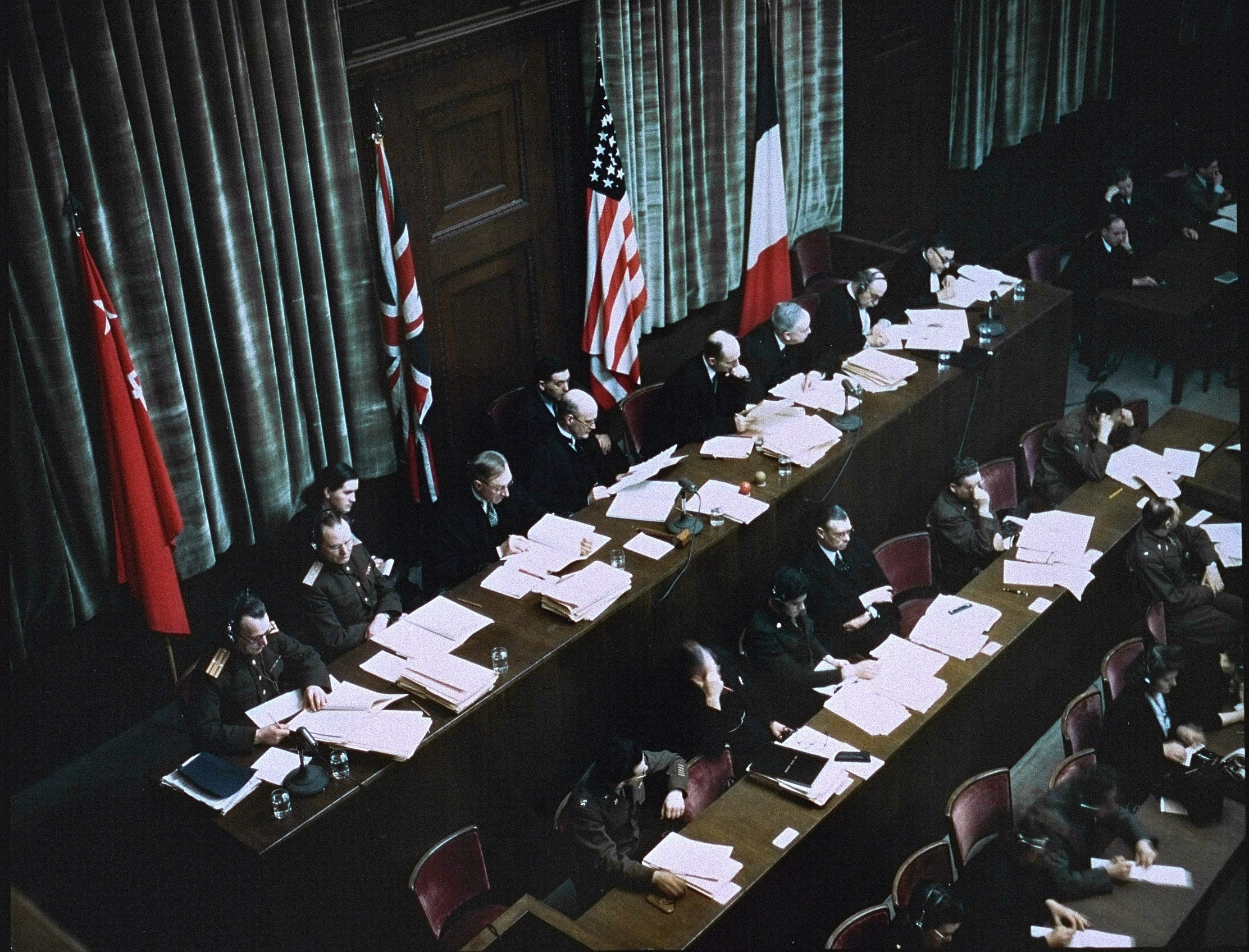
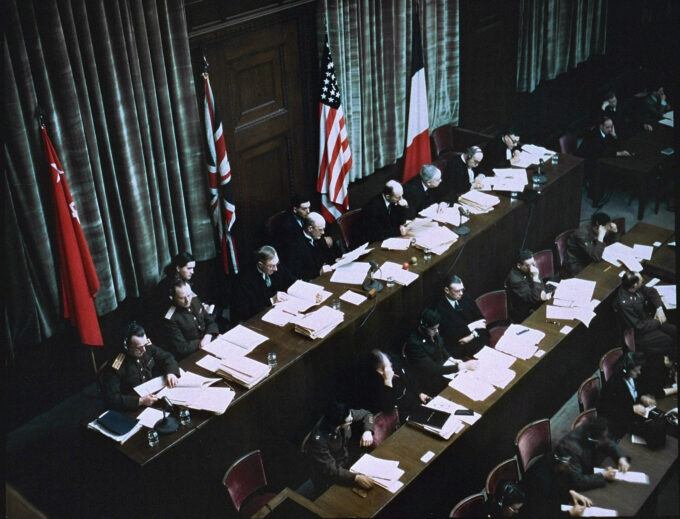
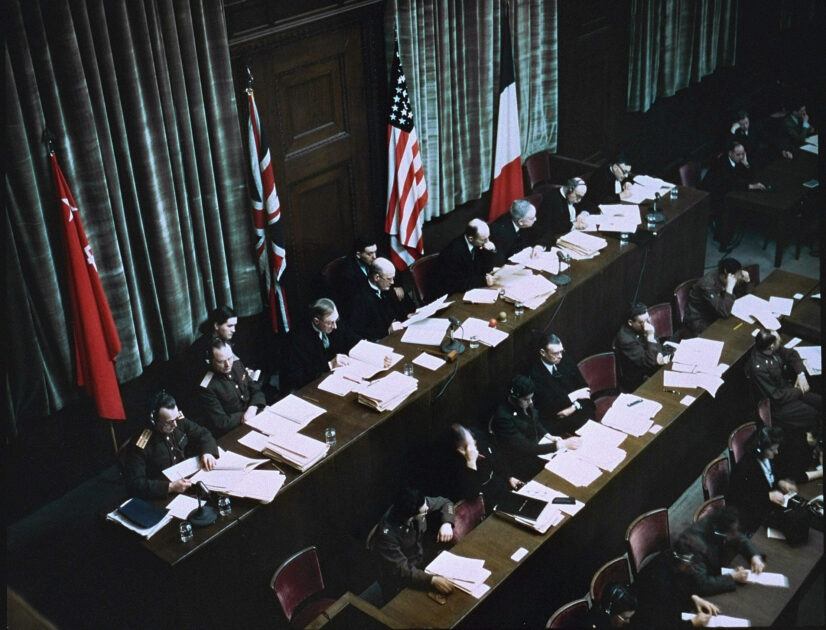
Photograph Source: Raymond D’Addario – Public Domain
As international law developed over the centuries, the principle of State sovereignty and the prohibition of interference in the internal affairs of other states gradually evolved — from the Peace of Westphalia of 1648 through the Congress of Vienna 1814-15, the establishment of the League of Nations in 1919 and the adoption of the United Nations Charter in 1945 as an incipient world constitution aimed at promoting peace, development and human rights.
In the light of the hecatomb of the Second World War, as a reaction to the Holocaust and other Nazi crimes, the victorious allies set up the International Military Tribunal for Nürnberg[1] and conducted numerous trials pursuant to the London Agreement of 8 August 1945 and Control Council Law Nr. 10.
The IMT Statute defined three principal crimes:
(a) ‘ Crimes against peace: ‘ namely, planning, preparation, initiation or waging of a war of aggression, or a war in violation of international treaties, agreements or assurances, or participation in a common plan or conspiracy for the accomplishment of any of the foregoing;
(b) ‘ War crimes: ‘ namely, violations of the laws or customs of war. Such violations shall include, but not be limited to, murder, ill-treatment or deportation to slave labour or for any other purpose of civilian population of or in occupied territory, murder or ill-treatment of prisoners of war or persons on the seas, killing of hostages, plunder of public or private property, wanton destruction of cities, towns or villages, or devastation not justified by military necessity;
(c) ‘ Crimes against humanity.- ‘ namely, murder, extermination, enslavement, deportation, and other inhumane acts committed against any civilian population, before or during the war, or persecutions on political, racial or religious grounds in execution of or in connection with any crime within the jurisdiction of the Tribunal, whether or not in violation of the domestic law of the country where perpetrated.
Leaders, organizers, instigators and accomplices participating in the formulation or execution of a common plan or conspiracy to commit any of the foregoing crimes are responsible for all acts performed by any persons in execution of such plan.”
Robert Jackson
The US Chief prosecutor at the International Military Tribunal for Nuremberg (IMT) Robert Jackson wisely stated in his opening statement in October 1945 that “while this law is first applied against German aggressors, the law includes, and if it is to serve a useful purpose it must condemn aggression by any other nations, including those which sit here now in judgment[2].” Similarly, the Tribunal’s1946 judgment concluded that: “to initiate a war of aggression is not only an international crime; it is the supreme international crime, differing only from other war crimes in that it contains within itself the accumulated evil of the whole.”[3]
In the same way as the prohibition of the crime of aggression extends to any aggression committed by any country (e.g. the USSR aggression against Finland in November 1939, the USSR aggression against Poland in September 1939), the prohibition of war crimes and crimes against humanity must provide for the indictment of all suspects, regardless of their country of origin. The principle of “tu quoque” means that all violations of international criminal law should be prosecuted, not only those of the vanquished. International criminal law must be applied uniformly. If applied selectively, international law loses authority and credibility and would promote a culture of impunity.
Victor’s injustice
The London Agreement of 8 August 1945 which laid down the statute of the IMT suffered from a “birth defect” or “original sin” – it was a classical victor’s tribunal. The judges and prosecutors all came from the four victorious powers, none of them came from neutral countries. All of the accused were defeated enemies.
The victorious Allies also set up a special Tribunal to try the Japanese aggressors and conducted trials in Tokyo. Alas, the Statute of the Tokyo Tribunal did not establish jurisdiction over crimes committed by the US, UK, France, Russia in their war against Japan.
The statutes of the IMT and Tokyo Tribunals did not envisage universal jurisdiction, the capacity to indict all persons who were suspected of violating the Hague and Geneva Conventions on the laws of war and international humanitarian law.
It was outside the IMT mandate to prosecute USSR officials for the execution of some 15,000 Polish officers and soldiers at Katyn and elsewhere, impossible to prosecute the Royal Airforce for the carpet-bombing of population centers in Germany, causing some 600,000 civilian deaths, for the crimes of the “dam-busters” who destroyed dams in Germany causing horrendous floods and tens of thousands of civilian deaths, for the atomic bombing of Hiroshima on 6 August 1945 or for the recidivist bombing of Nagasaki on 9 August 1945.
It was not possible to hold the participants of the Potsdam Conference accountable for the decision to “transfer” some 14 million ethnic Germans from territories where their ancestors had lived for seven hundred years, the expulsion and spoliation of the Germans of East Prussia, Pomerania, Silesia, East Brandenburg, Bohemia, Moravia, and for the expulsion of German “minorities” from Slovakia, Hungary, Slovenia, Croatia, Serbia, etc. These expulsions were far more serious than the “ethnic cleansing” practised in Yugoslavia during the 1990’s, which the international community unanimously condemned. Few know that up to two million human beings did not survive the ordeal.[4]
Nuremberg Principles
Notwithstanding numerous jurisdictional problems associated with the Nuremberg and Tokyo tribunals, it cannot be denied that they established a new international legal regime and that much of it is forward-looking and should be applied today to conflicts such as those raging in the Middle East.
The UN General Assembly entrusted the UN International Law Commission with the formulation of the Nuremberg Principles, which were adopted in 1950[5].
Principle I Any person who commits an act which constitutes a crime under international law is responsible therefor and liable to punishment.
Principle II The fact that internal law does not impose a penalty for an act which constitutes a crime under international law does not relieve the person who committed the act from responsibility under international law.
Principle III The fact that a person who committed an act which constitutes a crime under international law acted as Head of State or responsible Government official does not relieve him from responsibility under international law.
Principle IV The fact that a person acted pursuant to order of his Government or of a superior does not relieve him from responsibility under international law, provided a moral choice was in fact possible to him.
Principle V Any person charged with a crime under international law has the right to a fair trial on the facts and law.
Principle VI The crimes hereinafter set out are punishable as crimes under international law: (a) Crimes against peace: (i) Planning, preparation, initiation or waging of a war of aggression or a war in violation of international treaties, agreements or assurances; (ii) Participation in a common plan or conspiracy for the accomplishment of any of the acts mentioned under (i). (b) War crimes: Violations of the laws or customs of war which include, but are not limited to, murder, ill-treatment or deportation to slave-labour or for any other purpose of civilian population of or in occupied territory, murder or ill-treatment of prisoners of war, of persons on the seas, killing of hostages, plunder of public or private property, wanton destruction of cities, towns, or villages, or devastation not justified by military necessity. (c) Crimes against humanity: Murder, extermination, enslavement, deportation and other inhuman acts done against any civilian population, or persecutions on political, racial or religious grounds, when such acts are 3 done or such persecutions are carried on in execution of or in connection with any crime against peace or any war crime. Principle VII Complicity in the commission of a crime against peace, a war crime, or a crime against humanity as set forth in Principle VI is a crime under international law.
Undoubtedly, the Nuremberg Principles have been grossly violated by the United States and Israel in the context of the war of aggression against Iran. The International Criminal Court should motu proprio start an investigation into the evident violations of Articles 5, 6, 7 and 8 of the Statute of Rome[6], and issue the necessary warrants of arrest for those responsible of these crimes. The crime of aggression within the meaning of the Kampala definition[7] of 2010 and General Assembly Resolution 3314 of 1974[8] has undoubtedly been committed. This must have consequences. If the ICC fails to act, it will lose whatever authority and credibility it still has.
Is there a principle of “preventive self-defence”?
The Israeli and US governments have been invoking a co-called right of “preventive self-defence” in an attempt to legitimize their brazen aggression on Iran. Nevertheless, neither customary international law nor the UN Charter provides for any such right. Accordingly, notwithstanding the mainstream media narratives, neither the US nor Israel have a legal leg to stand on – there is zero right of pre-emptive action, but instead a prohibition of the use of force without UN Security Council approval.
When in March 2003 George W. Bush and the “coalition of the willing” attacked Iraq, UN Secretary-General Kofi Annan clearly stated that the Iraq War was “incompatible with the UN Charter”. When pressed by journalists for a clarification, he stated that the it was an “illegal war.”[9]
There was much discussion around the concept of preventive self-defence, and a consensus emerged among international lawyers that such a right did not exist. The exception to the prohibition of the use of force required a previous military attack. Only such a prior armed aggression could justify armed self-defence. Even pursuant to article 51, self-defence would not justify total war. Self-defence is understood as a temporary measure to repel an attack until the Security Council is seized of the matter and can act to resolve the conflict.
Article 51 of the UN Charter is unambiguous:
Nothing in the present Charter shall impair the inherent right of individual or collective self-defence if an armed attack occurs against a Member of the United Nations, until the Security Council has taken measures necessary to maintain international peace and security. Measures taken by Members in the exercise of this right of self-defence shall be immediately reported to the Security Council and shall not in any way affect the authority and responsibility of the Security Council under the present Charter to take at any time such action as it deems necessary in order to maintain or restore international peace and security. [10]
It is worth recalling that in 2003, Iraq had not attacked anyone. Saddam Hussein was always ready to negotiate with the US and actively cooperated with UN envoys Hans Blix and Mohamed ElBaradei. Recently Hans Blix commented on the current war in Iran. The former head of the International Atomic Energy Agency, now aged 96, Blix had led the hunt for nuclear, chemical and biological weapons in Iraq for many months, while the US and UK were sabre rattling and threatening to attack the Saddam Hussein regime. Blix now warns that the US risks repeating the “awful” results of the Iraq War by joining Israel in trying to impose regime change in Iran[11].
Although Blix and ElBaradei told the UN Security Council in 2003 that no evidence of any weapons of mass destruction had been found in Iraq. George W Bush and Tony Blair pushed ahead with their illegal invasion and toppled the regime of Saddam Hussein.
Speaking before the US bombardment of Iran’s nuclear facilities, Blix stated that the war against Iran shares “similarities” with 2003. It is déjà-vu. The US and Israel – with UK support – are “both using the suspicions of acquisition of nuclear arms as a main argument in favour of action. In reality, what they want is regime change.” But as Blix insisted, “Regime change is illegal, and it is also very dangerous. They thought removing Saddam would solve the situation, and they brought the Middle East to the worst situation I can imagine… The whole region has been embroiled in the consequences.”
UN Charter Articles 2(3) and 2(4)
In this context let us revisit the text of article 2(4) of the UN Charter, the prohibition of the use of force : “All Members shall refrain in their international relations from the threat or use of force against the territorial integrity or political independence of any state, or in any other manner inconsistent with the Purposes of the United Nations.”
In June 2025 and again in February 2026, Israel and the United States violated the UN prohibition of the use of force. The Security Council has been addressing the conflict for years, striving to find a rational solution through diplomacy. This was achieved in 2015 when the Security Council adopted Resolution 2231, the JCPOA (Joint Comprehensive Plan of Action), and the Vienna Agreement on the Iranian nuclear program of July 14, 2015. Thus, the US-Israel aggressions against Iran were in blatant contravention of the spirit and letter of Security Council Resolution 2231.
The US-Israeli attempt to dress aggression in the garments of “self-defence” has failed, because neither in June 2025 nor in February 2026 was there any “armed attack” by Iran against Israel or the USA. Article 51 of the UN Charter simply does not apply.
The factual situation is that Iran pursued a course of action laid down in Article 2(3) of the UN Charter, according to which all states are obliged erga omnes to engage in diplomacy: “All Members shall settle their international disputes by peaceful means in a manner that does not endanger international peace, security, or justice.”
Iran has complied with this. Israel and the USA acted in violation of Articles 2(3) and 2(4) of the Charter. Negotiations in Oman and Geneva were underway when Israel and the USA attacked Iran without provocation or warning.
The bombing of Iran on February 28 by the US and Israel, just like the attacks of June 2025, constitute serious war crimes. These unprovoked aggressions violate fundamental principles of customary international law, as well as international humanitarian law, namely the Hague and Geneva Conventions. More specifically they constitute the crime of “perfidy” as defined in Article 37 of Additional Protocol I to the 1949 Geneva Red Cross Convention.
Art. 37 stipulates in part:
“ It is prohibited to kill, injure or capture an adversary by resort to perfidy. Acts inviting the confidence of an adversary to lead him to believe that he is entitled to, or is obliged to accord, protection under the rules of international law applicable in armed conflict, with intent to betray that confidence, shall constitute perfidy. The following acts are examples of perfidy: (a) the feigning of an intent to negotiate under a flag of truce or of a surrender…”[12]
Professor Ben Saul[13], the UN Special Rapporteur on human rights while countering terrorism condemned these attacks as follows:
“I strongly condemn the illegal Israeli and US aggression against Iran, in violation of the most fundamental rule of international law and the United Nations Charter – the ban on the use of force. This is not lawful self-defence against an armed attack by Iran and the Security Council has not authorized it. Preventive disarmament, counter-terrorism and regime change on this scale constitute the international crime of aggression. All responsible governments should condemn this lawlessness from two countries who excel in shredding the international legal order.”
At the UN Security Council, Secretary General Antonio Guterres stated that the US-Israeli attacks violated the UN Charter and international law.[14] Numerousr UN special rapporteurs, including George Katrougalos, Independent Expert on International Order, similarly condemned the US-Israeli aggressions[15].
Conclusion
The US-Israeli against Iran is not only a war against the regime of the Mullahs, it is a war against the United Nations Charter, against international law and morals, against all of us, against civilization itself.
What do we understand under the term civilization? It means ordered life among human beings in pursuance of common goals, a framework and process enriched by traditions, memory, a sense of identity and a moral compass. Civilization builds on foundational values and entails an agreement to live according to rational norms, in an animus to observe the rules of the game, whether these rules are written or unwritten.
Long before writing was invented, language and codes of conduct existed to regulate communal human activity. Hunters and gatherers had their own cultures and gradually devised their own rules for survival and development — lived in small communities, improvised sports, invented stories, sang songs. Neanderthals and Cro-Magnon in Africa, Asia, Polynesia, Europe or the Americas, conceived their own codes and methodologies. Their civilizations found expression in religious ceremonies, initiation rites, music, dances, cuisine, practical rules of sanitation, irrigation, canals, bridges, funeral rites. They managed to survive and prosper in hostile environments, e.g. the Aboriginals of Australia.
Written laws came much later, when the Chinese, Indians, Mesopotamians, Persians, Greeks invented their respective symbols corresponding to vowels and consonants. The ability to record financial transactions with written symbols facilitated commerce between peoples, and enabled the cross-fertilization of cultures. Religion played an important role in giving meaning to natural phenomena, to life and death. Laws were codified to advance cohesion in societies, offer a measure of predictability, reward performance and punish those who broke the rules. Courts were established to give authority and credibility to the laws by ensuring their enforcement.
History teaches us that civilizations decline and end when societies abandon their foundational values and no longer respect the rules of the game. Legal uncertainty leads to chaos, violence and war. A “culture of cheating”, double standards and bad faith betray the “human Covenant” and undermine the proper functioning of society. As civilizations rise and fall, the responsibility for maintaining our culture and values rests on each one of us.
Today we observe a frontal attack on civilization, a return to barbarism and the primitive “might is right” paradigm. It is up to us to push back against this development, to name a spade a spade, to condemn the genocide in Gaza, to reject the aggression against Iran, and demand accountability from the United States and Israel.
What can the Global Majority do?
What should the BRICS, the Non-aligned movement, the Organisation of Islamic Cooperation, the Shanghai Cooperation Organiation do? I would propose to BDS both Israel and the United States.
Rhetoric alone will not reverse the downward spiral toward universal chaos. Those who are at war with the UN Charter and the world must be isolated economically.
A campaign to boycott, divest and sanction must be organized and followed-through. This would entail, inter alia, ceasing any purchases of weapons and technology from the US and Israel. Stop buying F-16, F-35, Boeing, Lockheed/Martin, Raytheon, General Motors, Caterpillar etc. Divest from US stocks and bonds. Sell off all US Treasury bonds. Stop supplying the US and Israel with “rare earths”. Such concerted action would immediately impact the economies of these two rogue countries.
Perhaps the citizens of those countries (I am an American citizen myself) will understand the gravity of the situation, go out on the streets with signs “Not in our Name”, “If the government does not stop the war and the genocide, we will stop the government”. My generation did that when I was a student at Harvard in the late 60’s and early 70’s in protest against the crimes being committed by the US during the Vietnam war. Concretely, this means organizing general strikes, refusing to load weapons on ships, refusing to cooperate with the pursuance of an illegal war not authorized by the US Congress.
We must kick out those undemocratic “leaders” who do not represent us. The people do not want to send their children to war. They want peace, not perpetual war. We demand a return to sanity and observance of the fundamental rules of civilization.
Notes.
[1]https://www.refworld.org/legal/agreements/un/1945/56517
https://avalon.law.yale.edu/imt/imtchart.asp
https://thejacksonlist.com/wp-content/uploads/2020/08/20200808-Jackson-List-London-Agreement.pdf
[2] https://www.roberthjackson.org/speech-and-writing/opening-statement-before-the-international-military-tribunal/
[3] The International Military Tribunal for Germany (1946-09-30), Judgment of the International Military Tribunal, the Avalon Project, Yale University.
https://legal.un.org/ilc/documentation/english/a_cn4_5.pdf
[4] Alfred de Zayas, Nemesis at Potsdam, Routledge, London 1977, new edition Routledge Revivals 2023; A Terrible Revenge, Macmillan, New York, 1994; 50 Theses on the Expulsion of the Germans, Verlag Inspiration, London and Berlin, 2012.
[5]https://legal.un.org/ilc/texts/instruments/english/draft_articles/7_1_1950.pdf
[6] https://www.icc-cpi.int/sites/default/files/2024-05/Rome-Statute-eng.pdf  ︎
︎
[7] https://asp.icc-cpi.int/crime-of-aggression
[8] http://www.un-documents.net/a29r3314.htm
[9] http://news.bbc.co.uk/2/hi/middle_east/3661134.stm
[10] https://www.un.org/en/about-us/un-charter/full-text
[11] https://inews.co.uk/news/world/hans-blix-truth-wmds-iraq-now-fears-repeat-iran-3762623
[12] https://ihl-databases.icrc.org/en/ihl-treaties/api-1977/article-37?activeTab=
[13] https://www.linkedin.com/posts/professor-ben-saul-46748a13_i-strongly-condemn-the-illegal-israeli-and-activity-7433454707546861568-GcSI ︎
[14] https://apnews.com/article/iran-israel-us-un-security-council-airstrikes-9140bca9241fb99be8cb3cff2c650741
[15] https://www.ohchr.org/en/press-releases/2026/03/un-experts-denounce-aggression-iran-and-lebanon-warn-devastating-regional
The post Iran in the Light of the Nuremberg Principles appeared first on CounterPunch.org.
This content originally appeared on CounterPunch.org and was authored by Alfred de Zayas.