
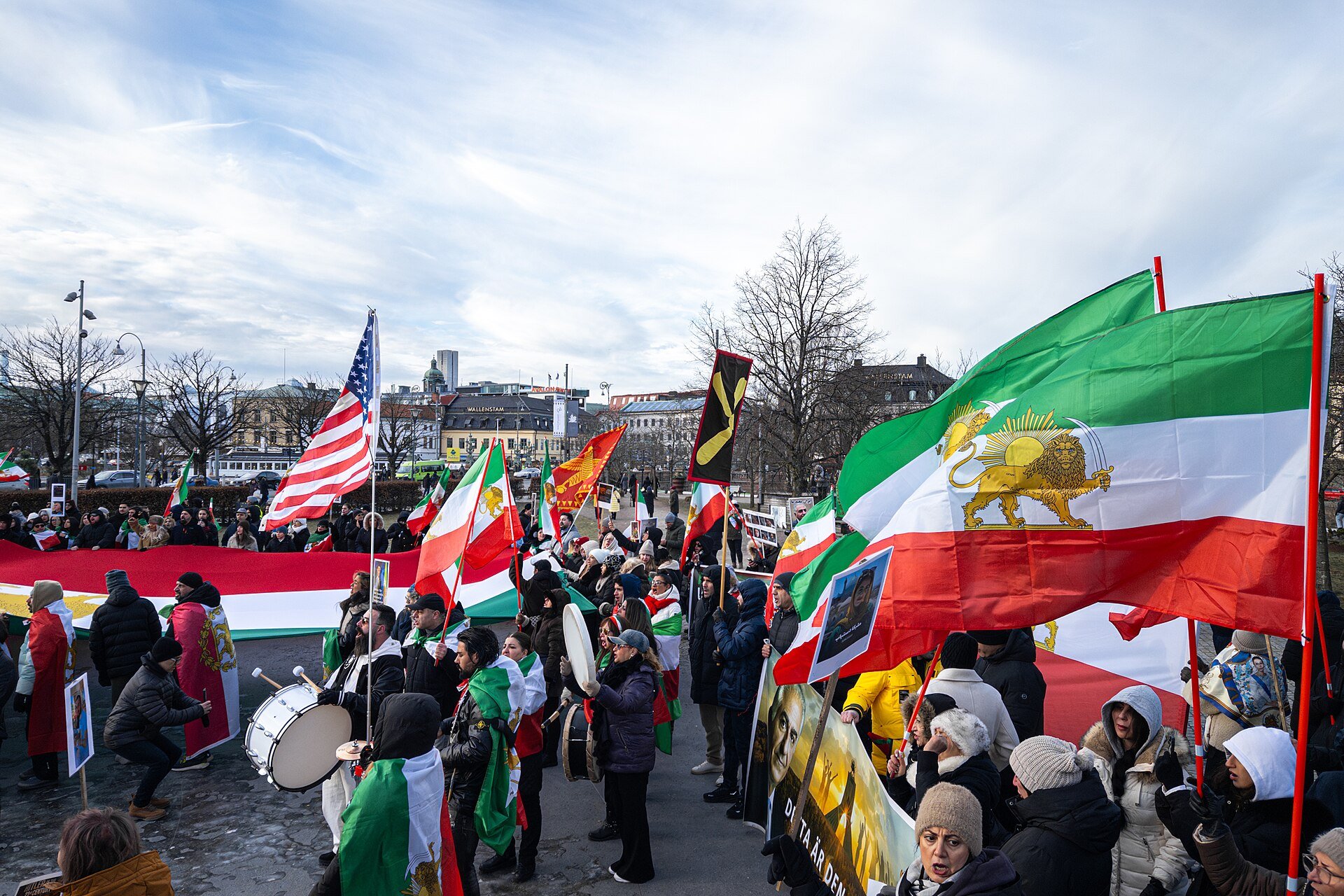
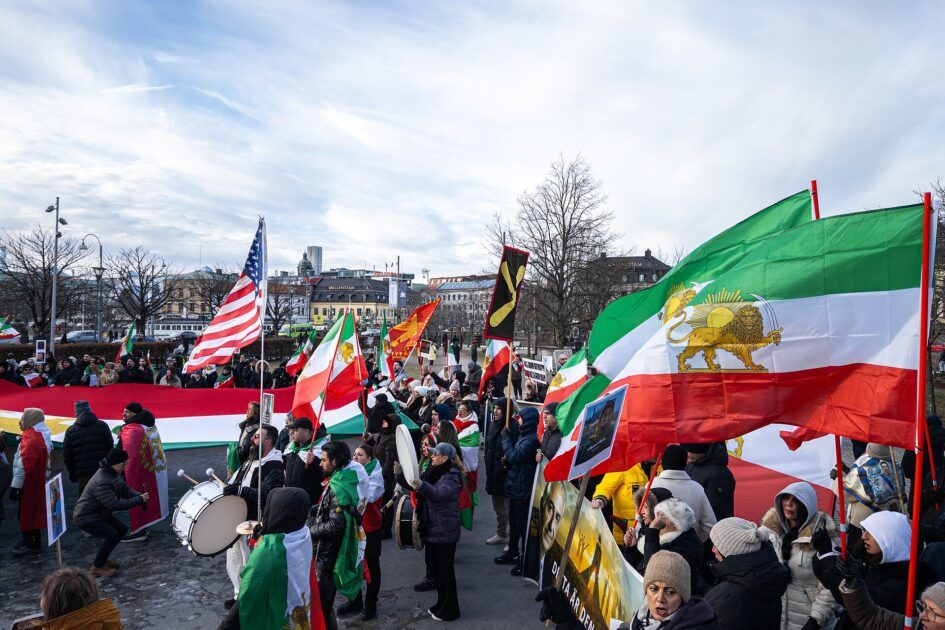
Photograph Source: Crannofonix News – CC BY 4.0
The sad truth is that most evil is done by people who never make up their minds to be either good or evil
– Hannah Arendt, Eichmann in Jerusalem (1963)
There is a word from another revolution that fits a little too well in this time: gusano—the exile who leaves a revolution only to spend decades begging Empire to bring them back. It belongs to Cuba, but its logic has migrated. You can now find it, almost intact, among a certain stratum of the Iranian diaspora—especially those still orbiting the fading promise of monarchy. In Miami, they waited for Washington to deliver Havana. In Los Angeles, Toronto, and Berlin, a faction now waits for Washington—or Tel Aviv—to deliver Tehran to them as it was in 1978. Same structure, different flag. And with the current war against Iran, that structure has hardened into something uglier: open alignment with destruction as a pathway to return.
Bombs as Liberation
Let’s not pretend otherwise. Sections of the diaspora—particularly monarchist-adjacent networks—have greeted the strikes on Iran with glee and enthusiasm. Not hesitation. Not grief. Enthusiasm. “Precision strikes.” “Necessary pressure.” “Transition.” The language is clinical. The reality is not. What’s being smuggled in here is a simple proposition: That a country can be saved by being broken via imperial hubris. We’ve seen this movie before. Iraq was supposed to be liberated. Afghanistan was supposed to be rebuilt. Libya was supposed to be freed. The ruins are still there, if anyone cares to look. But exile politics has a way of editing reality. Distance sanitizes violence. From abroad, war looks like strategy. Up close, it looks like collapse.
The Privilege of Distance and Zulm as Misplacement
The Iranian diaspora is not a monolith, since I am among them. Millions of people, scattered across continents, with wildly different views. Many, like myself, oppose the war outright. Many know exactly what foreign intervention produces: not democracy, but unmitigated wreckage. But the loudest voices are not always the most representative. They are simply the most amplified—and the least exposed to consequence. That asymmetry matters because the diaspora debates; the homeland absorbs; and in that gap, something corrosive takes hold: a politics with no cost attached to it.
Call it what it is: zulm. Not just injustice in the moral sense, but misplacement—putting a thing where it does not belong. What could be more misplaced than celebrating the bombing of your own country from the safety of another? This is not dissent. It is dislocation. Iran, in this frame, ceases to be a lived reality—people, cities, infrastructure, heritage, memory—and becomes an abstract object. Something to be broken, rearranged, restored. A symbol, not a place. That is zulm at the level of perception itself: The eye sees a spectacle, not a society; the ear hears rhetoric, not suffering; the tongue speaks from a ground it no longer inhabits.
Monarchy as Myth
At the center of this is not politics, but nostalgia—more precisely, mythologized nostalgia. The Pahlavi era is recast as a lost golden age. Its contradictions disappear. Its violences are minimized. Its image is polished into something exportable. Layered onto this is a civilizational narrative that increasingly slides into something else: a rejection of Iran as it actually exists, in favor of an Iran that must be purified, restored, reimagined—often in explicitly anti-Islamic or anti-Arab terms. But this isn’t a program. It’s a fantasy—and a dangerous one because fantasies, when backed by missiles, become very real, very quickly.
Outsourcing Liberation and Speaking For a Country Burning
Strip away the slogans and one idea remains: Liberation can be outsourced. Someone else will do it. Someone else will break the regime. Someone else will clear the ground. This is the gusano logic in its pure form. And it has a track record: It fails. Not morally, but structurally. Because external force does not produce internal legitimacy. It produces violent vacuums, generational fragmentation, and long, ugly aftermaths.
As war tightens its grip, voices inside Iran narrow—through blackout, repression, sheer survival. Meanwhile, the diaspora gets louder. It speaks not just about Iran, but increasingly for it. And in doing so, it risks turning war into narrative where distance becomes clarity, amplification becomes authority and reality becomes optional.
The Return of Measure and Naming the Formation
But there is a law that doesn’t care about narratives: the law of return, of proportion, of balance—call it qisas. Not revenge. Not vengeance. Rebalancing. What is displaced returns. What is distorted is answered. What is projected outward finds its way back. For those celebrating destruction at a distance, this should give pause, because wars don’t stay where they start. They echo politically, economically, psychologically and existentially. The fracture you cheer does not remain contained since—guaranteed—it takes a malevolent life of its own.
To call this “gusanos of monarchy” is not to condemn an entire diaspora. It is to identify a pattern: exilic, nostalgic, empire-facing, war-tolerant, if not war-dependent. It is a politics that mistakes collapse for opportunity and confuses proximity to power with proximity to truth.
The Final Question
Opposition to the Islamic Republic is not the issue. That is widespread, and in many cases entirely justified—politically, morally, historically. There is no shortage of reasons to resist authoritarianism, repression, or the suffocation of public life. But that is precisely why the question that follows cannot be evaded, because it cuts deeper than opposition itself: how is that opposition articulated, and through what means is it pursued? Do you oppose it in a way that preserves the possibility of Iran—or in a way that destroys it in order to save it? This is not a rhetorical flourish. It is the dividing line between two fundamentally different orientations to power and responsibility. One begins from the premise that a country is more than its regime: that it consists of people, infrastructure, memory, hritage, continuity—fragile, interdependent systems that, once shattered, do not simply reassemble themselves under a new flag. The other treats the country as an abstraction, a surface upon which political fantasies can be projected, erased, and redrawn at will.
The first approach is slow, uneven, and uncertain. It requires internal pressure, social transformation, and the difficult work of building legitimacy from within. It carries no guarantees, no timelines, no spectacle. The second is fast, decisive, and catastrophic. It promises rupture, cleansing, reset—the seductive language of zeroing out history so that it can begin again on more favorable terms. It is also, almost without exception, a lie. History has already adjudicated this choice. From Iraq to Libya, from Afghanistan to Syria, the record is consistent: when destruction is taken as the precondition of renewal, what follows is not rebirth but disintegration. Institutions collapse, social trust evaporates, violence diffuses, and what remains is not a liberated polity but a fractured terrain, open to new forms of domination.
Let me say this again: You do not get your country back. You get what survives the process—and survival is not the same thing as continuity. A society can endure and still be unrecognizable to itself. It can persist as a geography while losing its coherence as a world. And in the case of Iran—given its scale, its internal complexity, its regional entanglements—the risks are even starker. This is not a contained system that can be surgically altered from the outside. It is a dense, interwoven field. To rupture it violently is not to clear the ground, but to unleash forces that do not answer to anyone’s blueprint—not Washington’s, not Tel Aviv’s, and certainly not the diaspora’s.
So the question returns, stripped of illusion: What exactly are you willing to see destroyed in the name of saving it? Because if the answer includes the country itself—its cities, its infrastructure, its social fabric—then what is being pursued is not liberation, but substitution: one catastrophe in place of another, with the vague hope that something better might emerge from the wreckage.
And sometimes, it doesn’t. Sometimes what remains is not a country waiting to be reclaimed, but a space in which the very idea of return no longer makes sense. And that is the risk being entertained now—not in theory, but in real time.
The post Gusanos of Monarchy: War, Exile, and the Misplacement of a Nation appeared first on CounterPunch.org.
This content originally appeared on CounterPunch.org and was authored by Wahid Azal.