
The March 13, 2026, episode of CounterSpin was a review of the history of anti-Iran propaganda using archival interviews. This is a lightly edited transcript.
New York Times (3/10/26)
Janine Jackson: House Foreign Affairs Committee chairman Brian Mast declared of Iran, “This murderous regime has posed an imminent threat against every American, both at home and abroad, for the last 47 years,” leading many, at home and abroad, to reach for their dictionaries.
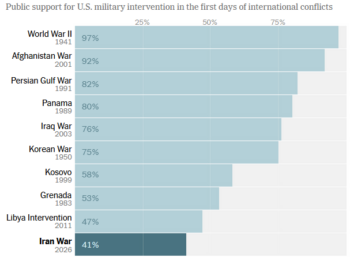
The Trump White House’s war on Iran is unpopular in the US. Even the highest level of public support for this conflict falls far lower than that at the start of most other conflicts, including World War II, the Korean War and the Iraq War, reports the New York Times.
That may have something to do with the parade of rationales being offered. Popular Information has a roundup of the (so far) 17 different reasons the Trump regime has given to date for why we went to war.
And all of it normalized by corporate media that allow recorded history to be put up for debate, that pretend we haven’t seen what we’ve seen, leaving today’s warmongers free to draw up a historical narrative, or several, that serve their present purpose.
As we record on March 12, some 251 groups have sent a letter to Congress demanding they vote against any additional funding for this unconstitutional war, which is now costing an estimated billion dollars a day. Signers included Public Citizen, the ACLU, Greenpeace, J Street and National Nurses United. “A supplemental worth $50 billion,” the letter notes,
would be enough to restore food assistance for 4 million Americans, establish universal pre-K education, and pay for the annual construction of more than 100,000 units of housing.
CounterSpin has been tracking US news media failings, omissions and propagandizing on Iran for decades. We’re going to revisit some of those conversations today.
***
Newsweek (10/12/09)
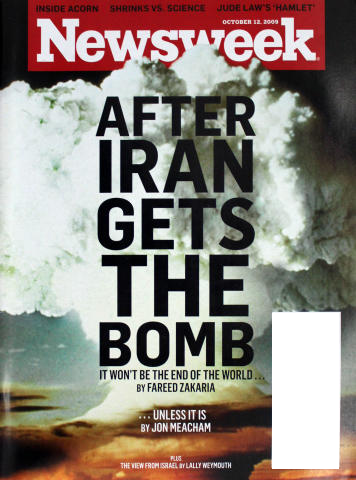
A glance at newsstands in October 2009 would offer the Newsweek cover story “After Iran Gets the Bomb.” A leaked report suggesting Iran was indeed pursuing nuclear weapons made its way to the front page of the New York Times.
We asked what to make of it from Cyrus Safdari, independent analyst and blogger at IranAffairs.com. We start with a question from CounterSpin’s Peter Hart.
***
Peter Hart: Now let’s start with this New York Times story. On the front page, October 3, the headline said, “Report Says Iran Has Data to Make a Nuclear Bomb.” That story was all over the rest of the media, with these matter-of-fact declarations about Iran’s “nuclear weapons program.” The lesson seemed to be, “Well, we were being told Iran wasn’t pursuing weapons, but now look at this.” It comes from the International Atomic Energy Agency. They’ve been saying all along, “We don’t have good intelligence on Iran wanting a weapons program.” What do we make of a story like that?
Cyrus Safdari: If you actually read the story, and actually press to see what the actual facts are that it says, you actually come away with very little in terms of facts. There is apparently, according to the New York Times, a dispute within the IAEA over the validity and legitimacy of certain evidence that the United States has provided to the IAEA. And this has caused, apparently, according to the New York Times, a split within the IAEA over whether this intelligence is believable or not.
But in phrasing it in terms of “data to make nuclear weapons,” that’s really their hedging their language, because data to make nuclear weapons is not the same thing as nuclear weapons. The data can be found in any library, essentially.
PH: Yeah. One part of the story that said that they might have “sufficient information to be able to design,” which could mean almost anything. We should point out that this story was floated a couple weeks ago in the Associated Press.
CS: Yeah. These stories have a way of being recycled. There was something called the Nth Country Experiment in the ’60s, in which the United States’ Lawrence Livermore Labs, which makes the nuclear weapons for the United States, decided to see how easy it would be for someone to come up with a design for nuclear weapons, using just their library cards. And a couple of PhDs in physics managed to do so using nothing more than pencils and library cards. Now in the days of the internet and all that stuff, it’s not very hard to come across data to make nuclear weapons.
PH: Now, some of this feels like the drive to war in Iraq all over again. The front page of the New York Times was used to make some of these claims in 2002 and 2003. Obviously, one major difference is that the current White House isn’t pushing the story the same way as the previous administration was, but what about this story feels like Iraq to you?
CS: I don’t think we should be too complacent. The current White House may not be pushing it, but there are definitely very powerful elements in the administration as a whole, and Congress, that are pushing for more of a confrontational attitude.
Let’s take this Iran gasoline sanctions law, which is currently pending in Congress. This isn’t really a question about imposing gasoline sanctions on Iran because, as people have said, it’s not quite clear whether those sanctions will have an effect on Iran or not. However, those sanctions are going to have to be enforced using naval blockades, and naval blockades constitute an act of war.
So whenever you see sanctions, you really should think war, because that’s really ultimately the outcome. And we are being gradually pushed to that extreme, where the matter is being radicalized and solutions are being ignored, in a push, essentially, for confrontation.
***
New York Times Magazine (1/25/12)
JJ: In February of 2012, the New York Times warned readers about Iran’s nuclear power program:
The new uranium enrichment plant, known as Fordo, has raised Western concerns because it is buried deep underground, making it more impervious to scrutiny.
Which is strange, because Fordo was regularly visited by UN inspectors, as Times reporter Rick Gladstone seemed to be aware, since he wrote, a few paragraphs later:
Last month, inspectors from the International Atomic Energy Agency, the United Nations nuclear watchdog, confirmed that Iran had started uranium enrichment at Fordo.
But the Times‘ specialized usage of that word “scrutiny” was clarified by a New York Times Magazine article, which explained that Fordo is
in a bunker that Israeli intelligence estimates is 220 feet deep, beyond the reach of even the most advanced bunker-busting bombs possessed by the United States.
That’s apparently the kind of “scrutiny” that Fordo was “impervious” to.
The same month, February 2012, US media were abuzz with stories in the wake of remarks by the US Director of National Intelligence, James Clapper, who declared Iran a greater threat than Al-Qaeda, saying they were prepared to carry out attacks in the Western hemisphere, including in the US. We spoke with author historian Vijay Prashad, director of international studies at Trinity College in Connecticut. CounterSpin’s Steve Rendall asked him to start with the state of relations between Iran and the Atlantic powers.
***

Vijay Prashad: “If there is an actual war, an actual threat that is going on, it is already inside Iran. There is no real threat to the United States.”
Vijay Prashad: If you ask most of the 78 million people who live in Iran, they will tell you that the economic life in Iran has gone from pretty bad to appalling. The currency, the rial, has lost its value against the dollar by at least 70% over the last 28 days, and that is a scandalous state of affairs for a country which relies on imports, like most countries do, which is why anything in Iran now is highly inflated in its cost.
And the reason the Iranian rial has gone into a free fall downward is because Iran has faced a series of economic attacks by the United States and Europe. And these economic attacks have had a direct consequence on the everyday life of people. We call these attacks “sanctions,” but the word sanction doesn’t carry exactly what the effects are on people’s lives.
Secondly, there was, of course, the hoopla around the so-called plot to kill the Saudi ambassador, that sounded to me like more the fantasy of a very strange man who lived in Austin, Texas. But on the other hand, there have been actual assassinations taking place in the streets of Tehran. We have four senior scientists assassinated in broad daylight. And so these real attacks in Tehran have chilled the scientific community, have actually brought fear to many intellectuals, afraid to go outside, afraid to deal with their daily life. So if there is an actual war, an actual threat that is going on, it is already inside Iran. There is no real threat to the United States.
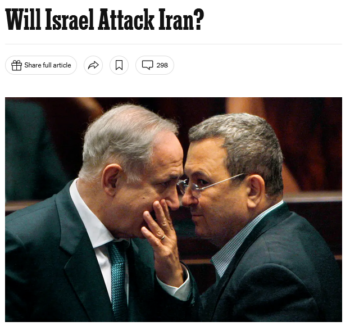
Steve Rendall: Over the last month or so, we’ve been seeing mixed messages from elites on an Iran attack. One week, there’s news chatter about a possible large-scale attack on Iran being too costly or dangerous. But then at the end of January, there was Ethan Bronner in a New York Times story, quoting Israeli Defense Minister Ehud Barak saying it wouldn’t really be such a big fuss.
And the coverage this past week or so seems to indicate that at least the US press is putting its combat boots on. One night, Brian Williams and Andrea Mitchell on NBC, and the next night Diane Sawyer on ABC, are touting the increased threat to the US homeland from Iran.
I’ll give a couple of examples of that. You have Williams calling Clapper’s testimony a “chilling new assessment about the scope of the threat from Iran.” And you have, at ABC, Diane Sawyer saying, “America’s top spy warns that Iran is willing to launch a terror strike inside the US.” What do you make of this?
VP: Firstly, one would have hoped that after the debacle of 2002 and 2003, and the kind of reporting that came out of, particularly, the New York Times, and in the New York Times it was Judy Miller, that these reporters would have at least developed some kind of mechanism for slowing things down, for asking the real questions.
Secondly, I welcome them. I will give them a free seminar on how to read the Iranian media and how to read Iranian statements. Perhaps they need to understand that every single statement is not transparent, that people have different cultures of the way they say things, what they propose to mean. And also perhaps a quick lesson in geography, because it seems to me that they don’t understand the part of the world they’re talking about at all.
So those two things said, the third thing, I think this talk about whether there’ll be an attack, or whether there’ll not be an attack, is extremely cynical and disturbing, and itself demonstrates to the rest of the world that we are becoming, increasingly, a people unconcerned about the wishes of people elsewhere.
In other words, imagine if some part of the world, people cynically, dangerously say, “Well, now we’ve decided not to attack immediately.” We’re talking about 78 million people. We’re holding 78 million people of another country hostage to the whims of our elite political class. And I think that is a moral question we need to ask ourselves, whether we want to have a political class that talks so cavalierly about the real lives of other people.
***
JJ: In September 2017, it was clear that Trump was trying to undo the 2015 deal in which Iran agreed to give up enriched uranium and destroy thousands of centrifuges, among other things, in exchange for the lifting of economic sanctions. We talked at the time with journalist Murtaza Hussain, then at the Intercept, now at Drop Site News.
***
JJ: The telegraphing began even before Nikki Haley, US ambassador to the UN, gave her recent speech at the American Enterprise Institute. Donald Trump, who has to recertify Iran’s compliance with the deal every 90 days, about a month ago simply said, “I think they’ll be noncompliant.” Coming from someone else, that might mean, I don’t think they’re actually complying, but from Trump, it sounds more like, I’m going to say they’re noncompliant. What, first of all, do we know about the reality of Iran’s fulfilling its end of the 2015 deal?

Murtaza Hussain: “The American objection to the deal now seems to be framed around issues which never had anything to do with the deal.”
Murtaza Hussain: The IAEA and European Union and Russia, China, have all indicated that they believe Iran will be compliant with the terms of the original nuclear agreement. And the Trump administration has not really provided any evidence in contravention of that.
The American objection to the deal now seems to be framed around issues which never had anything to do with the deal—the general history of distrust and animosity that existed between Iran and the United States—and they’re using this as a means of reframing the deal retroactively about non-nuclear issues, as a way of ultimately terminating it.
JJ: We got that feeling from Nikki Haley’s speech, which was really quite something. What were some of the things that she said in that speech that tell us the hand that the state is trying to deal here?
MH: In Nikki Haley’s speech, she identified a long list of American grievances, acts of terrorism over the past two decades which had been sponsored by the Iranian military in Lebanon, Saudi Arabia and elsewhere. But the thing is, both Iran and the United States have a long history of grievances with each other that stretch back several decades.
Arms control agreements—and we have a long history of these during the Cold War—they are seldom if ever created to address political issues, issues between states extraneous to the strictly defined goal of controlling the proliferation of weapons. So when the nuclear deal was created, it was created very narrowly around the nuclear issue itself, basically because if they made it about all these other issues, it would be impossible to ever reach any agreements.
Now, in the attempt to retroactively reframe the deal, it seems very clear that it’s an attempt to torpedo it after the fact, by saying, well, no, actually we have all these other problems with Iran that we want to deal with, and the deal must be restructured to accommodate that. But it’s simply impossible. There’s no way that it’s going to be able to reopen the deal. And the Iranians themselves have indicated that any attempt to do so would be a nonstarter.
LA Times (9/9/17)
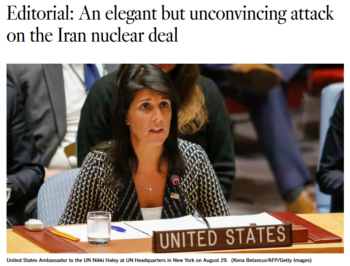
JJ: It certainly seems like moving the goalposts to say, we’re going to say they’re noncompliant for things that are not actually in the agreement itself. But nevertheless, the Los Angeles Times called Nikki Haley’s speech an “elegant but unconvincing attack” on the deal, which I found kind of surprising, especially given that one of the things she said was:
Judging any international agreement begins and ends with the nature of the government that signed it. Does it respect international law? Can it be trusted to abide by its commitments?
I mean, that just sounds like a howler to me. But there was this idea to say, Iran is just inherently law-breaking.
MH: Yeah. It was a very strange speech in some ways. And the idea that the entire problem is making a deal with Iran at all, then the only option, other than that, is to have a war, or to ratchet up tensions to the point where war becomes extremely possible.
It seems very clear that they’re trying to sabotage the deal. But because the deal itself was negotiated, not just by the United States, but several other parties around the world, the so-called P5+1 negotiating parties, they’re all loath to reopen this issue. As far as they’re concerned, they’re happy with the deal. It’s opened Iran up to their own businesses, to potentially do business, a very lucrative, untapped market.
And for the Americans to very transparently try to undermine that deal that took a lot of effort to negotiate, it won’t be looked upon kindly by other countries.
***
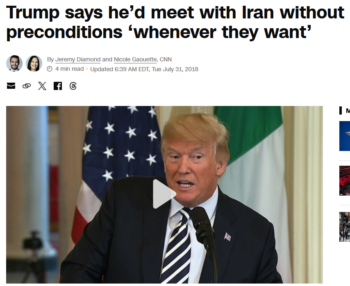
CNN (7/31/18)
JJ: In August of 2018, Trump wasn’t really obscuring that he wants what is blithely referred to as “regime change” in Iran, and media weren’t hiding that either, but that’s not the same as challenging it, as we well know. CounterSpin talked about trying to get off the war path with Trita Parsi, founder and former president of the National Iranian American Council, and now executive vice president of the Quincy Institute for Responsible Statecraft.
Trump, at the time, was saying he was willing to meet with Iranian leadership without preconditions. One week after threat-tweeting the Iranian president with “consequences the likes of which few throughout history have ever suffered before.” CNN called that “an abrupt shift in tone,” even though we know abrupt shifts in tone are Trump’s tone.
They also called the offer of a meeting “an olive branch.” I asked Trita Parsi if that were an appropriate depiction.
***
Trita Parsi: I think it would be quite inaccurate to call it an “olive branch.” At the end of the day, even if one were to accept it to be a genuine offer—and I think that’s a question mark in and of itself—just the offer of having conversations, while the actual policy is to escalate tensions, is to escalate economic pressure, is hardly an olive branch. An olive branch should at least bring forward some element of substance, and there was no such thing in anything that Trump has put on the table thus far.
JJ: Well, because Trump is Trump, there’s room to say, “Maybe he doesn’t really mean it in Iran; maybe it’s a shiny object.” What are the indicators that this administration truly intends, if not war, the sort of capitulation that is the goal of war?
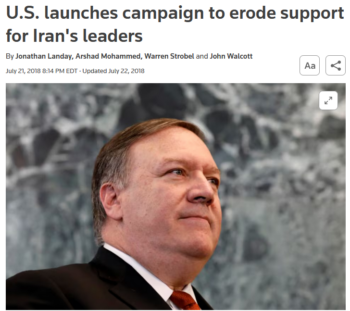
Reuters (7/21/18)
TP: I think the problem is that this administration is not pursuing one foreign policy; it’s pursuing five or six simultaneous foreign policies. So I think there is enough that are out there to be able to say that, “You know what? Perhaps Trump actually is serious.”
He would at least like to have a deal with the Iranians. The idea of him having his name on the deal, and the idea of him being able to say that it was a better deal than that of the previous administration, certainly is attractive to him. But is that consistent with the approach that is being pursued by [national security advisor] John Bolton and by [Secretary of State Mike] Pompeo, etc.?
And the many actual things that are taking place right now, in the manner in which the Trump administration is really undermining the Iranian economy. Reuters has reported that US officials have said that their objective is to foment unrest in Iran, and we are seeing unrest in Iran.
So mindful of the fact that this is an administration that has several simultaneous foreign policies, it makes it very difficult to be able to determine which one is the one that actually counts.
JJ: Right, right. Well, every time I hear that Trump or the United States are deeply concerned, or primarily concerned, with Iran’s mistreatment of its own people, I can’t believe it’s being reported without a laugh track. But you just talked about actual effects inside Iran, even if it sounds like it’s just rhetoric, or it’s just saber-rattling, there are actions here, and they’re having an effect inside Iran. What have been some of the effects within Iran of Trump’s words and actions?
TP: Even from the very moment he came into office, he has been undermining the nuclear deal, and creating so much uncertainty as to whether it would survive or not, that even before he actually pulled out of the deal, he was in violation of the deal, and he was making sure that European and other businesses were either not going into the market, or starting to get out of the Iranian market.
And part of the reason why this is important is because a big part of the nuclear deal was that the Iranians would agree to the restrictions to their nuclear program in return for sanctions relief. Trump was undermining and sabotaging the sanctions relief. In fact, the uncertainty that he injected into the atmosphere was, in and of itself, a de facto sanction.
And that has contributed—it’s not the sole cause, but it certainly has been a major cause—as to why the Iranian economy is doing as badly as it is right now. There is very likely some form of currency manipulation taking place as well, that is causing the Iranian currency to drop at a very fast pace right now.
And these are all part of a policy of pressuring the Iranians in the hope that they will capitulate. I doubt that they will. I don’t see panic in the Iranian government at this point, although the people are really, really suffering from the combination of Trump’s sanctions, the sabotage of the nuclear deal, the Iranian government’s own mismanagement and corruption in the economy, as well as the political repression that has taken place there.
JJ: And then, for people who are interested in supporting civil society, or supporting moderate factions within Iran, what has been the impact, politically, in that sense?
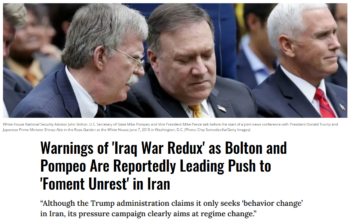
Common Dreams (7/22/18)
TP: If you want to drive things towards a confrontation, or even a regime change policy, one of the first things you will do is to deny that there is such a thing as moderates in Iran. You will make the argument that there is no difference between Rouhani and Ahmadinejad, for instance, which I think is a preposterous statement. But that is exactly the thing that John Bolton and Pompeo have been saying, and I think it’s quite clear that their preference is much more of a confrontation with Iran, whether it’s a military one, or whether it is regime destabilization or regime change, and that Trump is toying with the idea at least, of having some form of a summit with Iran. He seems to have fallen in love with the idea of doing summits.
But these are contradictory policies, and I think it is causing a lot of confusion. In Iran, they don’t know which policy actually is the policy, and whether Trump even is capable of steering this ship, and not be undermined by his own cabinet members.
JJ: On Democracy Now! back in May, you said:
Pompeo and Bolton have made the choice for the international community much, much easier. Either you collaborate with the Trump administration and go along with these sanctions, walk away from this nuclear deal and speed up this march toward war—or you resist.
What does that resistance look like?
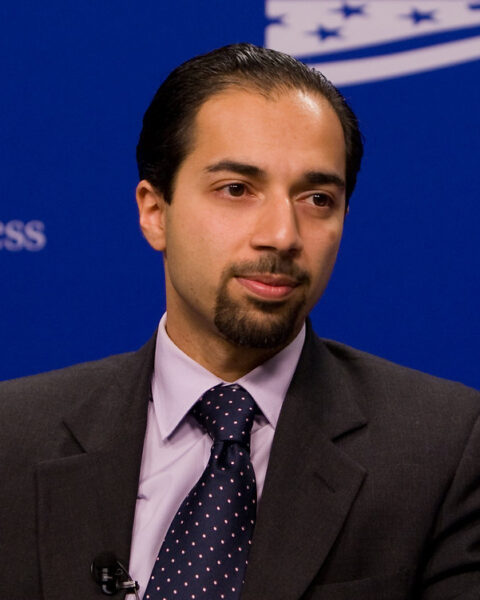
Trita Parsi: “Whatever the Iranians have done to destabilize the region, it does not in any way, shape or form come anywhere near the destabilizing effect that the Iraq War has had.” (image: Center for American Progress)
TP: First of all, I think there needs to be a much stronger of a public, and an international, outcry against the effort of undermining the nuclear deal. Now, key leader Europeans and others have spoken out, they’re trying to do whatever they can to make sure that the deal survives, but I think more should be done, and more is needed to be done. Because at the end of the day, if there is some form of a confrontation between the United States and Iran, that devastating effects will be of a completely different magnitude than the devastating effects of the Iraq War. And we are now, 17 years after the Iraq War, still—17, 16 years—still feeling the very negative repercussions of that, both in the US as well as in the region.
JJ: I fear, as I sort of indicated, that media can, editorially, reject the big picture, the idea of war, even the idea of pulling out of the nuclear agreement—which most major media in this country did oppose that—and still somehow not root out these underlying myths, like Iran’s ceaseless and vigorous pursuit of nuclear weapons for example, which newspapers in this country keep having to run corrections on—they keep asserting it and then having to take it back—or Iran’s unique involvement in regional wars, for example. These things kind of lay there, like tools, waiting to be picked up as long as media don’t really interrogate them to the root.
TP: Absolutely, and I think so. One of them that is very, very common is the idea that the Iranians are the only ones pursuing a policy in the region, that has an interventionist character to it. That clearly describes almost every country in the region. That is not to give the Iranians a pass for what they’re doing, but the singular focus on them actually reveals more of our unwillingness to realize and recognize and tell our public that this is actually a problem that not only is shared by everyone in the region, but the United States itself has actually been playing a significant role in this.
Whatever the Iranians have done to destabilize the region, it does not in any way, shape or form come anywhere near the destabilizing effect that the Iraq War has had on the region as a whole. That is the most destabilizing event of the past 25 years in the Middle East. And that was not Iran, that was the United States.
***
JJ: That was Trita Parsi. Before him, you heard Murtaza Hussain, Vijay Prashad and Cyrus Safdari.
This content originally appeared on FAIR and was authored by Janine Jackson.