
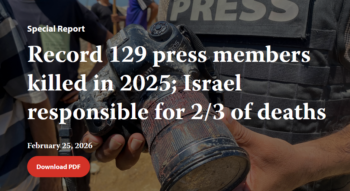
Among CPJ’s key findings (2/25/26): “The Israel Defense Forces (IDF) has committed more targeted killings of journalists than any other government’s military since CPJ began documentation in 1992.”
The Committee to Protect Journalists (CPJ) recently published two meticulous reports that further expose Israel’s violent repression of journalism, in its ongoing genocide in Gaza and elsewhere.
CPJ published a report on February 19 titled ‘‘’We Returned From Hell’: Palestinian Journalists Recount Torture in Israeli Prisons.” CPJ collected 59 in-depth testimonies from Palestinian journalists released from Israeli custody since October 7, 2023.
The report goes into excruciating and painstaking detail about the experiences of 56 journalists, who told CPJ they were “repeatedly beaten inside prisons by authorities, as well as during arrest and transfer to the facilities.”
Less than a week later, CPJ published a report (2/25/26) that found “Israel was responsible for two-thirds of all journalist and media-worker killings in 2025”—86 of the 129 deaths CPJ recorded.
That was an uptick from 2024 (when Israel was responsible for 85 out of 124) and 2023 (78 of 99), CPJ revealed.
Taken together, these reports added more evidence of Israel’s illegal and shameless targeting of the journalists who cover its war crimes.
IDF ‘strongly rejects claims’
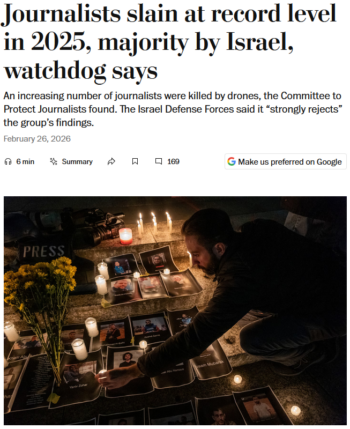
While the Washington Post (2/26/26) noted CPJ’s calling out of Israel in its headline, it made sure to get Israel’s denial into the subhead.
And yet, these reports were met with near silence by US corporate media.
In total, we could find only three mentions of the reports’ criticism of Israel in major US outlets: a three-minute interview with CPJ’s Sara Qudah by NPR (2/20/26), and 1,100-word articles by the Washington Post (2/26/26) and New York Times (3/5/26).
Even then, the Post‘s media reporter, Liam Scott, dutifully included a lengthy rebuttal from the Israel Defense Forces (IDF) in its fifth paragraph:
“The IDF does not intentionally harm journalists or their family members, and on the contrary, operates solely against military targets, in accordance with international law, and employs all possible measures to mitigate harm to civilians, including journalists,” the statement said. “Any claim of intentional harm to civilians—including family members of journalists due to their professional activity—is completely false.”
Scott didn’t attempt to offer any context or counter to this statement, despite the IDF’s long record of lying (FAIR.org, 11/1/24), and Israel’s long history of repeatedly targeting civilians, including journalists in particular, and civilian infrastructure.
To be fair, Scott did later attempt to challenge a couple of Israel’s claims, including by noting that Israel has provided no “substantial evidence” to its claims that “some of the journalists it killed were legitimate targets due to accusations that they were working with Hamas.”
‘Among the worst’
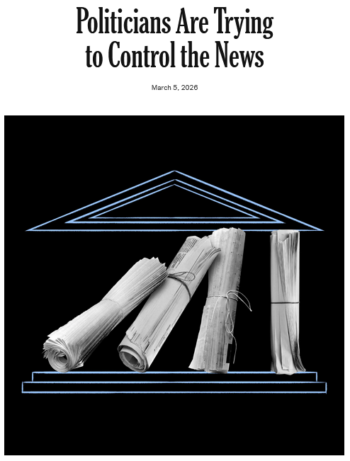
The New York Times (3/5/26) describes Israel as one of the “freer societies” where “the press faces challenges”—despite Israel being labeled an apartheid state by major human rights groups.
The New York Times editorial board (3/5/26), meanwhile, included only two mentions of Israel in its article on how “Politicians Are Trying to Control the News.”
The Times wrote that Israel is “among the worst offenders against press freedom,” but included Israel sixth on its list, behind China, Russia, Egypt, Ethiopia and Iran—despite the fact that 204 more journalists were killed in connection with their work in Israel and occupied Palestine in 2023, 2024 and 2025 than in all those countries combined.
In the ninth paragraph, the Times added:
Israel’s war in Gaza led to the arrest of almost 100 Palestinian journalists, often without charge, and at least twice that number were killed over two years, a toll without modern precedent.
The Times’ tallies were correct, but vastly understated. Israel’s killing of journalists since October 7, 2023, is not just “without modern precedent.” Indeed, as journalist Nick Turse noted in an April 2025 paper for Brown University’s Costs of War, it is more than the
US Civil War, World Wars I and II, the Korean War, the Vietnam War (including the conflicts in Cambodia and Laos), the wars in Yugoslavia in the 1990s and 2000s, and the post-9/11 war in Afghanistan, combined.
The Los Angeles Times (3/11/26) published an emotional opinion article from Colombian-American photographer Juan Arredondo about how “Journalists Risk Everything Because the Work Is So Important.” The article briefly referenced CPJ’s recent report of the 129 journalists killed in 2025, but contained no reference to the country responsible for two-thirds of the killing, instead centering the “400 journalists and media workers” killed worldwide since “the start of the Russia/Ukraine war.”
Independent US news outlets have covered the CPJ reports (Democracy Now!, 2/26/26, 2/26/26; Common Dreams, 2/26/26), as have overseas English-language alternative news outlets (Morning Star, 2/19/26; Canary, 2/21/26; Business Recorder, 2/20/26; Saba, 2/19/26; Middle East Eye, 2/19/26; Cradle, 2/25/26), foreign corporate news outlets (Guardian, 2/19/26, 2/25/26; Reuters, 2/25/26; Al Jazeera, 2/25/26) and even Israeli news outlets (Times of Israel, 2/19/26, 2/26/26; Haaretz, 2/25/26; Jerusalem Post, 2/26/26).
Electroshock, pepper spray between beatings
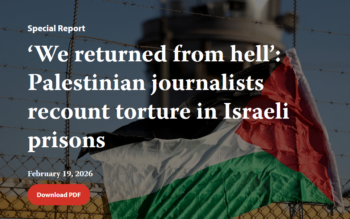
Interviewing 59 journalists released from Israeli prisons, CPJ (2/19/26) found ” strikingly consistent” accounts of “physical assaults, forced stress positions, sensory deprivation, sexual violence and medical neglect.”
The CPJ reports didn’t only provide surface-level statistics; they painted a portrait of persistence and bravery in the face of repeated attempts to silence and punish these journalists and their families.
The first CPJ report—over 3,000-words—included more than a dozen detailed testimonials from Palestinian journalists who faced horrific abuse from their Israeli captors:
- A Palestinian journalist, Ahmed Abdel Aal, was blindfolded in an Israeli detention site, stripped and beaten, while loud music played at an unrelenting volume.
- A journalist said that soldiers “bound his genitals with zip ties and beat him until the injuries made it impossible to urinate without blood.”
- A West Bank journalist, Mustafa Khawaja, said a beating in Shatta Prison caused “fractured ribs, meniscus tears and spinal injuries later diagnosed as herniated discs.”
- “Gazan journalists Islam Ahmed and Osama al-Sayed recounted the intermittent use of electroshocking and pepper spray between beatings”—a punishment that took place shortly after a visit by Itamar Ben-Gvir, Israel’s national security minister.
- A journalist imprisoned at Ofer Prison, Mohammad al-Atrash, recounted a “mass punishment involving dozens of prisoners” called a “Ben-Gvir party” or a “Shin Bet party” (after Israel’s secret police).
- “Al-Atrash stated that trained dogs were ordered to attack the detainees, and metal instruments were used to create long-lasting bleeding and scars.”
- Journalist Mohammed Nafez Qaoud said “repeated beatings during intake left deep wounds on his feet,” which became infected with “worms feeding on them.”
- Journalist Thaer Fakhoury said he “sustained a severe eye injury during beatings in Etzion and Ofer detention facilities, resulting in temporary loss of vision for about 20 days.”
- Journalist Abdul Mohsen Shalaldeh said he was “burned by lit cigarettes extinguished on his bare body.”
- “Journalist Yousef Sharaf said wounds from repeated beatings became infected in the poor sanitary conditions of the prisons, forming abscesses across his body. He said that after going without medical care from prison authorities, another detainee, Dr. Nahed Abu Taima, an imprisoned surgeon from Nasser Medical Complex, performed improvised procedures using what detainees believed was cleaning bleach.”
The second CPJ report, meanwhile, highlighted the journalists targeted by Israel for covering Israel’s war crimes, including Hossam Shabat, the 23-year-old Palestinian correspondent for Al Jazeera and Drop Site News. The Israeli military struck and killed Shabat on March 24, 2025, near the Indonesian hospital in the northern Gaza strip (FAIR.org, 3/26/25).
CPJ noted that Israel has “repeatedly killed journalists whom it subsequently—and in some cases preemptively—alleged were militants, without providing credible evidence to support its claims.” It cited Al Jazeera reporter Anas al-Sharif, who was murdered by Israel in August 2025 in a strike on a media tent. The other journalists killed in the strike were Mohammed Qraiqea, Mohamed Nofal, Ibrahim Thaher, Moamen Aliwa and Mohammad al-Khaldi.
Manufacturing consent for journalists’ killings
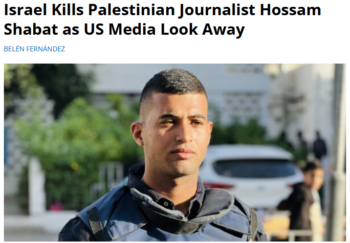
Belén Fernández (FAIR.org, 3/26/25) pointed out a year ago that “the International Federation of Journalists estimates that Israel has killed one out of every ten” journalists in Gaza.
As FAIR contributor Belén Fernández (3/26/25) noted at the time, Shabat’s death was covered in major international outlets and independent US outlets, but nearly no establishment US news organizations. She wrote:
The otherwise deafening silence has been punctuated by just a couple of corporate media interventions, including a Washington Post report (3/25/25) that made sure to mention in the first paragraph that Israel had accused Shabat of Hamas membership.
FAIR contributor Emma Lucia Llano (8/22/25) noted that establishment media used the murders of al-Sharif and the other journalists “as an opportunity to continue parroting the same Zionist talking points that contributed to manufacturing consent for their killings.” Llano wrote that FAIR looked at 15 different news outlets’ initial coverage of the murders, and found
they overwhelmingly centered Israel’s narrative, attempted to delegitimize pro-Palestinian sources, and failed to contextualize the killings within the larger context of the genocide.
By not covering these recent CPJ reports, US corporate media are continuing to manufacture consent for Israel’s systemic targeting of journalists.
Israel’s ‘surprising’ repression of journalists
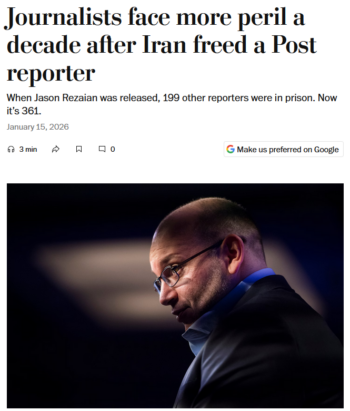
Even as Israel kills, tortures and imprisons scores of journalists, the Washington Post (1/15/26) describes it as “the most vibrant democracy in the Middle East” which could “demonstrate a commitment to transparency” by allowing foreign journalists in Gaza.
It’s far from the first time US news outlets have ignored CPJ reports that cast Israel in a highly unflattering light. CPJ has long published reports that detail abuses by Israel against journalists—and US corporate news outlets have repeatedly failed to adequately cover these significant findings.
Consider a CPJ report released in January 2026 that showed Israel was the third-worst jailer of journalists in the world in 2025—just edged out (by Myanmar) from the No. 2 spot it held in 2024. This CPJ report was met with complete silence in US corporate media.
Just five days prior to its publication, the Washington Post editorial board (1/15/26) published a piece on the state of global press freedom. It cited CPJ’s 2024 data in an editorial marking the tenth anniversary of the release of then—Post Tehran bureau chief Jason Rezaian, who had been imprisoned by Iran for 544 days. The Post used the anniversary to highlight the deterioration of press freedom around the world, noting that “Iran today remains one of the world’s most prolific jailers of journalists and odious practitioners of hostage diplomacy.”
Iran does have a history of jailing journalists, though it ranked No. 8 on the CPJ’s list that year, jailing 16. A few paragraphs later, the piece noted other countries named by the CPJ report: “In addition to Iran, the worst offenders largely remain the usual suspects: China, Russia, Vietnam, Azerbaijan, Eritrea.”
The next paragraph discussed Venezuela (not even a top 10 jailer) and Myanmar.
Finally, six paragraphs in, the Post acknowledged:
Surprisingly, Israel moved to second place on CPJ’s list after jailing more than 40 Palestinians who identify as journalists in Gaza and the West Bank, though the Israelis claim many were secretly working with Hamas. It’s important for the most vibrant democracy in the Middle East to differentiate critical reporting from supporting terrorism. Due process for journalists accused of crimes is essential. Another way for Israel to demonstrate a commitment to transparency is to allow international media unfettered access into Gaza, which it continues to block.
The only way anyone could be surprised that “the most vibrant democracy in the Middle East” has started prolifically jailing Palestinian journalists is if they have been willfully turning a blind eye to its broad assault on journalists and journalism.
Press abuse covered elsewhere
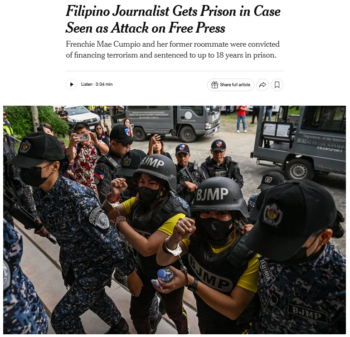
When reporting on the suppression of journalism in the Philippines, the New York Times (1/22/26) does not take seriously phony accusations that journalists are secretly terrorists.
The lack of US corporate media coverage of the Israel-focused CPJ reports sharply contrasts with its attention to individual stories of journalistic crackdown across the world.
Just this year, readers of US corporate media could find the stories of four journalists detained in Cameroon while reporting on Trump’s deportations (Washington Post, 2/19/26), a Filipino reporter convicted of dubious terror charges (New York Times, 1/22/26), the alleged murder by a Mexican cartel member of a journalist chronicling cartel violence (LA Times, 1/7/26) and the 20-year jail sentencing of Chinese dissident and newspaper founder Jimmy Lai (New York Times, 2/27/26, 2/9/26).
These stories are newsworthy in that they represent the worldwide degradation of press protection, primarily due to rising authoritarianism, increased physical attacks on journalists and legal intimidation.
However, by continuously ignoring reports on Israel’s targeting of (largely Palestinian) journalists, it’s clear that US corporate media believe some attacks on press freedom are more newsworthy than others, based on who is being targeted and who is doing the targeting.
This content originally appeared on FAIR and was authored by Drew Favakeh.