
Janine Jackson interviewed American Prospect‘s John Lewis writing fellow Naomi Bethune about anti-Black history for the February 27, 2026, episode of CounterSpin. This is a lightly edited transcript.
AP (via KTVB, 1/30/26)
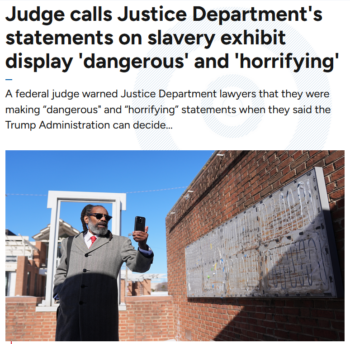
Janine Jackson: A US district judge pushed back on Justice Department lawyers who were defending removing historical exhibits about slavery from Philadelphia’s Independence Mall. Assistant US Attorney Gregory in den Berken had argued that, “The government gets to choose the message it wants to convey,” and that that justifies the sudden removal of six exhibits and 13 items in late January that addressed, specifically, nine people George Washington enslaved while living in Philadelphia.
Judge Cynthia Rufe, a George W. Bush appointee, had strong words for that, saying:
That is a dangerous statement you are making. It is horrifying to listen to. It changes on the whims of someone in charge? I’m sorry, that is not what we elected anybody for.
How history is told has, of course, always been disputed. But somehow, as on so many things, the Trump White House has managed to shock people who just assumed there was some kind of understanding about what people in power are permitted to do.
And how boldly they are allowed to declare and act on an idea that many of us, particularly Black people, have long understood: that rather than face up to the ugliness and violence of white supremacy in this country’s past and present, rather than see it as a scourge we can work together to overcome, they insist we pretend racism didn’t and doesn’t exist, and anyone who says it does hates white people.
American Prospect (2/23/26)
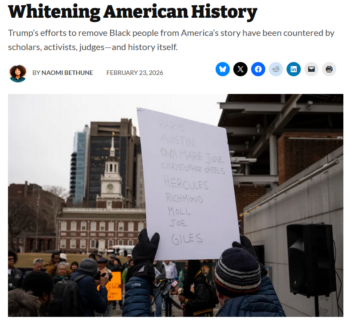
It’s deep, and yet it’s not that deep. Our guest tracks these critical issues. Naomi Bethune is John Lewis Writing Fellow at the American Prospect, where you can find her most recent piece, “Whitening American History.” She joins us now by phone from Washington, DC. Welcome to CounterSpin, Naomi Bethune.
Naomi Bethune: Thank you for having me on.
JJ: Let’s start, if it’s OK, with the Philadelphia President’s House Site, which seems to have captured some interest. We want to be clear, it’s not the only example of this attempt at historical erasure. But tell us what went on there. It sounds like the word came down, and things were disappeared within an hour.
NB: Yeah, it was very sudden and very strange. No one really knew it was going to happen. There was no notice. People who were visiting the President’s House Site, people who were walking by, saw National Park Service employees coming and taking down exhibits that detailed the lives of and the conditions that the people who George Washington enslaved experienced while living at the President’s House Site. That was on January 22. And one National Park Service employee said, “I’m just following orders” when asked why he was doing this.
So, naturally, the city of Philadelphia sued the Department of Interior and the National Park Service, arguing that the federal government had actually violated a cooperative agreement for the site’s development, because it’s kind of a joint project between the federal government and the local city government.
New York Times (2/16/26)
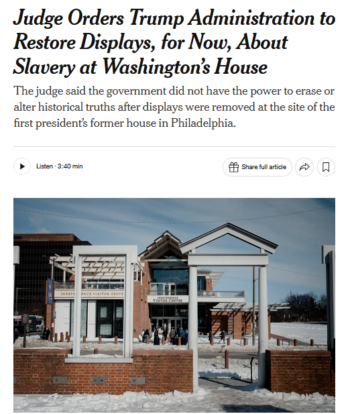
And about a month later, the judge who was presiding over the case, US District Judge Cynthia Rufe, like you said, ruled against the Trump administration. And in her ruling, she very cleverly cited and referenced George Orwell’s 1984. And she compared what the Trump administration is doing now, with this very public display of attempting to physically erase the dark parts of America’s history, to the Ministry of Truth in 1984. And she ruled that the federal government does not have the power or the right to dissemble historical truths and distort true historical facts.
And it was a very powerful ruling. I recommend that anyone listening reads it. I think it’s very strong, and has a lot of great context. But I think the major takeaway that I think we should understand from it, and Rufe says this very plainly, is that “each person who visits the President’s House and does not learn of the realities of founding-era slavery receives a false account of this country’s history.”
And I think that is applicable to any of the exhibits, the museums, the attacks on education that we’re seeing right now under the Trump administration. If we erase Black history, we’re not getting a full account of this country’s history. In fact, we’re getting a false account, like she said. So, yeah, it was very powerful, and now the panel, the exhibit, has actually been restored in Philadelphia.
JJ: And that’s important. And let me just underscore: not a partial understanding of history, a false understanding of history, right?
The latest, I understand, is that the Trump administration, pushing back on this ruling, is saying, “Hey, but you know what? We were just about to update these materials with a ‘fuller account of the history of slavery.’” I mean, pull the other one. Obviously, what were we to be looking forward to, with the Trump administration’s…. What do you make of that claim, just period?
NB: I did reach out to the Department of Interior, National Park Service, and I never received a response, asking what exactly the new exhibit would look like, what it would cover, and how different it would be from the original exhibit, which I believe a lot of people think did a good job of describing the lives and humanizing the people who George Washington, and the presidents who followed him, enslaved at that site.
And we still don’t know. To my knowledge, the federal government has not released any information on what their plans are, but like you said, they have appealed. So it’ll be interesting to see what comes next.
And I think it’s also just evidence that this isn’t a one-off thing. There is a push to keep moving forward in reframing and sanitizing Black history in this country. And this is just one instance that I highlighted in my story. There’s dozens of other situations we’ve seen over the past year that are similar. Some have failed, some have succeeded. I think this was a win, at least temporarily, but what’s to come is up in the air.
JJ: Yeah. And folks may know about the erasure of, for example, Black US veterans from government websites about various wars, and the attempt to erase Black military heroes from various exhibits, and to take down things in national parks that talk about the role of Black and brown people anywhere. So, yeah, you lift up this example, and it’s an important one, but it certainly is not the only one.
Naomi Bethune: “Right now is the exact moment that we should be looking back on the conditions that marginalized people experienced at this country’s formal conception.”
NB: Exactly. Yeah. And there’s been a lot of very small things, that maybe we wouldn’t necessarily see as a massive, impactful example of how the Trump administration is carrying out the executive order “Restoring Truth and Sanity in American History.” There’s another executive order which is similar, detailing how education needs to be reframed.
And the whole concept here, I think, the goal of the Trump administration, is saying that these very difficult, horrific parts of American history–that often have to do with the oppression of Black people, of Indigenous people, immigrants, all marginalized groups–are not appropriate; they paint a negative picture of the United States, and because of that, they should be eliminated.
One significant, smaller way that the Trump administration has been doing this is, in April, the Trump administration cut federal grants to the Whitney Plantation, which was a site that preserved a plantation where Black people were enslaved, and the site lost thousands of dollars to keep up with showing the site as a museum, and displaying how Black people were enslaved there. So there’s smaller instances like that that have happened, and they’ve all compiled in the build-up to this year, 2026, which is the 250th anniversary of the signing of the Declaration of Independence.
So the initiative’s called America250, and that’s something I really focused on in my story, because I think that right now is the exact moment that we should be looking back on the conditions that marginalized people experienced at this country’s formal conception, and how that should be a part of, and those stories should be highlighted this year in particular, as the government moves forward with celebrating all that this country has accomplished over the past 250 years.
History (3/6/18)
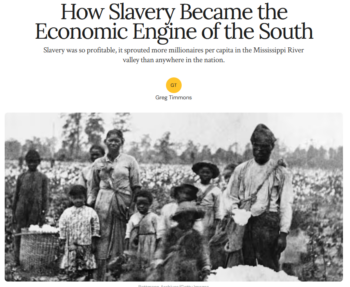
And some of those things are difficult. Some of the things that have happened in the United States are a result of unappreciated and erased labor by people of color. Many of our achievements have been pushed forward by marginalized groups who never received credit. The physical labor of enslaved Black people, of Indigenous people, physically built this country and forged our economy, made the United States, into this global powerhouse that it is today.
And pre-Trump administration, too, America250 had a vision of including those stories, taking a multiracial and multi-generational approach to looking back at 250 years of American history. But now the focus has shifted to the founders of this country. And with that focus shifting, there isn’t much talk about how the Founders themselves were problematic.
So I try to get at that in my piece, where it’s good we’re recognizing how this country came to be, but it’s also very, I think, cruel and dismissive to ignore what the Founders did, how they enslaved people, what they thought of women, of other marginalized groups, and how that was at the core of America’s founding 250 years ago.
So I think, in my story, that was the framing, and America250 is the catalyst for a lot of these ramping attacks we’re seeing right now on Black history, in schools, in museums, in parks, in the workplace. So it was really my goal to highlight all those things at this particular time.
JJ: Absolutely. It’s infantilizing, among many things, because of course many people, including white people, are capable of understanding the actual history of this country, and are capable of grappling with it going forward.
And it’s also such a competition of visions because, again, for many people, the United States means this terrible beginning, and the effort to build a democracy out of that, and to expand human rights, and rights in general, political rights, to more and more people. And for many people, that’s what they think America is.
So it’s a competition of visions. And I want to say, I appreciate the subhead on your February 23 piece, which is “Trump’s efforts to remove Black people from America’s story have been countered by scholars, activists, judges and history itself.” Because, even if we don’t read about it, as you report on, many of these aggressions are being countered. People aren’t sleeping on it, and it’s wrong to imply that they are.
NB: Yeah. There’s a resistance, and that’s because there always have been very widespread efforts to fight, to make sure Black history, Black culture, Black people’s contributions to the America we know today are recognized in every single part of our society. And I think one thing we need to recognize is that Black studies in college, or learning about Black history when you’re in elementary school or high school, or being able to go to the National Museum of African-American History and Culture, that’s all very new, like relatively new.
And people in every single area of advocacy and education and the courts recognize that, and recognize it as something that’s fragile and worth protecting because, one thing I believe, and many people believe, is that at this point, many Americans understand Black history as American history. Even though the Trump administration is really trying to scrub Black history from every corner of our lives and the society we live in, they’re always going to face roadblocks, because people know how long it took to fight to get to where we are today.
And that was something that I felt really heartening about writing the piece, is that everyone I spoke to was very certain that it would be a very hard initiative for the Trump administration to keep carrying out. And we’ve seen, like I said, some really great wins when pressure is put forth. Sometimes things are dropped, they’re changed, they’re reverted.
And I think another part of it, which is pivotal to the whole situation, is understanding that no one should really be surprised right now that this is happening. It’s not new. I mean, to the Black community, this has never been new, right? Maybe the Trump administration’s being more aggressive, maybe they’re making more of a point of it. Maybe the racism of it all is more blatant; but it’s not new, it’s not unfamiliar to Black people, to brown people, to other people from marginalized communities.
And I think that’s why there’s been such a strong and swift response to these attacks, because, unfortunately, advocates in the Black community recognize and know when and how to fight against attempts to repress Black history, dismiss Black cultural contributions, etc. So I think that cannot be wiped away, I guess, by the Trump administration’s efforts. That will continue to exist.
American Prospect (2/2/26)
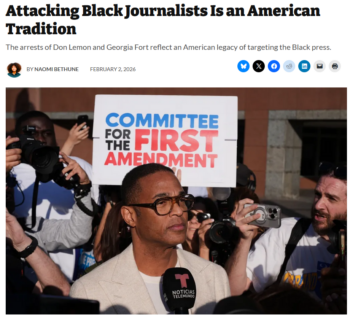
JJ: Let me ask you, also–it seems like a pivot, but it’s not: A very related piece you wrote earlier this month was about attacks on Black journalists themselves as also part of an American tradition. I know you can’t talk all about it in the time we have, but you’re talking about something there that also connects past to present, and also is about how folks want to shut up the storytellers who are telling the history of our communities.
NB: Yeah. Ida B. Wells and other pioneering Black journalists, their realities were defined by people who were racist, who did not want to see them report on the struggles that the Black community was facing, and build progress within the Black community, especially post-Emancipation. And I think that a lot of times, those were not governmental groups who were doing these attacks, but it doesn’t seem dissimilar to what’s happening now.
The courts have never been weaponized against journalists in the way that they’re weaponized against Don Lemon and Georgia Fort. Very rarely, I don’t think I can think of an instance, ever, where a journalist was arrested for reporting, because the First Amendment has always been very strictly adhered to by the Department of Justice. I mean, sometimes journalists are called to testify or they’re subpoenaed, but never arrested.
And I thought it was very telling and interesting that the first journalist to be publicly arrested and charged with the FACE Act, marked as people who betrayed or violated the civil rights of others, were Black people. Were independent journalists, too. That’s another, I think, factor there. They’re more vulnerable than journalists who work for organizations, especially larger ones.
CNN (9/8/25)
And it just struck me as a pattern. Like I said, it’s not new, maybe it’s showing up differently, but it reminds me of a little phrase that just popped back in my head when I report about issues related to the Black community: When white America has a cold, Black America has pneumonia. Or maybe Black America has been sick for a very long time.
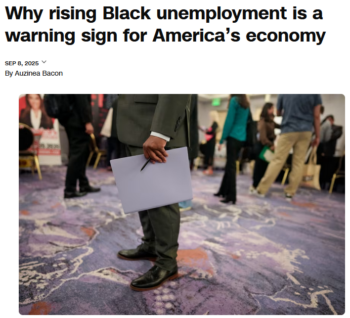
And it’s just true of everything that’s happening right now. I think that the recognition is that, if Black people are being targeted first, or if unemployment is spiking amongst Black people first, that is often a recession indicator, for example.
So if Black journalists are the first ones to be arrested, to be charged with violating civil rights of others, who’s next? How much worse can it get? Black Americans have been so vulnerable and so resilient, but I think that, like I said, it should not come as a surprise that Black people are the first to be targeted by the Trump administration.
But I think the part of it that is very positive, and I guess hopeful, is that people, like I said, are fighting back, and there are people with their finger on buttons that control every part of the courts, of governance, that are on the side of protecting Black history, Black people, and professional Black people who are reporting and doing really tough work that’s necessary right now.
So I think that we can equally be concerned, and also feel proud and strong in this moment. And I really wanted to drive that point home that it’s not new, but because it isn’t new, that means we know what to do about it.
NPR (2/21/26)
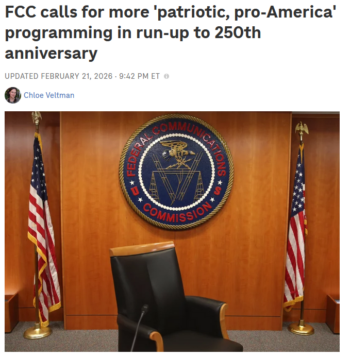
JJ: I want to thank you for that, in particular, but if you have any final thoughts, because, as you’ve noted, this America250, we’re going to see media all over this. They’re going to talk about it. They’re going to cover it. We’ve seen the head of the FCC come out and say, “Hey, this is an opportunity for you to do a whole lot of pro-America stuff.” And we know what that means from Brendan Carr.
But everything we’ve talked about has made it clear that we need to talk around and without mainstream media; we need to have other conversations. And so maybe this whole America250 can be an opportunity to further that conversation, as you’ve described.
NB: I agree. And if the federal government is attempting to change things, erase stories of people who have really contributed to the successes of this country, who have made this country into the diverse place that it is today, who have made so many sacrifices, who have been subjected to horrible oppression can’t be recognized, I just don’t think that we are understanding the importance of America250.
And it’s my hope that people outside of the Trump administration, outside of Trump’s allies, really push forward with a counter-narrative to the one that the Trump administration’s putting out, one is that is inclusive of true American history, which is Black history, it’s Indigenous history, it’s LGBTQ history, it’s the history of women. And those voices can’t and won’t be silenced this year, because we really can’t understand this country without understanding America’s most marginalized groups. So it’s my hope that people keep pushing, and take this as an opportunity to explore and promote stories that are being erased.
JJ: We’ve been speaking with Naomi Bethune. She’s John Lewis Writing Fellow at the American Prospect. You can find the pieces we’ve been talking about at their website, Prospect.org. Naomi Bethune, thank you so much for joining us this week on CounterSpin.
NB: Thank you.
This content originally appeared on FAIR and was authored by Janine Jackson.