
People who study domestic violence have an acronym, DARVO, for the set of tactics abusers use to avoid accountability: Deny, Attack, and Reverse Victim and Offender.
It’s that last tactic that came to mind while reading news reports of the United States and Israel’s unprovoked and illegal attack on Iran, and the assassination of Ali Khamenei, its leader. US corporate media frequently presented Iran as responsible for the predictably violent consequences of the US/Israeli aggression.
Sometimes the reversal is straightforward, as when an NBC News “analysis” (2/28/26) warned that “Iran’s Retaliatory Strikes Threaten an Escalation Across the Region”—as though it is Iran’s response, and not the ongoing attacks by the US and Israel, that poses a threat to the region.
‘Pretty much all its neighbors’
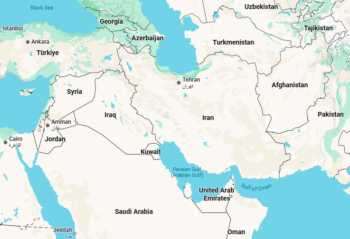
Iran and its many neighbors (Google Maps).
Another NBC analysis (2/28/26), by Richard Engel, more subtly tried to pin the blame on Iran, noting in the headline that “Iran Is Now in Conflict With Pretty Much All of Its Neighbors.” Wrote Engel:
Today Iran has launched drones and missiles not only at Israel, but also at US military installations in Bahrain, Kuwait, Qatar, Jordan, the United Arab Emirates and Iraq…. It puts Iran in a difficult position, because now it is at conflict with pretty much all of its neighbors.
Pretty much all of its neighbors, that is, except for Turkiye, Armenia, Turkmenistan, Afghanistan and Pakistan. (Azerbaijan said Iranian drones crashed in its territory on Thursday; Iran denies targeting the country.) And if we’re going to count Jordan as Iran’s “neighbor,” then Georgia, Kazakhstan, Uzbekistan and Tajikistan as well. Aside from those, though, pretty much all of them.
The point of depicting Iran as “in conflict” with “pretty much all of its neighbors,” of course, is to paint it as the country that no one can get along with. In reality, the countries Iran isn’t getting along with are the ones allowing the US to use them as platforms for launching bombs and missiles at it—behavior that will put a damper on any relationship.
‘Good reason to be worried’

USA Today (3/1/26) reports that “Sec. Pete Hegseth Reveals Trump Assassination Plot”—not “Hegseth Alleges,” because Hegseth wouldn’t say it if it weren’t true.
USA Today (3/1/26) told its American readers that they were the ones who should be worried as their government carried out continuous airstrikes against Iran, “due to Iran’s long history of plotting retaliatory attacks.”
“The FBI and the Department of Homeland Security have both announced they are on war footing,” domestic security correspondent Josh Meyer wrote. “And…veteran Iran watchers said there is good reason for them to be worried.”
Why is that? “The Iranian regime has a long history—dating back at least 46 years—of assassinations and other terrorist plots on US soil and against Americans overseas.” The article mentions exactly one instance of alleged Iranian violence on US soil—a former aide to Shah Reza Pahlavi who was killed in Bethesda, Maryland, 46 years ago. The rest are all “plots” that were “disrupted”—and that we should take the FBI and Department of Homeland Security’s word for. (FBI chief Kash Patel, DHS Secretary Kristi Noem and former national security advisor John Bolton are all offered with a straight face as experts on security threats.)
Meyer quotes DHS on “the likelihood of violent extremists in the Homeland independently mobilizing to violence.” And he notes the Department’s warning “that terror plots weren’t the only concern”: Cyberattacks “by pro-Iranian hacktivists are likely” as well.
‘Abandoned by their leaders’

The New York Times (2/28/26) seemed to blame Iran’s government—and not the Times‘ own government’s unprovoked attacks—for the fact that “highways leading out of [Tehran] were backed up for miles,” and “online access was severely disrupted across Iran.”
government provided little guidance to its millions of citizens about what to do and where to go for safety…. State television said little about how to stay safe from the bombs.
Perhaps in the news-you-can-use spirit, the New York Times could give readers some tips on how one can “stay safe” from cruise missiles and the 2,000-pound bombs Trump has provided to Israel.
This content originally appeared on FAIR and was authored by Jim Naureckas.