
REVIEW: Jubi Media
Yasinta Moiwend was startled when, on a quiet morning, a massive ship docked at her village pier in West Papua.
The vessel carried hundreds of excavators and was escorted by military forces. It was the first convoy of 2000 heavy machines to arrive in Papua under a National Strategic Project for food production, palm-based biodiesel, and sugarcane bioethanol.
Yasinta, a Marind Anim woman in Merauke, never realised that her village had been chosen as the ground zero for what would become the largest forest conversion project in modern history — turning 2.5 million ha of tropical forest into industrial plantations under the guise of “food security” and the “energy transition”.
- READ MORE: West Papuan filmmakers expose Merauke rainforest destruction in ‘siege’ doco
- West Papua Solidarity Forum, 7-8 March 2026
- Kōrero with Victor Mambor – West Papua: Journalism as Resistance, 9 March 2026
Vincen Kwipalo, from the Yei community, was also shocked when his clan’s land was suddenly marked with a sign reading: “Property of the Indonesian Army.”
Only later did he learn that the land had been seized for the construction of a military battalion headquarters, at the very moment when sugarcane, a plantation company, was also encroaching on his ancestral forest.
Threatened by the same project, Franky Woro and the Awyu community in Boven Digoel erected giant crosses and indigenous ritual markers on their land. Known as the Red Cross Movement, this form of resistance has spread among Indigenous groups across South Papua.
More than 1800 red crosses have been planted to confront corporations and the military—both physically and spiritually. Though a Christian symbol is central to the movement, local Church prelates condemned it as not part of the church.
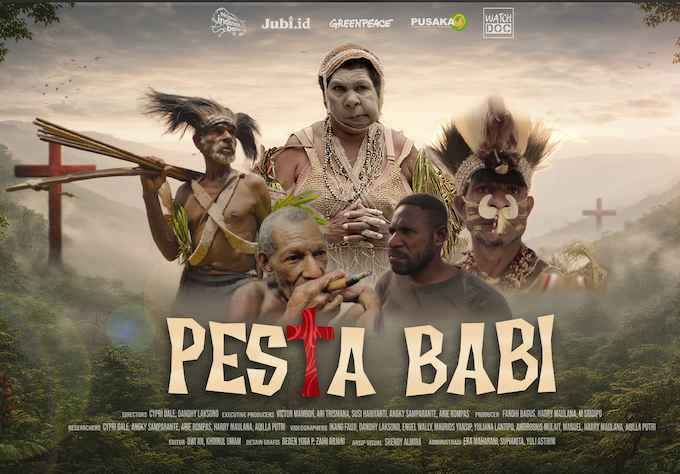
The Pesta Babi trailer. Video: Jubi Media at Café Pacific
Pesta Babi (“Pig Feast”) combines detailed field recordings with in-depth research to examine the power structures behind the operation.
It exposes how government and corporate entities — collaborating with military and religious groups — advance international and national goals of “food security” and “energy transition” at the expense of Indigenous communities and landscapes.
The documentary illustrates the networks of Indonesian elites, oligarchs, and multinational corporations that benefit from the project, providing a vivid depiction of the political ecology of Indonesian governance in Papua.
Pig Feast serves as a record of colonialism that remains intact today.
This film is co-produced by Jubi, Ekspedisi Indonesia Baru, Greenpeace, Yayasan Pusaka, and Watchdoc Documentary. It is being screened as part of a weekend of West Papua Solidarity Forum events organised by West Papua Action Tāmaki Makaurau.
- Pesta Babi (“Pig Feast”) — Colonialism In Our Time, directed by Cypri Dale and Dandhy Laksono and produced by Jubi Media and collaborators. Investigative documentary (90min).
- Book tickets for the “Sinéma Merdeka: Stories from West Papua” event here
This content originally appeared on Asia Pacific Report and was authored by Pacific Media Watch.