
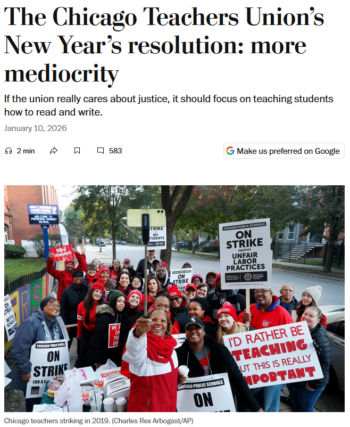
The Washington Post warns that CTU “president Stacy Davis Gates will be able to spread her radical agenda across the state after being elected to lead the Illinois Federation of Teachers.” The link goes to a right-wing site that identifies that “radical agenda” as “issues such as racial justice, climate justice and immigration.”
The Washington Post editorial “The Chicago Teachers Union’s New Year’s Resolution: More Mediocrity” (1/10/26) is the latest in a string of opinion pieces from both the Post and Wall Street Journal attacking the Chicago Teachers Union (CTU), amid historic victories for teachers and school staff. The opinion pages of these billionaire-owned media outlets have consistently relied on cherry-picked test scores to obscure union successes, and framed teachers’ advocacy for their students and communities as self-serving.
The Post opened by mocking a CTU New Year’s resolution, shared on X (1/5/26), that promised to “speak truth to power” by
defending Black and brown and immigrant communities who are targeted by federal agents…[and] fighting back against an administration trying to dismantle the US Department of Education and roll back civil rights protections.
The Post called these “lofty goals in a school district that can hardly teach kids to read and write.”
‘Allergic to excellence’
Using highly selective evidence to feign concern for Chicago’s students, the anonymous Washington Post editors gleefully bashed the union and its Black leader:
Failure seems to be the gold standard for this union, and now its president Stacy Davis Gates will be able to spread her radical agenda across the state after being elected to lead the Illinois Federation of Teachers.
The words “radical agenda” link to the right-wing, anti-union Illinois Policy Institute (IPI), which has deep financial ties to Republican megadonors aligned with the Trump administration. IPI warns readers that the union’s concerns include social justice issues like police-free schools and electric school buses.
The Post went on to describe Davis Gates as “allergic to accountability and excellence.”
The paper’s mockery ignored the very real safety concerns in Chicago schools from increased ICE activity as a result of Operation Midway Blitz, a campaign CTU has been preparing for since the first Trump administration. The ICE campaign disrupted schooling, leading to lower attendance rates among students in Latino and immigrant enclaves, students being detained on their way to school, parents being abducted waiting for their kids, and the fatal shooting of a father dropping off his child at daycare.
‘Students’ best interests at heart’
George Will (Washington Post, 8/16/24) says Chicago’s government has inflicted “destruction more comprehensive, deadly and intractable” than that of the Great Chicago Fire.
While the Washington Post raged about radical agendas, it turned a blind eye to the Trump administration’s proposed cuts of up to $12 billion for the department responsible for 50 million K–12 students. Federal government funding to public education is critical for protecting vulnerable students’ civil rights, particularly impoverished and disabled students.
To the Post, all that matters is test scores—as if student achievement isn’t seriously impacted by the safety, mental health, funding and discrimination concerns highlighted by the CTU. The editors pointed to metrics showing only 43% of Chicago students in grades 3–8 read at grade level, while 27% are proficient in math, as evidence that the union doesn’t “have the students’ best interests at heart.”
Pointing at test scores is a common tactic among anti-union groups like IPI and their media proponents. Post columnist George Will (8/16/24), in a column replete with stats and anecdotes from IPI, highlighted declines in test scores, again singling out Black students, while warning about Chicago’s “government of, by and for government employee unions.”
Framing CTU as responsible for Chicago’s broader struggles, Will pivoted to claims that “crime has soared, and public services have withered,” as a result of “almost half the city budget [going] to debt service and government employees’ pensions.” He leaves unsubstantiated his assertion that funding public education is responsible for crime and deteriorating public services, perhaps because data indicates the opposite is true. (The homicide rate in Chicago in 2024 was 28% lower than it had been three years earlier.)
Omitting clear success
Although standardized testing is a poor indicator of teacher performance, the data presented by the Washington Post editorial omitted clear successes: Chicago Public Schools (CPS) ranked first among large districts in post-pandemic reading gains, and in the top third in math gains. CPS data also show that Black students posted a 6% increase in English Language Arts proficiency, outpacing national trends.
The improvements of Black students did not make it into the Post’s editorial; rather, it shared that “Black students in third through eighth grade score 33% lower on reading than white students, and low-income students score 32% lower than the rest.” Of course, the kinds of gaps that the Post presented are not exclusive to CPS—nor attributable to union selfishness—but represent nationwide trends that show family income, parental education and socioeconomic factors as the best predictors of achievement gaps among students.
The Post warned that “fundamental deficits haunt kids into high school,” but the “deficits” don’t seem to be as detrimental as they want you to believe. CPS’s partnership with University of Illinois at Chicago has increased early college enrollment of CPS students by 62%, with 2024 CPS graduates now beating the national average in college enrollment, at 66%.
‘Bargaining for the common good’
Jacobin (9/10/22): “The union challenged the accepted truths of corporate education reform, built deep ties with community members, and empowered educators across the city and nation.”
Attacks on CTU from corporate media are nothing new (Extra!, 11/12), as the union has been one of the most militant and successful since the Caucus of Rank-and-File Educators (CORE) won control in 2010. Its success came through mobilizing workers against a catastrophic education “reform” led by neoliberal Democrats in Chicago that moved towards privatized and corporate education (Jacobin, 9/10/22).
The neoliberal agenda emphasized school-to-school competition, merit-based pay and survival-of-the-fittest school closures based on test scores. Some 200 schools, almost entirely in Black communities, were closed or reconstituted to make way for CPS opening 193 privatized charter, military and contract schools. This was part of a program called Renaissance 2010, led by some of the wealthiest companies in Chicago (Jacobin, 6/7/23).
Union leaders like Karen Lewis, and later Davis Gates, were elected to protect educators and students, culminating in the 2012 strike that won a 17% pay raise, blocked a 40% increase in healthcare costs, and prevented a proposal to tie pay to standardized test scores (Jacobin, 9/10/22).
In 2019, CTU struck again, winning nurses and social workers for every school, $35 million annually to reduce overcrowding, raises for low-wage paraprofessionals, expanded bilingual education and support for English Language Learners, sanctuary school protections, and funding to assist immigrant students navigating federal enforcement (Jacobin, 11/3/19).
The strategy that CTU has employed is called “bargaining for the common good.” It’s allowed teachers to be leading advocates in the state beyond education, impacting climate reform, affordable housing and ICE resistance. By embracing a broader political platform designed to address inequity beyond just schooling, CTU has been a target of conservative groups such as the IPI and the Trump administration, contributing to misrepresentation in the media (FAIR.org, 9/11/12).
‘Socialists seek control of schools’
The Wall Street Journal (4/25/25) dismisses teachers’ support for one of the most effective ways to boost student achievement—smaller classes—as “more about money and power to pad their ranks than about helping students.”
The Murdoch-owned Wall Street Journal is another paper leading that charge. Like the Washington Post, the Journal leans heavily in its CTU attacks on cherry-picked data and fear mongering. The opinion piece “Socialists Seek Control of New York Schools” (4/25/25), written by Mailee Smith of the IPI—the same anti-union think tank cited by the Post—exclusively cited IPI data. The piece asserted that “under the CTU’s influence,” spending “exploded” while achievement “crater[ed].” Smith warned:
New Yorkers should view Chicago’s experiment with radical union power not as a utopian template, but as a cautionary tale. Better schools don’t follow from increased activism. Costlier contracts and worsening student outcomes do.
That op-ed came soon after CTU announced a tentative contract with CPS that included pay raises, limited class sizes, and expanded services for special education, bilingual and unhoused students—prompting an outraged Journal editorial (4/1/25).
Though the union fought for—and won—concessions that benefit staff and students alike, the Journal’s editorial board told readers only about the teacher pay raises in the deal, portraying the deal as a self-serving act that “sentences the city’s children to four more years of the failing but still expensive status quo.” It cited test scores that have “remained in the basement”—despite CPS outpacing the country in post-pandemic gains.
The Journal wants it both ways: very low spending on public education with big gains on test scores. But CPS (among other low-income districts) has been underfunded by the state for decades, and a report from the Center for Tax and Budget Accountability states that they will not be adequately funded until 2034.
The Murdoch-owned Journal concluded: “The union still got its money, but as usual the losers are the students.”
‘Dodging accountability for student failure’
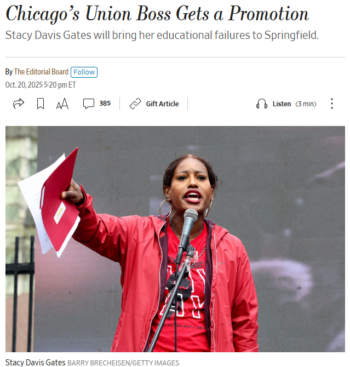
The Wall Street Journal (10/20/25) caricatured the CTU’s critique of standardized testing as “grading is racist.”
Like the Post, the Journal took Davis Gates as a bogeyman in another editorial, “Chicago Union Boss Gets a Promotion” (10/20/25), which snarked that Davis Gates—now also head of the Illinois Federation of Teachers—was “failing up.” The pejorative headline used the classic anti-union dogwhistle “union boss,” while omitting that Davis Gates was elected (unanimously) to lead the IFT, not promoted.
Meanwhile, it accused “union teachers” of caring “most about money and dodging accountability for student failure.” The reality is that teachers are highly stressed and underpaid. And the gains CTU has made go beyond just teachers, with pay bumps secured from the 2019 strike for support staff who were making poverty wages (Jacobin, 11/3/19).
Both the Journal editorial attacking Davis Gates and the Post editorial attacking the CTU scoffed at Davis Gates’ critique of standardized testing, specifically her statement that it is “junk science rooted in white supremacy.” While the Journal dismissively characterized her statement as saying that “grading is racist,” her assessment of standardized testing is supported by historical evidence.
As the Yale-New Haven Teachers Institute (2025) describes, early IQ testing was “used to justify racial discrimination, forced sterilizations and immigration restrictions.” These tests “placed disproportionate numbers of Black and immigrant children in ‘special education’ programs and lower academic tracks.” By the late 20th century, standardized testing became central to so-called school accountability, leading to narrowed curriculum and more stress for students that “disproportionally harmed students of color, multilingual learners and students with disabilities.”
While the opinion pages of the Post and the Journal lament the academic struggles of disadvantaged students, they reinforce this inequality by attacking CTU for being the leading advocates for these students. These papers dismiss investment in educators and social workers as wasteful spending, ignoring the student success that results. Instead, they align themselves with a billionaire-led movement for school privatization that undermines the interests of both students and teachers.
This content originally appeared on FAIR and was authored by Silas Gaughran-Bedell.