
Janine Jackson interviewed Mother Jones‘ Ari Berman about attacks on voting for the February 13, 2026, episode of CounterSpin. This is a lightly edited transcript.
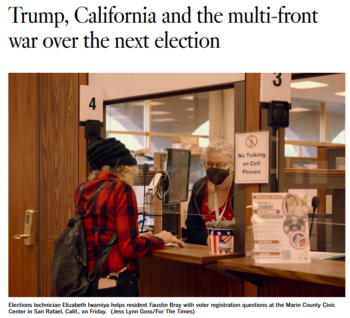
LA Times (2/8/26)
Janine Jackson: The LA Times recently reported on a California election administrator who explained that, along with the things she’s accustomed to do before a midterm—ordering supplies, confirming voting locations—she’s also having to prepare staff to deal with federal agents showing up and demanding ballots, potentially, and masked ICE agents marching around at the polls with guns.
But that’s just one piece of the Trump administration’s multi-front assault on democracy. The most recent development is the passage through the House of legislation that would make it harder to vote, and harder for some than for others.
Our guest tracks these dispiriting events along with the pushback. Ari Berman is national voting rights correspondent for Mother Jones and author of, most recently, Minority Rule: The Right Wing Attack on the Will of the People—and the Fight to Resist it. He joins us now by phone. Welcome back to CounterSpin, Ari Berman.
Ari Berman: Hey, Janine, good to talk to you again, thanks.
JJ: I do want to ask you about the so-called SAVE America Act that passed the House yesterday, even though it seems unlikely to get through the Senate. But I wonder if I could start by asking you about a story that’s supposedly about the past, but not really—and that’s Fulton County, Georgia, and the FBI raid. What the heck happened there, and what is the story behind it?
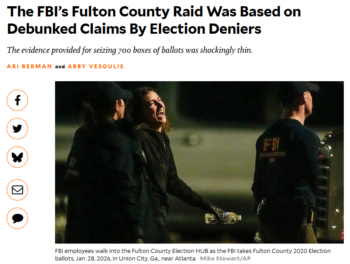
Mother Jones (2/10/26)
AB: It’s really crazy. The fact that the FBI just rolled in and took 656 boxes of ballots and election records from the 2020 election was a massive escalation, in terms of President Trump’s attempt to try to take over the election system. They had been talking about getting the ballots for years, but to actually just take them was really shocking.
And then when the affidavit was unsealed, and we saw the quote unquote “evidence” they presented, it was even more shocking. They didn’t have any evidence. It was a bunch of recycled claims from election deniers. It was even crazy that they got a judge to sign off on it, because you need probable cause, meaning that you need evidence of a criminal offense, to be able to get a warrant for this kind of raid. They seemed like they wanted to get the ballots to try to find the evidence. So they were doing it backwards, in the election that took place over five years ago.
So it’s just really, really crazy from the beginning to the end—the fact that they’re still so obsessed with the 2020 election, the fact that President Trump is putting so many resources into trying to relitigate the 2020 election, the fact that he is now involving the FBI, the director of national intelligence, the Department of Justice in this effort, that he’s bringing in debunked election-deniers into the White House.
We now know that this raid was based on an election denier, Kurt Olsen, who was involved with January 6, is now a temporary White House employee, and he was the basis for the FBI raid.

Ari Berman: “While it’s been portrayed as about 2020, I think the bigger reason they want the ballots is about 2026 and 2028.”
You’re right, though: While it’s been portrayed as about 2020, I think the bigger reason they want the ballots is about 2026 and 2028, so they can say, “OK, we now have definitive proof the election was rigged,” even though it wasn’t, and therefore we have to “nationalize the voting,” as Trump has called for. “We have to take over the voting process.”
And, of course, Fulton County is one of those places where they’re going to try to do that, because we “can’t allow,” in the words of Steve Bannon, another election to be “stolen” again.
JJ: Wow. Just point of information: The whole Georgia thing was investigated, right? We did this in the past, in terms of looking at whether there was malfeasance in Georgia’s voting in 2020; it’s not like it wasn’t looked at, right?
AB: It was looked at extensively, more so than probably in any other place. And it was looked at by Republicans. I mean, it was the Republican governor, the Republican secretary of state, the Republican attorney general, the Republican legislature that signed off on all of this. There were three audits. There were multiple subsequent investigations.
But you know, this has gained momentum in election denier circles. One of the things that’s happened in Georgia was a trio of election deniers took over the state election board, and they have really been beating the drum on Fulton County, Georgia, which is Georgia’s largest county—home to Atlanta—and they’ve been trying to get more control over elections in Fulton County, and they have now been feeding information to the Justice Department, to the FBI. You’ll see if you read that affidavit, two Republican members of the state election board are named as witnesses in that affidavit.
And so there is a feedback loop, between election deniers in Georgia and election deniers in Washington, to try to not just relitigate the 2020 election, but to gain more control over how elections are run in 2026 and 2028. And Georgia is one of those places that’s going to have a lot of important elections, not just for the US House, but for the US Senate, the governor’s race, the secretary of state’s race, the state attorney general’s race, all of those are up. And what happens in 2026 is going to determine who’s in charge of elections in that state and other states in 2028.
JJ: It clearly seems disturbing and dangerous and worrisome, and then also a test case. If this gains traction in Georgia, why wouldn’t they try it somewhere else?
AP (via PBS, 1/29/26)
AB: Yeah, for sure. It’s definitely a test case. Trump is obsessed with the fact that he lost in Georgia, and has been singling out Fulton County ever since. But it’s not the only place he’s obsessed with; he’s obsessed with the fact that he lost Arizona and Michigan and Pennsylvania. So I think they’ll try to do this in as many places as they can.
And the question is, will they get away with it? A judge ordered this affidavit to be unsealed, so people could see the evidence. The evidence was pretty meager, to downright nonexistent.
And so I think the judge is a Trump supporter, but apparently a relatively reasonable Trump supporter, and is going to have a lot of questions about this; and these ballots might have to be returned.
Just the fact that they took the records, we don’t know where the records are, who’s supervising them, what they’re using them for, why the director of national intelligence was there…there’s so many red flags here.
I mean, the director of national intelligence is prohibited by law from taking part in any kind of domestic law enforcement operation. So her entire portfolio with regard to elections would only be preventing foreign interference in elections. And the affidavit showed no links or even allegations of foreign election interference.
Of course, we know there was no election interference, but the fact that there wasn’t even any allegation made raised even more questions about what Tulsi Gabbard was doing at that raid.
JJ: Yeah. Well, “dystopian” is right for all of this, and yet it doesn’t convey the brutishness, in a way. First of all, the fact that we don’t know where these ballots are, and yet this is being sold as protecting the “integrity: of the election…?
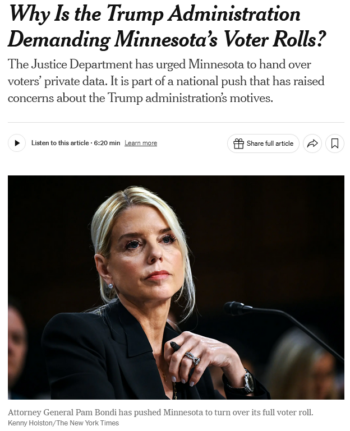
New York Times (1/26/26)
But you have to pair what went on in Georgia with [US Attorney General] Pam Bondi’s attempt at Minnesota strongarming, right? That is also a kind of interference in the voting process that seems very clearly just a power move. What was the Minnesota story?
AB: The Minnesota story was the DoJ has been trying to get the voter rolls of Minnesota and other states for quite some time. This is a big project of the Department of Justice. They want the sensitive voter information from all 50 states. They’ve sued 24 states already, mostly blue states but not all blue states, to try to get access to this information.
They want to create this federal database of registered voters, which they could then compare to the Department of Homeland Security’s own databases to try to search for illegal voting. They’re not going to find any, but they could potentially wrongly flag people as noncitizens and say, “Hey, we found the fraud.” And, just like in Georgia, they’ll try to do that so they can take more control over elections.
But what Pam Bondi did is she basically said, “If you want ICE to leave Minnesota, you need to give us your voter rolls.” That was one of the number of conditions that she put out there. And this was shocking, because ICE is supposed to be there, ostensibly, for immigration purposes. Now we know that ICE has gone way beyond what their mandate was supposed to be in Minnesota, but the Department of Justice went even further, to tie the voter rolls to immigration raids, which made it seem like the whole purpose of ICE being there was just as a political front, so that the administration could carry out its political priorities.
And it’s just really disturbing, because I think if you look at the way it’s gone down in Minnesota, the way it’s gone down in Georgia, basically blue states, blue cities, election boards controlled by Democrats, I mean, they are essentially occupied territory right now.
And it’s kind of like the Trump administration is the Kremlin, and anyone who opposes the Kremlin becomes the opposition. And we know what happens to the opposition in authoritarian countries. And I think that is the playbook that the Trump administration would like to follow.
We’ll see if they’re successful in doing so, but I don’t think we’ve ever seen an administration use the full weight of the federal government and the full weight of law enforcement, whether it’s the FBI, ICE, DoJ, in this kind of way before.
JJ: And that’s because legally, or at least last we checked, there are things that a president can’t do at the state level, right? There’s involvement that is meant to be prohibited, and that’s why they’re throwing everything at the wall, and bending rules and making up new ones, because there’s meant to be a separation there, yeah?
AB: Yeah, and that’s a really good point, Janine. I mean, the fact is the Trump administration hasn’t been very successful in its attempts to quote unquote “nationalize the voting.” Trump passed an executive order early in his term to try to do a lot of things like, for example, require proof of citizenship to register to vote. It wasn’t successful. It’s been blocked in the courts, because the president can’t usurp the power of the states and Congress.
Congress has also tried to pass due restrictions on voting, but they haven’t been able to get it through the Senate, because of the 60-vote requirement in the Senate, and the lack of enthusiasm even from some Republicans for trying to federalize voting.
And then the US election system at the state level is very decentralized. That is something that Republicans have often praised, the fact that there is so much power for the states when it comes to running our elections. So that has made it difficult for Trump to take over, and they’ve met resistance even from Republicans when it comes to some of this stuff.
I just saw yesterday, the secretary of state of West Virginia said he wasn’t going to turn over his voter rolls to the Department of Justice, basically saying the DoJ can’t run state elections. You had a recent conference of secretaries of state, and there was a bipartisan outcry over the kind of things that Pam Bondi has tried to do to federalize elections. So I think the Trump administration is operating from a position of weakness rather than a position of strength, and that’s why they’re acting more and more extreme in terms of their tactics.
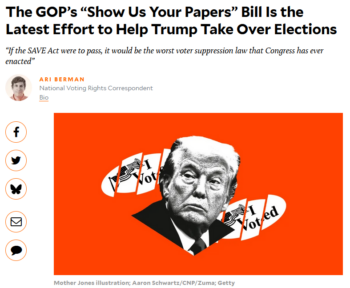
Mother Jones (2/11/26)
JJ: Continuing that, because this so-called SAVE America Act, which has been tried and failed before, and folks say is very likely to fail again in the Senate, but Wednesday, February 11, the House, with the whole Republican caucus plus Henry Cuellar, passed this so-called SAVE America Act. But we still have to think about it, because it’s what they want to do, even if they are not going to get there. But what would this in fact try to do?
AB: It does three major things. The first thing is what’s already been passed in an earlier bill called the SAVE Act, which is require proof of citizenship to register to vote. And that is much worse than just requiring a driver’s license, for example, to cast a ballot, because you would need a passport or a birth certificate to be able to register. These are things that people don’t carry around with them. Half of all Americans don’t have a passport. A lot of people don’t know where their birth certificate is, or may have had issues obtaining one in the first place. These aren’t things that you carry around with you on a regular basis.
It also requires you to show your documentation in person at an election office. That means people that live in rural areas could have to drive very long distances to show this kind of information. There’s also the possibility that it could really burden married women who have changed their names and taken their partner’s last name.
Interestingly enough, both rural voters and married women are more likely to be Republicans than Democrats. So it could hurt conservative constituencies more than liberal ones.
Then they’ll add it onto it a strict photo ID requirement to vote. About 21 million Americans don’t have a current driver’s license. That’s about the same numbers as the number of Americans that don’t have access to their citizenship papers. And other IDs would be excluded, like student IDs, tribal IDs.
And the third thing it does is it forces states to hand over their voter rolls to the Department of Homeland Security, much like the Department of Justice is trying to get those voter rolls in states like Minnesota and other places.
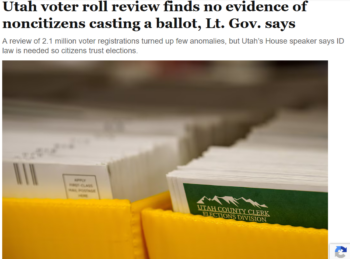
Salt Lake Tribune (1/23/26)
JJ: Wow. When you hear just kind of talk radio arguments, you might hear someone say, “Oh, well I have ID. Why would you object to showing ID?” And it’s framed that way. You less often hear, “What is the problem this intervention is supposedly addressing?” Because we’ve been around this story before.
AB: Exactly. It’s trying to address the problem, in particular, of noncitizens voting, which is basically a completely nonexistent problem. There have been so many audits at the state level of this—recently in Georgia, in North Carolina, in Utah—and they find an infinitesimal number of noncitizens who are even registered to vote, and a much smaller number, to a nonexistent number, of noncitizens who have actually voted.
Utah just reviewed the 2.1 million people on its voter rolls, and didn’t find a single instance of a noncitizen voting. Because the cost/benefit analysis just doesn’t make sense: Why would someone risk five years in jail, a felony, potential deportation, for casting a ballot? It doesn’t actually make any rational sense. And of course there’s already safeguards against it.
But, yeah, they added voter ID to this bill for messaging purposes. So they could say, “You need an ID to buy liquor, you need an ID to get on a plane, so you need an ID to vote.” We’ll leave aside the fact that those other things are not constitutionally protected rights like voting is; they always understate the difficulties of it.
But the real problem with the bill is not the voter ID part. It’s the proof of citizenship part, and that is a lot more burdensome. And I think a lot of Americans maybe intuitively support this, but would be surprised by the difficulties they would have under a kind of law like this.
For example, Kansas put a proof of citizenship law in effect a few years ago, and it blocked one in seven people from registering to vote because, again, people do not bring their birth certificates with them when they register, like, for example, people carry around a driver’s license. So it’s much more draconian than what they already passed.
If you listen to Trump, he would like to go much further. He wants to get rid of mail voting altogether. That’s not going to happen. That would hurt a lot of Republican constituencies.
But they just keep banging this drum, and they’re putting out a tremendous amount of disinformation. A lot of it’s fueled by Elon Musk on X, and they’re convincing a lot of people of things that aren’t true, and that can’t be good for democracy in any kind of way.
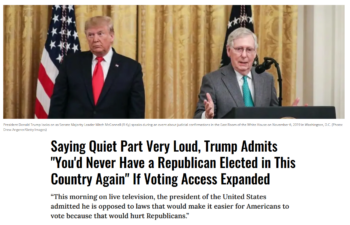
Common Dreams (3/30/20)
JJ: Well, finally, Donald Trump, on Fox and Friends in 2020, said that if voting access were expanded, if we eased barriers to voting for disabled people, poor people, rural people, working people, if voting were made more widely accessible, Trump said, “You’d never have a Republican elected in this country again.”
So, again, I come back to the idea that this could possibly be spun, these measures, as protecting democracy, or even respecting the democratic process, is just Bizarro World. But I don’t see a lot of media on this bigger picture, the fact that this is a frank effort to avoid accountability and to have the capacity to push through policies that are simply not popular, to do things that people don’t want, through these power moves. And I am concerned that media seemed to be more interested in whether he can “pull it off” than about the bigger enterprise at work.
AB: Yeah, I think that’s true. I also think the risk is always just reporting this like it’s a normal political story. Like, oh, it’s the average Tuesday, and the FBI just took a hundred boxes. That’s not normal. And I think we risk becoming numb to the abnormality that we’re seeing here, because so much of this stuff is just truly unprecedented, even compared to Trump’s first term.
The kind of things that Trump is doing in his second term are the kind of things he contemplated in his first term, but was talked off the edge of. And so we really are in the Mike Flynn declaring the Insurrection Act, seizing ballots, that kind of thing. And I think we just can’t report it like it’s a normal thing, when it’s deeply, deeply, deeply abnormal.
JJ: All right, then. Absolutely. Thank you.
We’ve been speaking with Ari Berman. He’s national voting rights correspondent for Mother Jones. They’re online at MotherJones.com. His latest book is Minority Rule: The Right Wing Attack on the Will of the People—and the Fight to Resist it. Ari Berman, thank you so much for joining us this week on CounterSpin.
AB: Thanks so much for having me, Janine.
This content originally appeared on FAIR and was authored by Janine Jackson.