
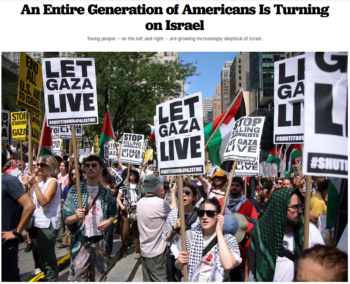
Politico (9/29/25) cites Israel’s “latest moves to launch a ground offensive in Gaza City…and deny evidence of widespread famine” as reasons for the country’s loss of support among young people.
Younger Americans are turning against Israel. “On both the left and the right, young Americans are growing more skeptical of offering unconditional US support to Israel,” Politico (9/29/25) reported. Brookings (8/6/25) ran the headline “Support for Israel Continues to Deteriorate, Especially Among Democrats and Young People.” According to the Forward (11/21/25), “Younger Jews are more than twice as likely to identify as anti-Zionist than the overall population.”
Pro-Israel media are looking for blame. It’s often easy to paint youth opinion that is out of sync with official state policy as emotionally driven social justice warriorism, the result of hearts not yet hardened by life’s cold realities. The Zionist media narrative is looking for the culprits who have apparently miseducated our youth, turning them not just into Israel critics, but Jew haters.
‘Panicked’ by young people
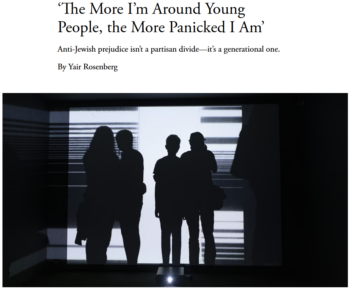
“Younger Americans…are likely to trust and get their news from lightly moderated social-media platforms,” writes Yair Rosenberg (Atlantic, 12/15/25), “which often advantage the extreme opinions, conspiracy theories, and conflict-stoking content that drive engagement.”
At the Atlantic (12/15/25), Yair Rosenberg wrote a piece headlined “The More I’m Around Young People, the More Panicked I Am,’” with the subhead, “Anti-Jewish prejudice isn’t a partisan divide—it’s a generational one.” To his credit, Rosenberg starts off reporting on very real instances of antisemitism, but then watch carefully what he does in the middle:
Young people also tend to be more critical of Israel than their elders, leading a minority to excuse or even perpetuate anti-Jewish acts in America in the name of Palestine. These critics are likely to consume anti-Israel content on their social-media apps of choice. The platforms then funnel some of those users toward antisemitic material—a sort of algorithmic escalator that ends up radicalizing a percentage of them.
In the first sentence, the only evidence Rosenberg cites is a link to his own article (Atlantic, 5/22/25) about how “Elias Rodriguez allegedly shot and killed two people as they were exiting an event at the Capital Jewish Museum,” with the headline “A Dangerous Disguise for Antisemitism.” Rosenberg said the “assailant used the Palestinian struggle as a pretext to harm Jews.”
But as I have previously written (FAIR.org, 5/29/25), much of the media framed this attack as antisemitic without any factual basis. While there was plenty of evidence that the act was political, with Rodiguez’s manifesto denouncing Israel as a “genocidal apartheid state,” there wasn’t any evidence that the attacker held antisemitic views, or targeted the event because of the faith of the victims. If someone obsessed with Saudi Arabia’s aggression in Yemen killed two Muslim workers at the Saudi embassy, that would certainly be anti-Saudi political violence, but not necessarily anti-Muslim terror.
‘Sewer of filth and lies’

The root of the antisemitism problem at X is not criticism of Israeli war crimes (FAIR.org, 1/23/25).
Rosenberg doesn’t quite say that today’s young critics of Israel are necessarily antisemites, but argues that by putting anti-Israel content on social media, they’re helping to drive traffic to actual antisemitism. This is a framing that lets Elon Musk—who famously gave a Nazi salute at Donald Trump’s second inauguration—off the hook for overseeing the rise of this antisemitic content on X (CNN, 9/29/25).
Nor does he recognize that Meta is aggressively policing against criticism of Israel, even as it ends efforts to proactively screen out hate speech like antisemitism (Washington Post, 2/25/25). Last year, Meta announced “that it will expand its policies to classify the misuse of the term ‘Zionist’ as a proxy for ‘Jews’ as antisemitic and Tier 1 hate speech” (World Jewish Congress, 6/9/24). Al Jazeera (10/24/24) also reported on “testimonies of routine deletion of Palestine-related posts and a deep-seated pro-Israel bias” at Meta.
Rosenberg is rightly concerned that there are too many far-right extremists promoting white nationalism and antisemitism on social media networks (Wired, 5/2/24; PBS, 8/13/24), and these corporate regimes are too tolerant of such activity on their sites. But Rosenberg manages to twist this into an argument that young people need to shut up about Gaza.
Of course, many people are upset about anti-Israel content on social media not because it leads to antisemitism, but because it’s anti-Israel: The reason for the shift in youth opinion isn’t Israel’s behavior, the argument goes, but social media’s influence. Hillary Clinton blames youth criticism of Israel on TikTok (Hollywood Reporter, 12/2/25). The Australian (12/12/25) wrote: “Young people live now on social media. And social media is an unregulated sewer of lies and filth.” The Israeli government has reportedly recruited social media personalities and public relations firms to tell its version of the story (Jerusalem Post, 10/3/25; Al Jazeera, 10/30/25).
‘Brainwashed’ into opposing sex pests
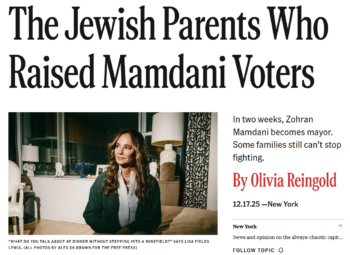
“Younger Jews have shifted away from Israel,” Free Press (12/17/25) reported. “That has put some of them on a collision course with their more traditional parents, many of whom view Mamdani as a totem of the anti-Zionist movement and a threat to the safety of Jews in New York City.”
The issue of this generational divide is the center of a piece at Free Press (12/17/25) by Olivia Reingold, called “The Jewish Parents Who Raised Mamdani Voters.” For the unacquainted, Free Press was bought by Paramount (10/6/25), now controlled by oligarch David Ellison, thus turning the once-marginal publication into the closest thing the right has to the New Yorker. (The acquisition also elevated Free Press co-founder Bari Weiss, noted right-wing pundit, to CBS News editor-in-chief.)
Free Press quoted one parent in particular, Sagra Maceira de Rosen, whose bio describes her as “chair of SIO Global, an investment and advisory firm working with private equity and investment.” She said she was “horrified” that Mamdani won the election. What’s worse for her was that her grown child campaigned for him. “I fear that kids I care for—my children—are brainwashed.”
Parents looked for answers. Reingold reported:
They wondered if they should have parented differently. Did their children get enough Jewish education? Were they brainwashed by their elite private schools? Where did they go wrong?
“Maybe I failed in the sense that the kids didn’t go to Israel enough,” a 63-year-old physician in Greenpoint, Brooklyn, told me. He said his daughter, a civil rights attorney, holds anti-Zionist views and refused to vote for former New York Gov. Andrew Cuomo due to his alleged sexual harassment. “It would’ve been better if they went more, just to see the lies they’re being told.”
It’s not clear if the doctor or Reingold knows what they’re saying here. Jewish kids need to 1) go to Israel to get indoctrinated and 2) stop being appalled by sexual harassment. These issues are more connected than one might think, as a Jewish Currents (4/18/18) investigation by Lilith executive editor Sarah Seltzer found widespread problems of sexual violence within Birthright, the program offering young Jews free guided trips to Israel.
Lacking ‘a capacity for critical thinking’
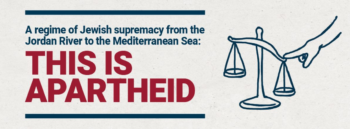
It’s hard to accuse B’Tselem (1/12/21) of not going to Israel often enough.
Another parent, Lisa Fields Lewis, lamented that her grown children liked Mamdani:
Lewis was raised by an Israeli mother; her father survived Bergen-Belsen concentration camp. She said the rise of Mamdani awakened a “generational trauma” in her. Now, she can’t shake the feeling that history is repeating itself. And kids don’t seem to realize just how dangerous Mamdani’s views are, Lewis said.
With Mamdani set to be sworn in just after midnight on January 1, Lewis doesn’t know if their relationship can return to normal any time soon. “I feel sad,” Lewis said. “I feel envious of my friends whose kids are proud Zionists, or at least have the capacity for critical thinking.”
It’s not FAIR’s job to comment on others’ parenting skills, but Lewis just told the world she thinks her children don’t have a “capacity for critical thinking”; the tension in this household might have to do with a lack of respect, rather than just differing politics. What’s really dangerous here is that the author doesn’t challenge the absurd suggestion that “Mamdani’s promise of providing free buses and righting the city’s widening income gap” is the first step in sending the Jews to the camps.
By what measure does the Free Press think Mamdani is dangerous for Jews? It pointed out that he “has consistently denied Israel’s right to exist as a Jewish state,” saying instead that “Israel should exist ‘with equal rights for all’—a bar the nation already meets.”
Reingold can’t decide what she wants here: a Jewish state or a state that doesn’t discriminate. Maintaining the former requires preventing the latter, as Palestinians that have been under Israeli control for nearly 60 years need to be denied the right to vote in Israeli elections. Jews from anywhere in the world have a “right to return” to Israel, but non-Jewish refugees from pre-1948 Palestine do not. A number of human rights groups, including an Israeli one, have found that the legal separation of peoples in Israel proper and the Occupied Territories amounts to apartheid (B’Tselem, 1/12/21; Human Rights Watch, 4/27/21).
Reingold went on, “More recently, the mayor-elect has caught flack for his controversial appointments to his transition committees, which include fringe anti-Zionist rabbis.” Again, there’s nothing here that represents antisemitism–instead, there’s inclusion of Jews. The problem is that Mamdani is close to clergy whose politics don’t align with the Weiss editorial regime. To put things into perspective, Mamdani won a third of the city’s Jewish vote (Jewish Telegraphic Agency, 11/5/25)—not a majority, but not exactly a “fringe” either.
‘A problem of disobedient children’
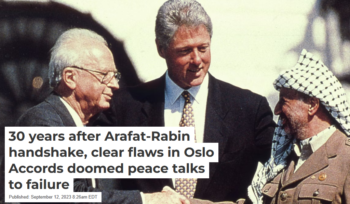
Though the Oslo Accords produced great optimism in the West, Maha Nassar (Conversation, 9/12/23) noted, “life for Palestinians became worse during the post-Oslo years, not better,” as “Palestinians lost further control over their lands, homes and resources.”
These pieces spend a lot of ink displaying anxiety for this generational divide, but never really ask why it exists. If they did that, they might find out that while many in the older generation could indulge the fantasy that a pre-Netanyahu Israel was engaged in a peace process, when mainstream Israeli leaders paid lip service to the idea of a two-state solution, younger Jews only know a place of extreme bellicosity.
Any voter in their 20s doesn’t remember the Oslo Accords or Yitzhak Rabin shaking hands with Yasser Arafat (Conversation, 9/12/23). Instead, what they know is a country that has mostly been under the control of the right-wing Likud party and its extremist allies, an anti-democratic slide into authoritarianism (Haaretz, 10/30/25; Committee to Protect Journalists, 12/11/25), government corruption (New York Times, 11/30/25), settlement expansion (UN News, 9/29/25), alliances with the European far right (CNN, 3/26/25; Foreign Policy, 5/9/25) and several lopsided wars against Gaza.
But neither the Atlantic nor the Free Press can say this. The answer can’t be that Israel’s actions against Palestinians and its decaying political system are turning people off. No, the problem is that young people are led astray by social media and distance from real education.
“While Israel’s actions have always been structured by apartheid and ethnic cleansing, the scale and the visibility of its structural violence has been placed at the center of American political discourse,” said Benjamin Balthaser, author of Citizens of the Whole World: Anti-Zionism and the Cultures of the American Jewish Left. “Americans, not just Jews, are compelled to respond.”
He added, “That the Free Press sees this as a problem of disobedient children or a lack of Torah school is not unlike Hillary Clinton blaming outrage at Israel on TikTok videos and social media.”
This content originally appeared on FAIR and was authored by Ari Paul.