
Janine Jackson interviewed Free Press advocacy director Jenna Ruddock about the Department of Homeland Security’s domestic surveillance for the January 30, 2026, episode of CounterSpin. This is a lightly edited transcript.

AP (via PBS, 1/26/26)
Janine Jackson: After the murder of Renee Good by ICE agent Jonathan Ross, the first words from the White House were that she was a “domestic terrorist.” After the killing, by so far unnamed agents, of Alex Pretti, officials declared that he was a “would-be assassin” out to “massacre law enforcement.”
Maybe there was a time when such bald statements would carry the day and be stamped in history as the truth, and certainly there are some right now for whom anything Trump mumbles is unimpeachable—if miraculously malleable—gospel. But we have ever-more powerful countervailing forces in the form of witnessing and social media and independent reporters, who maybe don’t have pensions, but also don’t have to bow to a corporate line-toeing boss.
As the powers that be find it harder to force-feed their narrative over your lying eyes and questioning minds, the game shifts to their seeking to use their power to silence anyone who might say anything different than what they’re saying—not by proving them wrong, because they aren’t wrong, but by shutting them up.
Our guest is following the various means the administration is using to target efforts, not just to oppose their actions, but to publicly disagree with them. And not just that, but to even document what’s being done in our name.
Jenna Ruddock is advocacy director at the group Free Press. She joins us now by phone. Welcome to CounterSpin, Jenna Ruddock.
Jenna Ruddock: Thank you so much for having me.
Free Press (1/26/26)
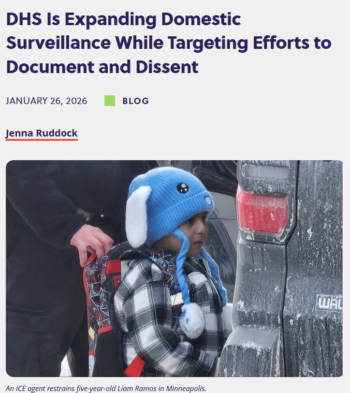
JJ: If we’re looking for ways to not just stop what’s happening in Minnesota—and, of course, elsewhere—not just stop it, but prevent its recurrence, we have to look at not only what’s happening in the street, but also what’s been happening in offices, where budgets are made and deals are cut and policy is communicated. So while it’s very important to keep eyes on ICE itself, we also need to see what DHS is and has been doing, and the tools that they’re using to do it. And that’s where you situate your recent, super useful piece at FreePress.net. Tell us please about how DHS has been busy, as you say, “expanding its own sprawling, invasive web of surveillance.”
JR: Absolutely. And I think you’ve already hit on two of the key points here. So DHS, as folks may know, is a product of the so-called “War on Terror.” It was created in the early 2000s. The agency didn’t exist prior to that. It brought together some preexisting immigration enforcement functions, but really with the mandate, following 9/11, to expand domestic surveillance in order to prevent additional terror attacks. And that was the pitch.
And what we saw pretty quickly was that DHS, along with other federal law enforcement agencies, began this web of domestic surveillance, particularly targeted on Muslim communities, that has only grown over the years, across administrations, to target other types of activists, including immigration justice groups, racial justice groups such as Black Lives Matter organizers, environmental activists. And a lot of this is blending what you flagged in the beginning here, about allegations of criminality, up to and including terrorism, and the technological capability to surveil people organizing on the ground.
JJ: And they’re working with very particular tools here. It’s important to make clear, this didn’t sprout out—I think some people might think this came up last week, or last year. This is going back to 9/11 and, ostensibly, the “War on Terror,” which journalists never should have taken out of irony quotes. But they’re drawing on technology, and making contracts with private sector companies, to employ this surveillance machinery, yeah?
404 (1/30/26)
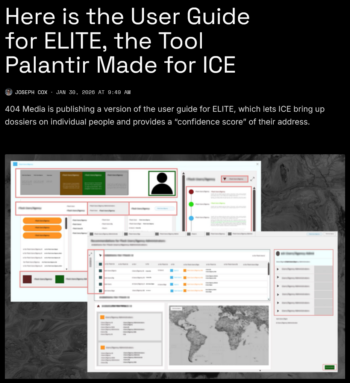
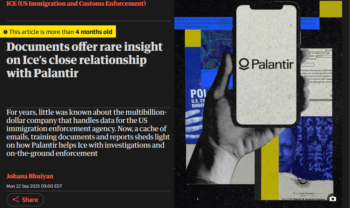
JR: Exactly. And there’s been a range of scrutiny on these corporate players. The agency has built its own internal tools, but a lot of its surveillance technology it has outsourced. There’s been a lot of reporting, in particular, on the agency’s relationship with the surveillance firm Palantir, which has pitched existing products, in addition to custom-building products. There’s been some great reporting by 404 Media, in particular, on this, on Palantir’s Immigration OS system, in addition to a new tool that it’s apparently building, to create a custom mapping of potential targets for ICE and Border Patrol raids.
And then there are other, lesser-known tools and companies that draw on existing commercial surveillance infrastructure. So a couple of the tools I mentioned in my piece, and that outlets like 404 and Wired have done a great job covering, are tools like Webloc and Tangles, which plug into commercial location data surveillance. And that’s all of your app providers, sometimes web browsers and other websites that are constantly pulling location data, precise location data, off of our phones. And that’s up for grabs. That’s up for sales on the open market.
And because we don’t have any regulations at the federal level, or in many states, preventing law enforcement from buying this data, which under almost any other circumstances would require a warrant to get, DHS is going directly to those companies, which enables them to do things like real-time, consistent monitoring of mobile devices, which is both a concern for our immigrant communities, and also for folks who are trying to support them, both in a protest context, and also for a lot of what we’re seeing in Minnesota and other places, things like mutual aid, folks who are going from a grocery store to an immigrant neighbor’s house to bring them groceries, because people are afraid of leaving their home.
So these sorts of tracking mechanisms are really manifold, in terms of the potential implications.
JJ: So if I could just interrupt to say: We’re mainly talking, it sounds like, about location, about companies that are able to track where a given person is at any given moment. Is that the thrust of it?
Brennan Center (1/7/22)
JR: I think that’s a big piece of it. Another piece is the social media surveillance. And I think that plays also into the tracking, because watching where folks are posting from on social media can help you target where somebody is in a particular location, but that can also help track what the conversations are. It can help map relationships between organizers, for example, when they’re looking at social movements.
But I think the big thrust of it right now is location data, and then also facial recognition, which is what we’re seeing with some apps, like the new Mobile Fortify app.
JJ: I think a lot of folks think of themselves as tech savvy. So what can you tell us about the ability to get out of these? If you’re aware that you’re being—would you be aware that you’re being surveilled?—would you be able to opt out in any way?
JR: I think there are some ways that you can opt out. Obviously, there are steps people can take to minimize their online presence, not to carry their phones on them at all times, because our phones really are pretty consistently tracking us. Even if we’re taking off social media apps, things like our weather apps are tracking our location. That’s how they tell us what the weather is in our given spot, as long as we have location services enabled.

ACLU (2/13/23)
But something I touch on in the piece is that this is really a collective project, because there are other technologies like Flock, which is an automated license plate reader, that’s not attached to any person. It’s something that’s contracted by a city, or usually local law enforcement agencies. And those cameras are just in your neighborhood. Or other folks in your neighborhood might have something like an Amazon Ring camera. And so that’s not going to be within your personal control.
Or [there are] other types of data that people have to hand over to the government, that the Trump administration has been trying to break down barriers, things that would otherwise be protected and siloed, like IRS data or Social Security data, data that you don’t have control over sharing with the government. And now the Trump administration is trying to share across agencies, to law enforcement agencies like ICE.
So there are steps that individuals can take, certainly, but it really requires us to have a more holistic look at what the community-level impacts are.
JJ: In addition to the surveillance, or as a piece of it, we see an attack on the ability to witness—in other words, pressuring tech companies to, for example, pull down crowdsourcing apps. That’s another facet of this, yeah?
Reuters (12/6/25)
JR: Absolutely. We saw that this past fall, the Department of Justice sent a letter to Apple about a couple of different crowdsourcing apps that had popped up for people to raise awareness and share information about ongoing ICE raids. And the Department of Justice is leaning on Apple, in its position as a gatekeeper over its mobile app store, to take those apps down.
Google quickly followed suit, and pulled down a couple of apps on its own. They are still hosting apps that the DHS is using, itself, to track and monitor folks. So it’s certainly a double standard.
And, also, it’s important to know that the companies were under no legal obligation to pull those apps down. It was really a voluntary act of corporate capitulation.
JJ: You’ve said that there are some, but limited, things that individuals can do—and we know how difficult it is to try to extricate yourself while still trying to stay in communication with the modern world. But are there legal interventions that states could do, for example, to try to push back or to resist, on this overweening surveillance?
JR: Yeah, states have taken some really important steps in the absence of action by the federal government. There are a number of states that have considered bans on the sale of location data, for example, which makes some of these companies possible in the first place. There are other states that have restricted the use of biometric data, including facial recognition. And so there are certainly legislative efforts that have been successful at curtailing some of this at the state level.
The problem then becomes, what do you do when you’re dealing with a federal agency? And Congress has really failed to move in a significant way on any of these major privacy concerns.
Guardian (9/22/25)
JJ: While I do see, as you note, some critical and informative media telling us about this, there is an overarching air of inevitability, as though this kind of encroaching surveillance is just what technology does, and there’s no way to rein it in because it’s just the march of time.
But that’s not the case. I mean, technology is always political.
JR: Technology is always political. And I think we’ve seen some really successful campaigns by communities—especially when folks are aware that these surveillance technologies are being contracted by their cities or their police department—pushing back and ending contracts, and getting surveillance technologies taken out of the infrastructure of their communities.
And so I think that, I hope that, the collective requirement for a response here is actually empowering. I think it’s an important source of organizing for people, a place where people can really start to learn about how the state is exercising surveillance over us, but also to realize how we can push back. This is public infrastructure; this is our infrastructure too. And people should really feel empowered to say, this is not inevitable. A lot of this is profit driven. We have constitutional rights, and we can organize against this.
JJ: Just finally, there’s a quote that I bring out often, it’s USA Today talking about Seattle in 1999: “Little noticed by the public, the upcoming World Trade Organization summit has energized protesters around the world.” It’s just a little sentence, but it’s a lesson: You can be part of the public, and that’s cool. But if you band together with other people and speak out, well, you become a protester, and that’s different. And now you’re somehow marginal. And in today’s climate, marginal is turning into criminal.
So news media aren’t doing nothing when they label people as “protesters” or “observers” or “activists.” It matters, because it tells people you’re in a category that might be protected.
But I think more and more people are thinking, no category is protected, and they’re recognizing that observing or witnessing makes them a protester, and they’re over it; they don’t care about the way that they’re labeled by media.
And I just wonder, finally, what do you say to people who are looking for something to contribute in this moment, but they don’t necessarily want to go out in the street, but they don’t want to feel they’re sitting on the sidelines. What do you say, as advocacy director? What would you encourage people to think about, or be doing in this moment?

Jenna Ruddock: “What we’re seeing is this criminalized language around acts that are simple acts of solidarity…. Those smaller acts of solidarity every day are so important.”
JR: I think in every moment there are different roles people can play. I think in this moment, as you flagged, that folks need to assess where their skills are, where their heart is, where they feel compelled to contribute, and not to consider as deeply how that might be reflected back.
Like you mentioned, people who are going out on the street and who are recording videos, who might not even be going out with the intention of engaging in a program like ICE Watch, for example, but who might simply be out on the street when an ICE raid happens, and feel compelled to document—the government can then turn around and try to spin that, no matter what the person’s intention was being there. And, to be clear, that’s a constitutionally protected activity in the first place.
So what we’re seeing is this criminalized language around acts that are simple acts of solidarity. And so I think that there needs to be a broader social shift, where we recognize that that rhetoric shouldn’t hold as much power over our choices, in terms of how we mobilize.
But then, also, those smaller acts of solidarity every day are so important. These acts, like bringing your neighbor’s groceries, as you know that they feel afraid to go outside. Or simply talking to your neighbors, of knowing their names, of knowing who to call if there’s an emergency, and being able to alert their families.
I think so often there have been great acts of observation on the street that have held state violence accountable; but there are also so many people who have been abducted and disappeared, because no one was there to capture their name. Or somebody might notice that they didn’t come back home, but not know who to call. And so all of these little pieces are part of the broader solidarity that we need right now.
JJ: We’ve been speaking with Jenna Ruddock. The article we’re discussing is available at FreePress.net. Jenna Ruddock, thank you so much for joining us this week on CounterSpin.
JR: Thank you so much.
This content originally appeared on FAIR and was authored by Janine Jackson.