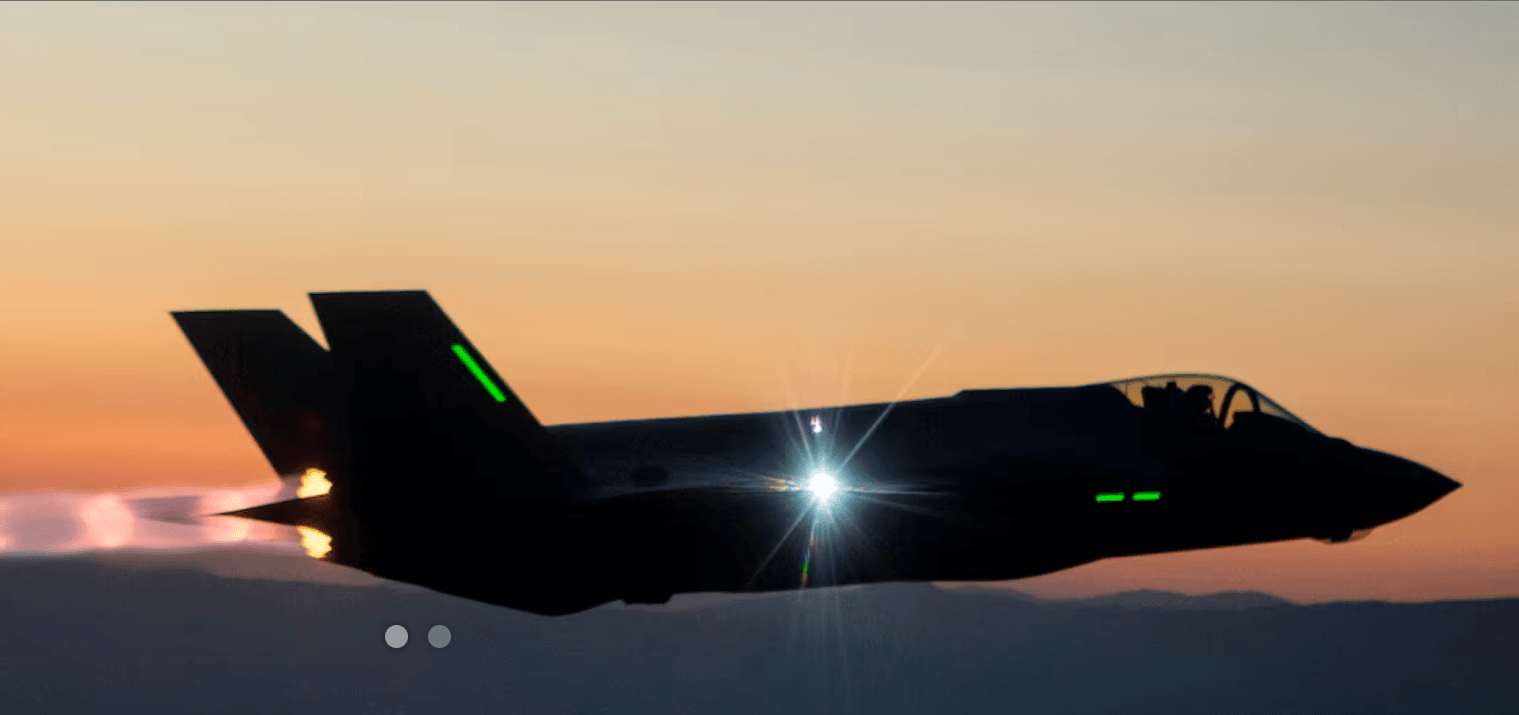
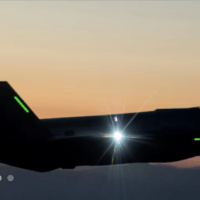
F-35 in flight. Photo: US Air Force.
What the United States is signaling in Venezuela is not merely a dispute over one government, one election, or one leader. It is a warning to the world that international law—already fragile, already selectively enforced—has now been openly pushed aside. And this warning comes from a man who presents himself as a global peacemaker, a would-be Nobel laureate, a self-styled dealmaker who claims to have “ended” nearly twenty wars that exist largely in his own imagination.
The contradiction is not incidental. It is the point.
Under Donald Trump, the United States has not merely returned to coercive foreign policy; it has hyper-normalised it. Practices once associated with rogue states—economic strangulation, collective punishment, political blacklisting—have been repackaged as routine tools of diplomacy. Sanctions are no longer instruments of last resort; they are weapons deployed reflexively, indiscriminately, and punitively.
European Union officials have been sanctioned for the offence of disagreement. International human rights advocates have seen their insurance canceled and their travel restricted after criticizing U.S. policy. Palestinian officials have been barred from entering the United States altogether. These are not measures aimed at resolving conflict or protecting civilians. They are warnings—meant to intimidate, isolate, and silence.
On the other hand, European NATO members are trapped in a relationship they refuse to name. Security is outsourced upward; responsibility is displaced outward. When Washington acts illegally, allies are expected to align—or at least not resist. This is not collective defence. It is asymmetric dependence.The has resulted is moral paralysis.
The threat to forcibly remove—or effectively kidnap—a foreign head of state crosses an even darker line. It is a clear violation of international law and the United Nations Charter, which explicitly prohibits the threat or use of force against the political independence of any state. Sovereignty is not a favour bestowed by Washington, nor is it conditional on ideological alignment. Yet the Trump administration has behaved as if these principles no longer exist, projecting a confidence born not of legitimacy, but of impunity. Just imagine Putin kidnapping Zelensky, or Xi Jinping snatching Lai Ching-te of Taiwan. What will the international community do then?
This impunity is reinforced at home. Trump has openly asserted that the U.S. War Powers Act is unconstitutional—a claim that may take years to resolve in American courts, if it is resolved at all. In the meantime, the institutional safeguards designed to restrain executive overreach have been steadily dismantled. Career diplomats sidelined. Inspectors general purged. Congress bypassed. The result is a presidency with extraordinary freedom to act first, escalate fast, and justify later—or simply dare the system to stop it.
The criminal charges levelled against Venezuela’s president, Nicolás Maduro, including allegations of large-scale drug trafficking, have been widely disputed by international legal experts. But even if they were not, the method matters. Unilateral indictments issued outside international courts, followed by sweeping sanctions that collapse entire economies, are not justice. They are punishment without trial. They are collective penalties imposed on civilian populations who have no power over the decisions being made in their name.
Hospitals lose medicine. Food systems collapse. Migration accelerates. And then the resulting humanitarian crisis is cited as proof that the targeted government has failed.
The consequences of this behaviour extend far beyond Venezuela. When the United States openly flouts international law, it does not merely weaken one norm—it hollows out the entire framework meant to restrain state violence. Russia’s invasion of Ukraine, Saudi Arabia’s devastation of Yemen and China’s growing pressure on Taiwan all unfold in a world where rules are applied selectively and enforcement depends on power, not principle.
In such a world, legality becomes a talking point, not a constraint.
Trump frequently invokes the language of peace, but his understanding of it is dangerously superficial. He confuses ceasefires with peace, dominance with stability, and submission with order. Starving economies, collapsing health systems, and political blackmail do not resolve conflict. They freeze it temporarily, radicalise it permanently, and export it elsewhere.
Cuba has lived under economic siege for more than six decades for refusing to submit to U.S. demands. Venezuela is now subjected to the same logic. Any state that resists risks financial isolation, diplomatic erasure, and economic suffocation. Only China currently possesses the scale and leverage to resist such pressure, a reality that should alarm U.S. allies rather than reassure them.
What happens to Ukraine—or to Europe—when American power itself is exercised without restraint? What does “rules-based order” mean when the chief architect of that order ignores its rules? Why has the international community failed to develop collective defences against coercion by its own supposed guarantor of stability?
History offers little comfort. U.S. intervention in Central and South America is not an aberration; it is a pattern. From the Monroe Doctrine onward, Latin America was treated less as a constellation of sovereign nations than as a zone of extraction and control. Nicaragua, Haiti, and the Dominican Republic endured prolonged occupation or domination. During the Cold War, Washington backed coups and military dictatorships in Chile, Brazil, Argentina, and beyond—crushing leftist movements, silencing civil society, and installing regimes that tortured, disappeared, and murdered their own citizens while American economic interests flourished.
Long before Vietnam or Iraq, the United States financed proxy militias, death squads, and covert operations across the region. The “dirty wars” of the 1970s and 1980s left tens of thousands dead and entire societies traumatised. Venezuela does not represent a departure from this history. It represents its continuation—updated for a sanctions-based age.
If the United States continues down this path, domestic unrest and international protest will be repurposed as pretexts for further confrontation—perhaps with Iran—deepening global instability and empowering hard-line actors everywhere. The lesson being taught is simple and corrosive: that might makes right, and law exists only when it is convenient.
International law survives only if the strong are willing to restrain themselves. The United States no longer even pretends to try. By discarding the very rules it helped create, it exposes the “rules-based order” as a fiction—useful only when it serves American interests, disposable the moment it does not. What follows is not peace, but global cynicism; not justice, but revenge politics; not security, but endless escalation. The world is being taught a brutal lesson: that law means nothing, and power means everything. The question facing the international community and the European Union and NATO is particular is no longer abstract. It is whether it will continue to live under American impunity—or finally say no.
The post With the Attack on Venezuela, Trump Has Put the Death of International Law in Plain Sight appeared first on CounterPunch.org.
This content originally appeared on CounterPunch.org and was authored by Ibrahim Quraishi.