
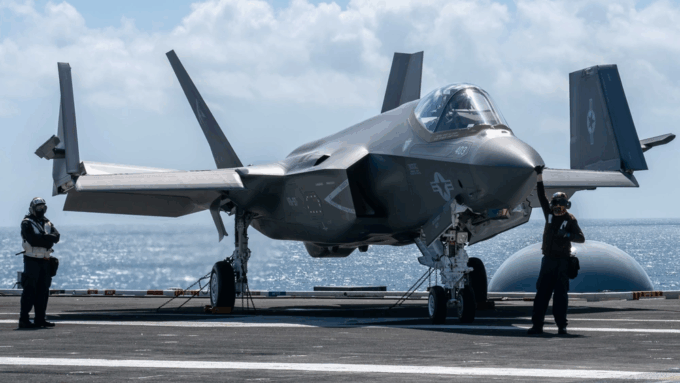
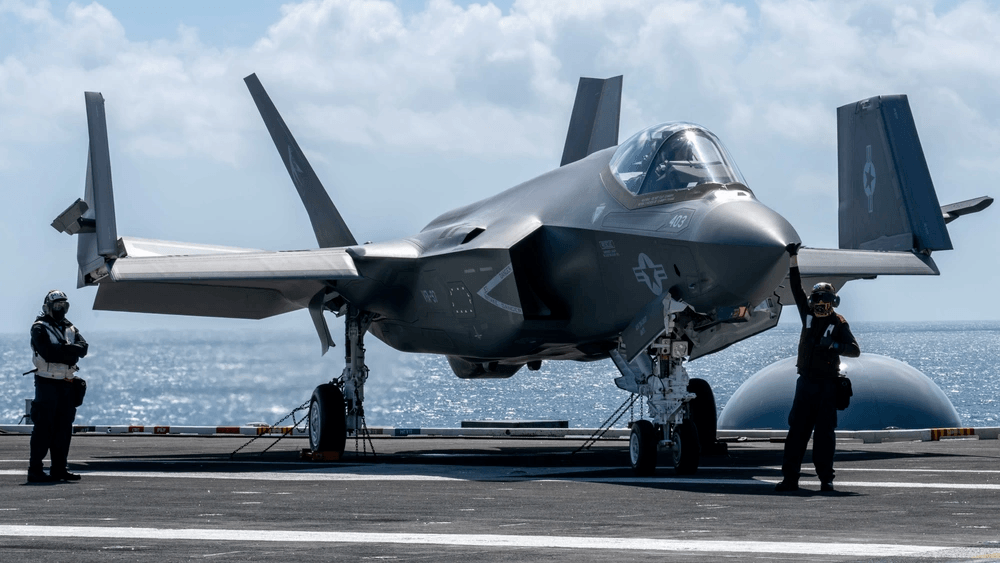
F-35 Lightning on the deck of the USS Carl Vinson. Photo: Seaman Derek Kelley, US Navy.
On December 14, the New York Times devoted its entire Opinion section of 14 pages to lobbying for greater defense spending. The NYT managed to do this without mentioning numerous strategic advantages that the United States maintains over its most important rivals or the strategic waste of resources in such programs as the Golden Dome national missile defense. The United States has become that militarized nation that President Dwight David Eisenhower presciently warned against in his farewell address 65 years ago. And mainstream media, even the vaunted New York Times, remains a strong ally of the Pentagon and the military-industrial complex.
We in the United States have created a land of illusion, and the mainstream media have helped in that regard as well. We have the highest medical costs in the world, and lack universal health care coverage that other developed nations have. Our costs for entitlements such as Medicare and Social Security are out of control, but there is no discussion of reform—even when there are simple adjustments that could be made. Our corporations and the wealthy pay the lowest taxes in the industrial world, but we adamantly oppose raising tax rates that could alleviate our deficit problem. Gun control is no longer discussed despite the regularity of massacres in this country. We have the most expensive and lethal military force in the world, but we face no existential threat. Nonetheless, the NYT not only declares the defense budget sacrosanct, it also wants to spend more.
In making its case, the Times exaggerates the threats that Russia and China represent. Russia is about to begin its fifth year of fighting in Ukraine, demonstrating great difficulty in dealing with a much smaller and weaker neighbor. China has no battlefield experience other than the Korean War 75 years ago or the limited war it fought in Vietnam in 1979. Neither Russia nor China is looking for a confrontation with the United States. Nevertheless, the Times believes that the United States is “more threatened today than it has been in decades,” and that we have “forfeited our military edge.”
The Times makes no mention of our geopolitical and military advantages. For example, the United States has the most secure geopolitical environment of any major nation, thanks to oceans east and west, and good neighbors north and south. We sustain a defense budget that is equal to the defense spending of the rest of the world combined. We have hundreds of military facilities the world over, whereas China has one facility on the Horn of Africa and Russia has two modest facilities in Syria.
In dealing with the challenge of Russia and China, the United States has important allies in Europe, such as the 31 member states of NATO that confront Russia, as well as allies in the Indo-Pacific, such as Australia, Japan, and South Korea, which China must take into account.
While Donald Trump and Secretary of Defense Pete Hegseth have weakened our military by emphasizing domestic deployments, illegal anti-drug missions, and preparing for a war with Venezuela, there is no sign that either Russia or China is anxious to challenge the U.S. military.
Nevertheless, we barricade ourselves behind a national missile defense that doesn’t work, fight wars in which no vital national security interests are at stake, and post hundreds of thousands of U.S. troops overseas. We are investing hundreds of billions of dollars to “modernize” nuclear forces that have no utilitarian value and already have a huge overkill capability. The idea of arms control and disarmament, which saved billions in the past, is dead in the water.
In addition to supporting greater defense spending, the mainstream media supports madcap ideas. My current favorite is the Washington Post editorial support for returning and taking over the Bagram Air Base in Afghanistan, where we spent 20 wasted years. The Post (and Donald Trump) want to do so because of its “proximity to China” and China’s nuclear testing range in Xinjiang province, presumably so we can monitor testing. But we can monitor it in other ways. The return to Bagram, according to the Post, would allow the United States to “conduct counterterrorism operations in a volatile region.” This would recreate an active U.S. presence and involvement in the Taliban’s Afghanistan that we left in 2021.
The United States lacks a strategic vision for a world without a serious enemy, and the Times offers no ideas about creating one. We are the only nation in the world that deploys its military primarily to support foreign policy rather than to defend our borders and people. The role of diplomacy has been seriously diminished, and the Department of State offers no ideas for invigorating U.S. diplomacy. Meanwhile, the Pentagon has assumed an unprecedented position of power and influence in the making of national security and foreign policy. The singular failure of the Trump administration to deal with the international community has worsened these developments.
By adding its authoritative voice to support U.S. notions of exceptionalism and triumphalism, the Times has ignored the need to inform the American public of the information needed to debate these notions. Hundreds of thousands of U.S. troops in Vietnam, Iraq, and Afghanistan only weakened U.S. security in wars lasting longer than WWII. The invasion of Iraq empowered Iraqi Shia to draw closer to Iran, creating a long-term problem for U.S. strategic interests far worse than the challenge posed by Saddam Hussein.
President Eisenhower warned that there have been too many schools we have not built, too many roads and bridges without repair; too little investment in engineering and education because of excessive military spending and influence. As a result, we have turned the sympathy for the United States in the wake of 9/11 into anti-Americanism around the world.
The post The NYT Wants More Defense Spending appeared first on CounterPunch.org.
This content originally appeared on CounterPunch.org and was authored by Melvin Goodman.